There is a bag of cotton macrame cord that has been sitting in my cupboard for the better part of two years.
I bought it at Eckersley’s, of course. Where else? I have written before about my habit of wandering around that shop picking up bits and pieces with the dream that this time, this purchase, will be the one that turns me into an artist. The cord came home, went into the cupboard behind the fabric scraps, and stayed there.
Last month I finally got it out.
I have been knotting ever since. Constantly. There is now cord all over my house, my family have started making remarks, and I am deep enough into it that I have decided to write a whole series — Learn-to-Macrame, a sister series to Learn-to-Sew — starting with this post.
And here is the part that surprised me. I did not come to macrame as a stranger.
If you have been eyeing off macrame and thinking it looks complicated, or expensive, or like something other people do — this post is for you. Let’s start at the very beginning.
What is macrame?
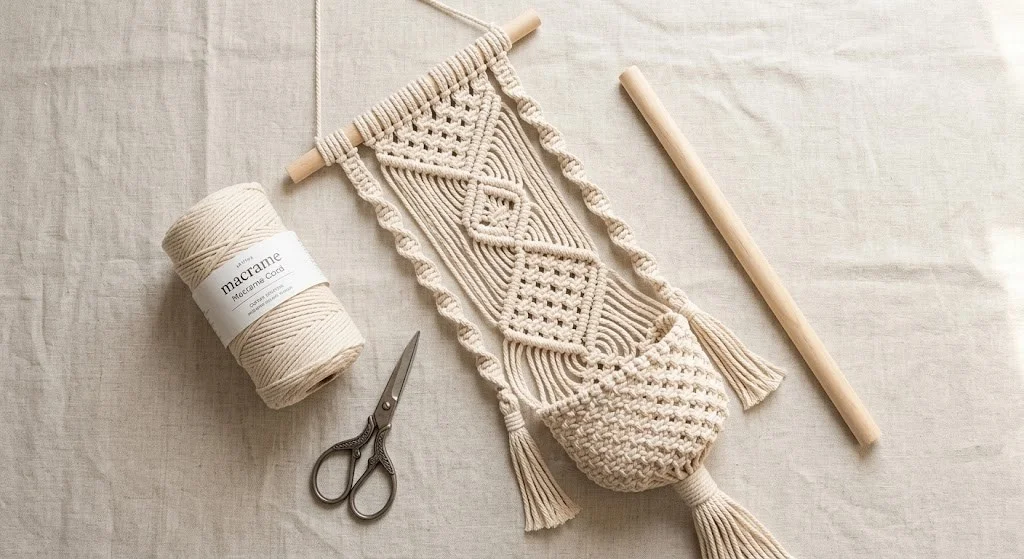
Macrame is the craft of making textiles by knotting cord by hand, with no needles, hooks or machines involved. You use your fingers and a small number of repeated knots to build pattern and texture. It is used for plant hangers, wall hangings, bags, jewellery and homewares, and most pieces rely on just three or four basic knots.
That is the short version. The longer version is that macrame sits in a lovely spot between weaving, knitting and simply fiddling with string. There is no equipment to learn, no tension dial to fight with, no machine to thread. It is your hands, some cord, and something to hang it from.
You will also see it spelled macramé with the accent, and occasionally ‘macrama’ by people typing quickly. All the same craft.
A very quick history
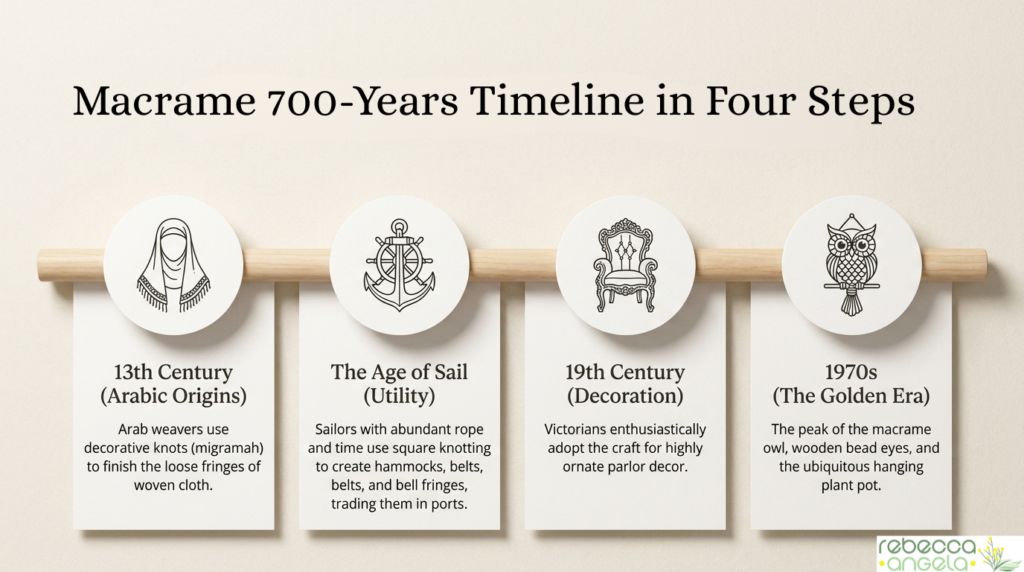
Macrame is old. Properly old.
The word itself is usually traced back either to the Arabic migramah, meaning a fringe or an embroidered veil, or to the Turkish makrama. The story you will find repeated is that Arab weavers used decorative knotting to finish off the loose ends at the edges of woven cloth — a practical solution that turned into an ornamental one.
Then the sailors got hold of it. This is my favourite part. Sailors on long voyages had two things in abundance: rope and time. They made knotted hammocks, belts, bell fringes and screens, and traded them in port when they landed. Square knotting, they called it — a much less glamorous name.
The Victorians took it up enthusiastically, as the Victorians tended to.
And then the 1970s. The decade of the macrame owl, the hanging pot plant, the fringed wall hanging in brown and mustard and burnt orange.
Which is where my mother comes in.
My mother’s hands
My mum was — is — very good at macrame.
Not “had a go at it once” good. Properly good. In the seventies she made plant hangers for every window in the house, a wall hanging that lived above the sideboard for what felt like my entire childhood, and at least one owl with wooden bead eyes that I would dearly love to have now.
I remember the cord more than anything. Great hanks of it, jute and cotton, kept in a cane basket. It had a particular dry, dusty smell. I remember the sound it made when she pulled a knot tight — a sort of soft creak.
And I remember sitting on the floor beside her while she worked, being handed four lengths of cord tied to the leg of a chair and told to practise square knots.
I was, I would guess, seven or eight. Old enough to be trusted with scissors, not old enough to be patient. My knots were terrible. Wildly uneven, some so tight she had to pick them out for me, some so loose they fell apart when I picked the whole thing up. I distinctly remember being cross that mine did not look like hers, which is a feeling I have written about a great deal since comparison is creative poison.
She never fussed about it. She would just say “again” and hand it back to me.
Somewhere in my teens I stopped, the way you do. Macrame went thoroughly out of fashion, I got interested in other things, and the cane basket of cord disappeared into a cupboard.
Which brings us back to that bag of cord in my cupboard, sitting behind the fabric scraps for two years, doing nothing at all.
When I finally got it out and sat down with it, something quite strange happened.
My hands knew what to do before I did.
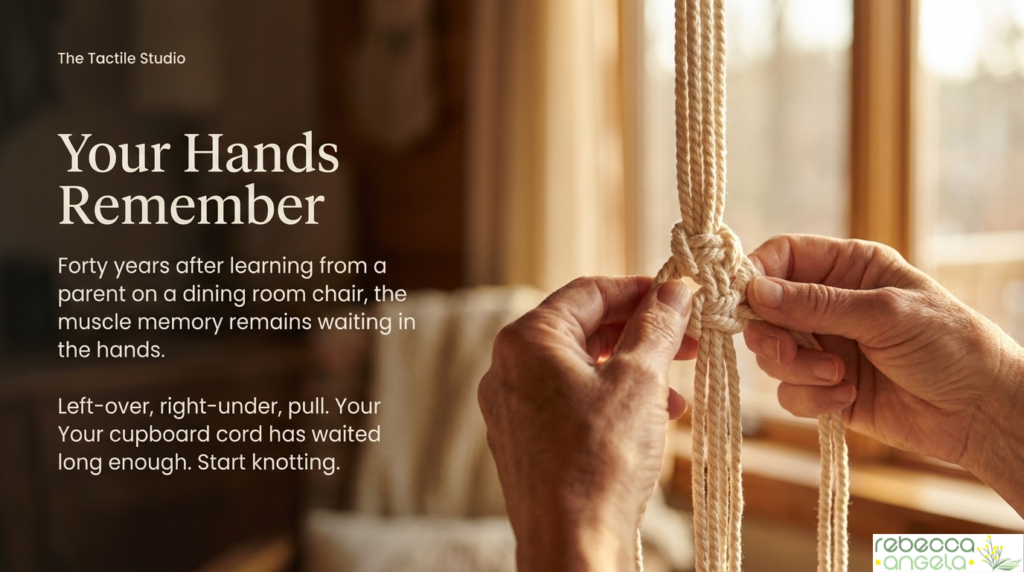
I did not remember the square knot. I could not have told you the sequence if you had asked me. But I picked up four cords and my fingers went left-over, right-under, pull — and there it was. Forty years later. Sitting in my hands the whole time, apparently, waiting.
I rang Mum that evening and told her. She laughed at me and said she was not the least bit surprised, and then talked for twenty minutes about tension, which I had not asked about but very much needed to hear.
So no, I am not a macrame expert. She is. I am a woman relearning something she was taught as a child by someone who was extremely good at it, and writing it down as I go. Which, honestly, might make me better company for a beginner than an expert would be — I can still remember what is confusing, because most of it is still confusing me.
What you actually need to start
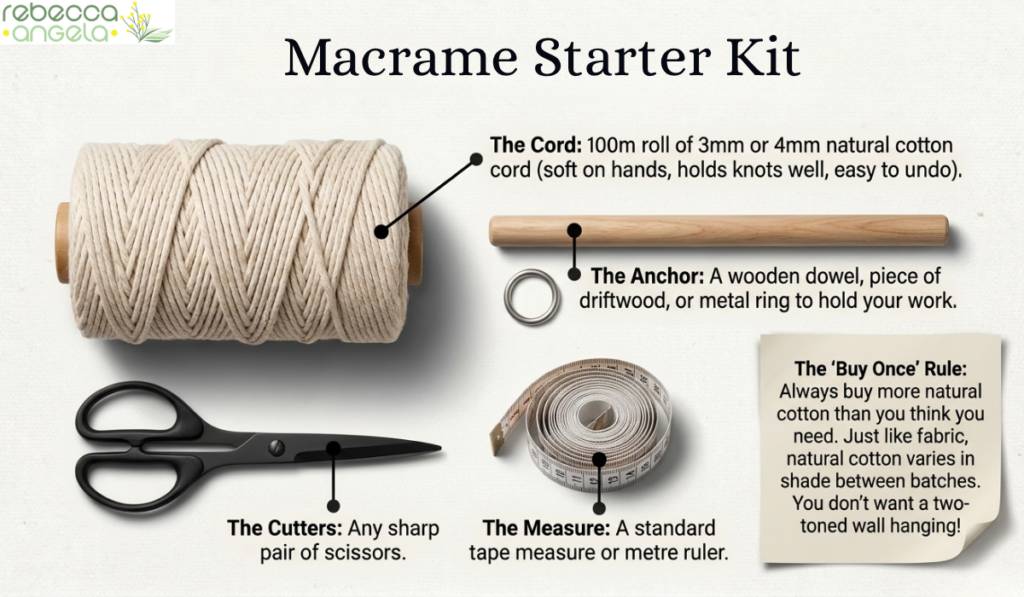
Here is the good news: macrame has one of the lowest barriers to entry of any craft I have tried. Mum started me on four bits of cord tied to a chair leg, and truthfully you could do worse.
You need:
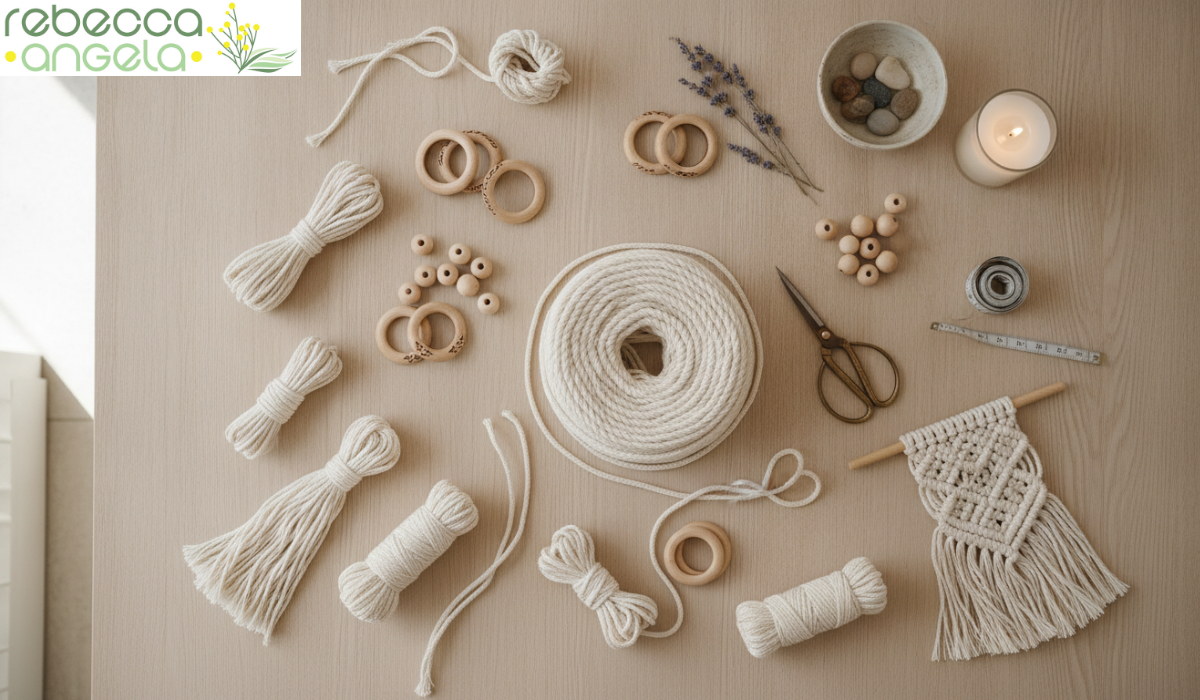
- Cord. 3mm or 4mm cotton cord is the standard beginner’s choice. Start with one 100m roll in natural.
- Sharp scissors. You have these.
- Something to hang your work from. A wooden dowel, a length of driftwood, a curtain rod, a metal ring — or the back of a dining chair while you are practising.
- A tape measure. Or a metre ruler.
- Something to hold it all up while you work. A clothes rail, a coat hook, a door handle, a couple of S-hooks on a shelf bracket. I use a rail in the laundry, which is deeply unglamorous but does the job.
That is genuinely it to begin with. No machine. No pattern paper. No special table.
Later you might want a comb for fringing (a cheap pet slicker brush is what a lot of people use), some wooden beads, and a proper dowel or two. But you do not need any of that on day one.
Tip: Buy more cord than you think you need, and buy it all at once. Natural cotton varies in shade between batches — the same way fabric does — and it is very annoying to run out halfway up a wall hanging and find the new roll is a slightly different white.
I have written a whole separate post on choosing between 3-ply, single twist and braided cord, what the different diameters suit, and where to buy it in Australia Macrame Cord, Kits and Supplies. If you are standing in a shop right now feeling overwhelmed by the options, start there.
The knots to learn first
This is the part that surprises people.
You would assume macrame involves dozens of knots to memorise. It does not. Almost everything you see — the plant hangers, the wall hangings, the big showy pieces — is built from a very small handful of knots, repeated and combined.
The four to learn first are:
- The lark’s head knot. How you attach your cord to a dowel or ring. This is the starting knot for most projects.
- The square knot. The workhorse. Four cords — two working, two filler — and a left-then-right sequence. Most of what you will make is square knots. This is the one my hands remembered.
- The half knot, which is simply half of a square knot repeated. Do it over and over and the work twists itself into a spiral. It looks clever and takes no extra skill at all.
- The half hitch, and its cousin the double half hitch, which is how you make diagonal and horizontal lines across a piece.
Learn those four and you can make a plant hanger, a wall hanging and a keyring. Really.
I have given each one its own step-by-step with photos in the knots post Learn-to-Macrame: The Only Knots You Need, because knots are one of those things where a photo is worth a thousand words of me describing which cord goes over which.
Note: Practise your knots on a short length of cord tied to a chair back before you cut into a full project. This is the same advice I give about testing stitches on scrap fabric before you start sewing Learn-to-Sew: Top 5 Tips for Happy Sewing — and it is, I now realise, exactly what my mother did with me and the chair leg. She was not keeping me busy. She was teaching me properly.
How much cord do I need?
Ah. This is where I came unstuck, so let me save you the trouble.
The general rule of thumb you will see quoted is to cut your cord about four times the finished length of your piece — and remember that if you are folding each cord in half over a dowel (which a lark’s head knot does), each cut length gives you two working cords, so measure accordingly.
Some patterns say five or six times, particularly for very dense knotting. Spiral sections eat cord. So do rows and rows of square knots.
My honest advice for your first few pieces: be generous. Cutting cord too long costs you a bit of waste. Cutting it too short costs you the entire project, because you cannot join macrame cord invisibly halfway up.
Ask me how I know.
Your first project
Make a plant hanger.
I know that is what everybody says, and I resisted it a little because it felt like the obvious thing. But it is the obvious thing for good reasons. A basic plant hanger uses lark’s head knots, square knots and a gathering knot, it is forgiving of wobbles, it takes an evening, and at the end you have something that holds an actual plant.
Finishing something genuinely matters when you are new. It is what makes you want to start the next one.
A wall hanging is the other common first project, and it is lovely, but it takes longer and small errors are more visible on a flat piece.
I have written up the plant hanger I made — wobbles and all — plus a round-up of free patterns from makers who know a great deal more than I do Macrame Plant Hangers: Tutorial and Free Patterns.
Why knotting is good for your head
I want to say something about this, because it is the real reason I keep picking the cord up.
Macrame is repetitive. Once the square knot is in your hands you are not thinking about it any more — left over, right under, pull, repeat. Your hands know what they are doing and your mind is free but occupied. Not blank. Occupied.
I have written before about ‘flow’ the importance of sustaining creativity — Csikszentmihalyi’s idea that we are happiest when we are so absorbed in something that we stop noticing time passing. Flow needs a particular meeting of skill and challenge: too easy and you are bored, too hard and you are anxious. Macrame hits that spot remarkably well, and it hits it early, because the basic knots become automatic so quickly.
I am not going to tell you it cures anything. I have not gone hunting through the research literature on macrame specifically (yet!), and I am wary of craft being sold as medicine.
What I will say, as a counsellor and as someone who has been making things for a very long time, is that a repetitive activity you do with your hands, away from a screen, is one of the more reliable ways I know to settle a busy head. I noticed it in the first week. I would sit down intending to do twenty minutes and look up an hour later.
And I think I understand my mother’s evenings rather better now than I did at eight years old.
If you have been struggling to find time for anything creative Making Time for Creativity, macrame is a genuinely good candidate. You can put it down mid-row and come back to it. It does not need a set-up or a pack-down. It lives in a basket beside the couch — a cane one, in my case, which I am aware is not subtle.
What I got wrong coming back to it
My hands remembered the square knot. They did not remember anything else. In the spirit of learning out loud, here are the things I got wrong so you do not have to.
I cut my cord too short. Twice. The first plant hanger ended up a good 15cm shorter than I intended and the fringe at the bottom is more of a suggestion than a fringe.
My tension was all over the place. My first few rows of square knots are noticeably tighter than the ones I did later in the evening, once I had relaxed. You can see the change in the finished piece. This is precisely what Mum spent twenty minutes on the phone telling me about, and she was right, and I should have asked sooner.
I did not count. I lost my place in a row of half hitches, could not work out where I had gone wrong, and undid about forty minutes of work. Count your cords. Count your rows. Say the numbers out loud if you have to.
I tried to do it while watching something with subtitles. Do not do this. Ask me how that went.
None of these ruined anything, and that is rather the point. Macrame undoes beautifully — no seam ripper required, no fabric damaged, no holes left behind. You pull the cord back through and go again. Of all the crafts I have tried, it is the most forgiving of mistakes, which makes it a wonderful one to be a beginner at Recovering from Creative Mistakes.
Where to next
If you are ready to start, the order I would suggest is this.
Read the Macrame Cord, Kits and Supplies post and buy yourself a roll of 4mm cotton cord. Then work through the four knots in Learn-to-Macrame: The Only Knots You Need on a practice length — tied to a chair leg, if you want to do it the way I was taught. Then make the plant hanger.
That is a fortnight of evenings, at most. And at the end of it you will have made a thing that holds a plant, which is more than my roll of cord managed in two years in the cupboard.
After that, the series carries on with wall hangings, jewellery and keyrings, pieces for the home and 20 project ideas to make.
There is a great deal more of this series coming, and I am writing most days at the moment — I said a bit more about that, and about being away from this blog for longer than I meant.
Questions people ask about macrame
Is macrame hard to learn? No. It is one of the easier crafts to start, because there is no machine and no tension to manage. Most projects use three or four knots. You can learn the basics in an evening and make something usable in a weekend. My mother taught me the square knot when I was about seven.
What cord should a beginner use? 3mm or 4mm cotton cord. It is soft on the hands, holds a knot well, and comes undone easily when you make a mistake — which you will.
How much does it cost to start macrame? Very little. A roll of cotton cord, a wooden dowel, and scissors you already own. It is one of the cheapest crafts to try, which is part of why I recommend it to people who are not yet sure what they want to make.
What is the difference between macrame and knitting or crochet? Knitting and crochet use needles or a hook to build fabric from loops of yarn. Macrame uses your hands only, and builds from knots. No tools, no stitches.
Can children do macrame? Yes — and it is a very good one for them. I am living proof. A keyring or a simple bracelet uses the same square knot as a full wall hanging, and older children in particular tend to like it because the result looks properly made rather than obviously childish Ten Things to Sew with Boys.
Do I need a macrame board? Not for hanging pieces. A board is useful for flat work like bracelets, where you want to pin the cords down while you knot. For plant hangers and wall hangings, a rail or a hook is all you need.
So that is where I am. Back at the keyboard, covered in cotton fluff, and quietly delighted to find that something my mother put in my hands forty years ago was still in there.
Tell me — did someone teach you a craft when you were small? Did you keep it up, or are you circling back to it now like I am? And is there anything about macrame you are stuck on that I could work out and write up for you?
Comments below. I read every one — and it is very good to be back.