
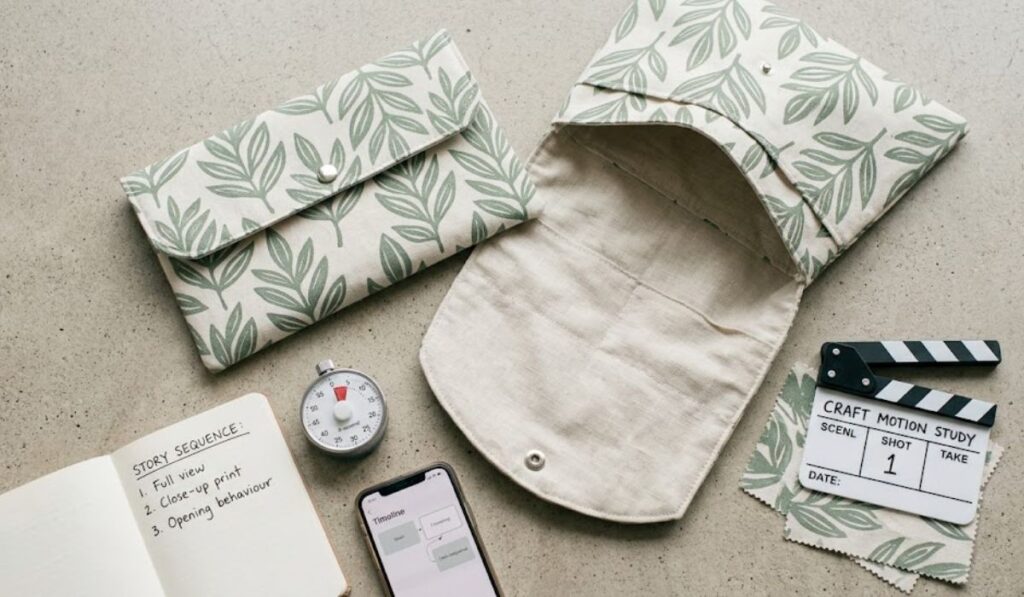

A photograph of a handmade object can communicate details that a moving image might overlook, the texture of a stitch, a brush mark, a join, or the shape of a finished edge. A short motion study can explore something different about the same piece, its mood, say, or the way its colours sit together. The useful question to ask before starting either one is what the movement should actually help a viewer notice, and just as importantly, what it might lead them to misunderstand instead.
Take an original fabric pouch with a hand-printed leaf pattern as an example. Its maker has photographed the finished pouch and owns those photographs outright. One image shows the whole item, another the fabric texture, a third the opening. These can support a straightforward record, an authored sequence, or a generated interpretation, and each of those three deserves a clear description of what it actually is.
Start With a Photograph That Explains the Object
Choose the still image before deciding on any motion treatment. Ask whether someone unfamiliar with the pouch could understand its shape and spot the specific feature you want them to notice. If the goal is to show the printed pattern, the photograph needs to actually make that pattern visible. If the goal is to explain the opening, a photo of the closed pouch may leave the important part hidden entirely.
Keep an unchanged original on file. Working copies can be cropped or adjusted as needed, but the original stays useful as a reference point when reviewing later versions. It’s worth avoiding any alteration to a factual product photograph that conceals damage, shifts the item’s colour, or implies a different material than what’s actually there.
A still image can also be the whole story on its own. It doesn’t need movement to earn its place. A short caption explaining the material or process can communicate more than an animated effect, particularly when someone’s comparing details rather than just taking in the atmosphere of the piece.
Give an Authored Sequence a Specific Purpose
An authored sequence puts the choice of what appears, and when, entirely in your hands. For the pouch, that might mean showing the full object, moving to a close-up of the print, then finishing on the opening. The three views already contain the actual information. Editing just gives it a shape.
Write the sequence as three short statements before assembling anything: introduce the shape, show the printed detail, show how the opening looks. Keeping it this simple makes the project easier to stay focused on, and easier to review once it’s together. If a transition ends up distracting from the pattern, simplify it. If a close-up disappears before anyone’s had a chance to actually look at it, give it more time on screen.
Worth being clear-eyed about what a sequence like this actually demonstrates. A gentle pan across a photograph is still an edit of a still image. It doesn’t show how the pouch behaves when it’s actually handled. In the same way, a run of photographs doesn’t establish the making process unless those photographs genuinely document the steps involved. A presentation of finished details is worth labelling as a detail sequence rather than a process demonstration, since the two aren’t the same thing. If the goal is to show a real action, opening it, folding it, that action needs to actually be recorded or photographed at each stage, and kept separate from anything built as an imaginative motion treatment.
Treat Generated Motion as a Concept Study
An owned craft photograph can serve as the starting point for generated motion. Magic Hour’s image-to-video tool is one route for turning a still image into a moving interpretation. A brief might call for restrained movement, or something more atmospheric built around the object.
The result still needs checking against the original photograph before it goes anywhere. It’s worth describing the clip plainly as an AI-generated concept or motion interpretation, since it isn’t automatically a recording of the finished item. A generated fold, flutter, or shift in lighting can look convincing without actually matching how the real fabric would move. A detail can appear in the clip that was never in the photograph at all.
For the pouch, that means inspecting the printed leaves, the seams, the opening, and the overall silhouette closely. Do the leaves change shape in a way they shouldn’t? Does a seam shift? Does the opening suggest a fastening the real item doesn’t actually have? These questions matter more than they might seem to, particularly if the clip is going to accompany a sale or help someone decide what the object is actually like in person.
Essential factual details, wording on a label, a measurement, belong in a caption or a controlled text layer rather than left to generated imagery to preserve accurately. If the real goal is to explain how something’s constructed, that’s a job for real photographs or recorded footage, not a generated clip.
Make the Difference Visible When Sharing
The explanation needs to travel with the image, not sit somewhere separate from it. A caption along the lines of “AI-generated motion study from my photograph, see the still image for the finished handmade item” draws a clear line between an interpretation and a factual record. That kind of wording only belongs there when the photograph is actually yours to claim; otherwise the real creator needs identifying accurately, with permission sorted properly.
In places where a clip might circulate without its original caption attached, a readable on-screen description is worth considering. Worth checking too whether cropping for a vertical format accidentally strips that description out. The thumbnail and the opening frame deserve a look as well, since someone might encounter either one without ever watching the full sequence through.
For a portfolio, placing the original photograph beside the motion study keeps things honest. For a shop, dependable photographs of the actual item should stay front and centre, with any concept material clearly set apart from them. That gives anyone looking a real way to inspect the craft itself, rather than guessing which details genuinely belong to the object and which don’t.
Check Access, Rights and the Final Impression
A complete still alternative, along with a short written description of the essential visual information, is worth providing alongside any motion content. Pause controls should be available wherever the publishing surface allows for them, and flashing effects or unnecessary rapid movement are worth avoiding outright. Nobody should need to sit through a looping clip just to find out the item’s name or get a basic sense of what it looks like.
Permission is worth confirming for every source ingredient involved, patterns, photographs, fonts, background artwork included. Owning the finished object doesn’t automatically grant the right to reproduce a licensed design in every context, or to upload it to a generation service without a second thought. Those permissions are worth settling before the source material gets used at all.
It helps to finish by looking at the piece the way a stranger would. What does it actually claim about the handmade object? Which details can be checked directly against the photograph? Which are imaginative additions layered on top? Keeping those answers clear is what lets a motion study express an idea while the original craft stays understandable entirely on its own terms.

