
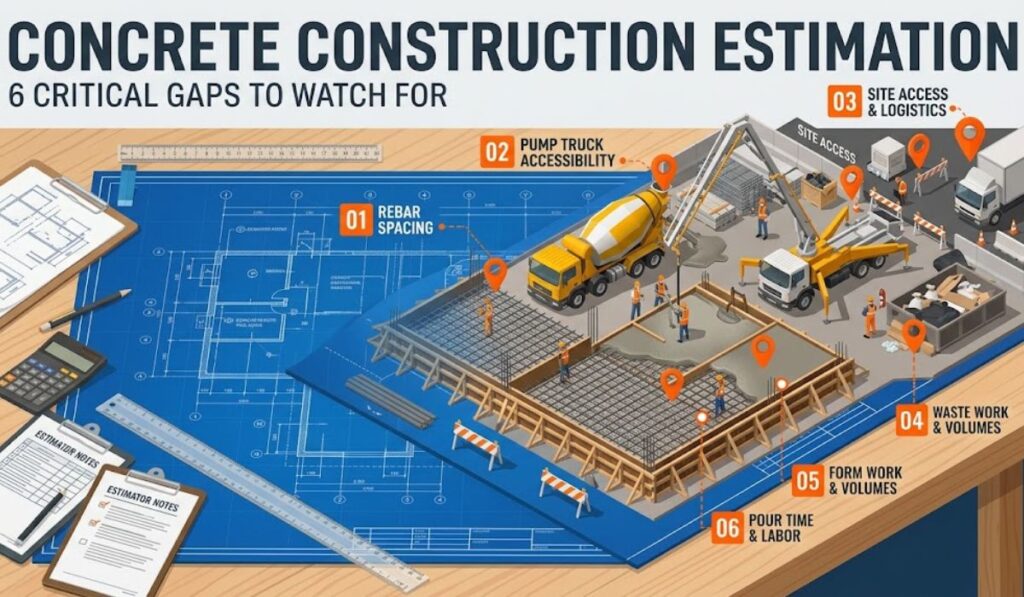

A contractor told me once about a slab that came up short by four yards on pour day, the kind of gap that means a second delivery, a short load charge, and a crew standing around waiting while someone makes an awkward phone call. Ask any contractor about a job that went sideways, and there’s a decent chance concrete is somewhere in that story. Maybe the slab needed more yardage than expected. Maybe the rebar count was off. Maybe the pump truck showed up and nobody had priced it in. Concrete is a trade where small mistakes get expensive fast, because once the truck arrives and the pour starts, there’s almost no room left to correct course.
The frustrating part is that most concrete estimating errors genuinely aren’t exotic. They come from the same handful of habits, repeated across project after project. Here are six of the most common ones, and what experienced estimators actually do differently to stay ahead of them.
1. Treating the Raw Quantity as the Final Quantity
A basic volume calculation is simple enough. Length times width times thickness, converted to cubic yards. The trouble is real pours never match the math perfectly. Subgrade’s rarely dead flat, forms flex slightly under load, and some concrete gets lost to spillage, pump priming, and whatever’s left in the truck at the end of the day.
Newer estimators often order and price the exact calculated number, then find themselves short on pour day. That’s the second delivery, the short load charge, sometimes a cold joint nobody wants to explain to the client later. Experienced estimators build in a waste and overage factor based on the type of work. Footings and thickened edges usually need a bigger cushion than a clean, flat slab, and elevated work behaves nothing like slab on grade. They also keep a record of how closely past estimates matched what actually got ordered, so the allowance sharpens over time instead of staying a guess forever.
2. Treating Rebar and Reinforcement as an Afterthought
Concrete gets most of the attention in an estimate, but reinforcement can quietly eat a large share of the budget without anyone noticing until it’s too late. Bar sizes, spacing, laps, chairs, dowels, mesh, ties, all of it needs counting, and it tends to live on different sheets than the concrete itself.
The classic mistake is pulling rebar quantities from a single plan view and missing what the details actually call for. Lap lengths alone can add several percent to the total weight, which adds up fast on a bigger job. Experienced estimators read the general notes first, cross check every footing and wall section against the schedules, and count reinforcement as its own distinct scope, never a line item tacked onto the concrete price as an afterthought.
3. Ignoring Site Conditions That Drawings Never Show
Two projects can have identical slab dimensions and wildly different costs. One has an open site with easy truck access. The other sits behind a building with a narrow driveway, overhead power lines, and a subgrade gone soft after a week of rain nobody planned around.
Drawings describe what’s being built, not how hard it’ll actually be to build it. Access determines whether concrete can be chuted directly or needs a pump, and a pump brings its own setup fees, hourly charges, and minimums that catch a lot of estimators off guard the first time. Poor subgrade can mean extra compaction or stabilisation before any form even goes in.
Experienced estimators visit the site when they can, or at least study aerial imagery and ask specific questions about access, staging, and ground conditions. They treat the site itself as part of the scope, not something to think about after the drawings are already done.
4. Using Outdated or Generic Pricing
Concrete pricing moves constantly. Cement, aggregate, admixtures, fuel surcharges, delivery fees, all of it shifts with the market, and differently from one region to the next, sometimes significantly so. A number pulled from last year’s job, or from a national average, can be off by enough to wipe out the margin on a tight bid entirely.
Labour follows the same pattern. Crew productivity, local wage rates, and union or prevailing wage requirements all change what a square foot of finished slab actually costs to place. Experienced estimators price from current local supplier quotes, update their labour assumptions regularly, and keep material and labour separate, so they can see exactly which side of the estimate moved when a bid comes in higher or lower than expected.
If you want a closer look at how detailed concrete takeoffs and regional pricing actually come together in a finished estimate, this website walks through the process and the kinds of deliverables contractors can realistically expect.
5. Forgetting the Work Around the Pour
A concrete bid is more than just concrete. Forming, stripping, vapour barriers, expansion joints, embeds, anchor bolts, finishing, sealing, curing compounds, saw cutting, cleanup, all of it takes real time and materials. Each one looks small on its own. Together they can account for a surprising share of the total cost, the kind that’s genuinely easy to underestimate until the invoice shows up.
Rushed estimates tend to catch the big items and skip the small ones, which is exactly why a bid can look complete and still come in thin once the job’s underway. Experienced estimators work from a consistent checklist, so the same items get considered on every job, whether it’s a small patio or a large warehouse floor.
6. Missing Addenda, Specs, and Revisions
Plans change constantly. Addenda get issued, details get revised, and specifications sometimes call for something the drawings never actually show, a specific mix strength, a special finish, a curing requirement buried in a note nobody flagged. If an estimator prices from an outdated set, the bid might be perfectly accurate for a project that no longer exists.
Experienced estimators confirm they’re working from the latest drawing set, read the specifications alongside the plans rather than separately, and track every addendum against the takeoff carefully. They also write down their assumptions and exclusions clearly in the bid itself, so there’s no argument later about what was and wasn’t included.
How Experienced Estimators Build Reliability Into the Process
Looking across all six mistakes, a pattern shows up pretty clearly. Accuracy rarely comes from one clever trick. It comes from process: consistent checklists, a second set of eyes, current pricing, and honest feedback on how past estimates actually compared with real costs once the job wrapped.
That’s also why a lot of contractors bring in a dedicated construction estimator rather than stretching a project manager or superintendent across estimating on top of everything else they’re already juggling. A dedicated person learns your pricing, your preferred methods, and your typical project types over time, and the quality of the numbers improves simply because the work isn’t being squeezed into evenings and weekends anymore. For busy contractors, that consistency tends to matter more than raw speed ever does.
Common Questions
How much waste should I add to a concrete estimate? It depends on the type of work. Flat slabs on grade usually need a smaller allowance than footings, walls, or irregular shapes. Many estimators start with a modest percentage and adjust based on site conditions and their own historical data.
Should rebar be estimated separately from concrete? Yes. Reinforcement has its own quantities, pricing, and labour, and it’s often detailed across multiple drawing sheets. Treating it as a separate scope makes it a lot less likely to be undercounted.
How often should concrete pricing be updated? Material and fuel costs can shift quickly, so many estimators confirm supplier pricing at the start of every bid. Labour rates deserve regular review too, especially on projects with prevailing wage requirements.
What It Actually Comes Down To
Concrete estimates rarely go wrong because of one huge error. They go wrong through a series of small gaps: a missing waste factor, an uncounted bar, an unpriced pump, an outdated unit cost, the same kind of gap that left that contractor four yards short on pour day. The estimators who consistently hit their numbers aren’t guessing better than everyone else. They’re following a process that makes those gaps harder to miss in the first place, and that’s something any contractor can build into their own bidding workflow.


