
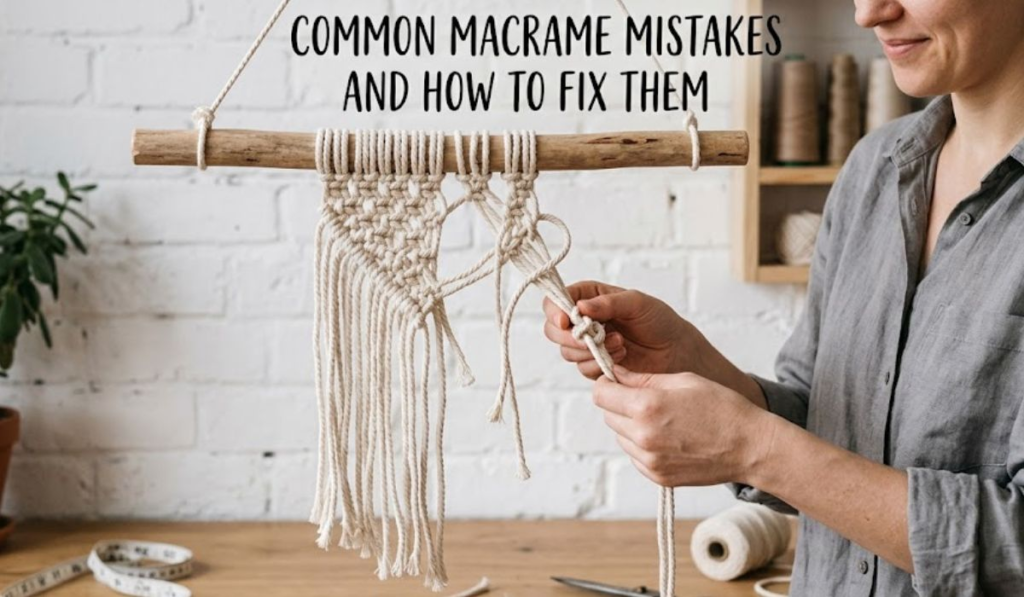

I have now made enough macrame mistakes to write this post with some authority, which is not a sentence I expected to type six months ago.
Every “What I got wrong” section scattered through this series has been building towards this one page, and I thought it was time to gather them up properly. Partly for you, and partly, I will admit, for me — there is something rather satisfying about seeing your own errors laid out in a tidy list rather than tripping over the same one twice.
None of these ruined anything permanently, which is the whole point of this post. Macrame undoes beautifully. No seam ripper, no fabric damage, no holes left behind. You pull the cord back through and go again. I have written about that principle more generally in Recovering from Creative Mistakes, and it has never felt truer than it does with a length of cord in my hands.
So here is everything I have got wrong, organised by what actually went wrong, with the fix for each.
Cord and cutting mistakes
I cut my cord too short
This is the one I keep coming back to, because it is the most expensive mistake in the whole craft and the easiest to make.
Why it happens: underestimating how much cord a project actually eats, or forgetting that a cord folded in half over a dowel gives you two working cords from one cut length — so the maths runs backwards from what feels intuitive.
The fix, before it happens: cut generously. The rule of thumb is four times your finished length as an absolute minimum, more for dense knotting or long spirals. I go through the actual sums properly in the cord and supplies post.
The fix, after it happens: there genuinely is not one. You cannot join macrame cord invisibly partway up a piece. This is why I say cut generously so often — it is the one mistake in this whole list with no undo.
I bought the wrong diameter for the project
My first market bag attempt used cord meant for jewellery. It looked like dental floss trying to hold a pumpkin.
Why it happens: all cord looks roughly the same on a shelf, and the difference between 2mm and 5mm does not register until you are holding a finished object that is either flimsy or absurdly chunky.
The fix: match diameter to purpose before you buy — fine cord for jewellery, 4mm for most beginner projects, heavier cord for bags and large hangings. There is a proper table in the cord post if you want the specifics.
Tension mistakes
My knots got tighter or looser as the evening went on
Look closely at almost anything I have made and you can see roughly when I started getting tired. The top of my first plant hanger is noticeably tighter than the bottom.
Why it happens: your grip relaxes as you settle into a rhythm, or tightens up again when you get tired and start concentrating harder. It is entirely normal and, I am told by my mother, entirely universal.
The fix: work a little on each section of a piece rather than finishing one arm completely before starting the next, so any tension drift spreads evenly rather than showing as an obvious band. Take breaks before you notice you need one, not after. And do not be too hard on yourself about it — a small amount of tension variation reads as handmade rather than as a flaw, and only you will ever notice it.
My coaster (or anything worked in rounds) curled into a bowl
This is the single most common complaint in round macrame, and it took me a genuine half hour of frustration to work out.
Why it happens: two causes, usually together. Either your knots are pulled too tight, which shortens each round relative to the growing circumference, or you have not added enough new cords to let the circle spread as it widens.
The fix: tie snug rather than tight, and watch for gaps opening between knots as you work outwards — the moment you see one, add a fresh cord. I go through this properly, with the actual mechanics, in the coasters tutorial. If a piece is already curling, undo the last couple of rounds and redo them with a lighter hand.
Knotting mistakes
My square knots came out spiralled instead of flat
I tied an entire practice length before I noticed every knot had twisted.
Why it happens: a square knot is two halves, mirrored — left-start, then right-start. If you repeat the same half without alternating, you are tying half knots instead, which spiral by design.
The fix: say it out loud if you have to. Left, then right. Left, then right. It sounds silly and it works. If a section has already spiralled and you did not want it to, there is no fix except undoing it — but do have a look at whether you like it anyway. Half of my favourite pieces began as this exact mistake.
I lost count partway through a row and could not work out where I had gone wrong
Forty minutes of half hitches, undone, because I could not tell which cord I was meant to be on.
Why it happens: macrame is repetitive by nature, which is wonderful for the mind and terrible for keeping track of your place, especially with the television on.
The fix: count your cords and count your rows as you go, not just at the end. Say the numbers if it helps. And do not try to knot while watching anything with subtitles — ask me how I know.
Shaping mistakes
My four plant hanger arms came out different lengths
Three centimetres of difference does not sound like much until the pot sits at an angle in the window and you notice it every single morning.
Why it happens: counting knots rather than measuring. Tension varies slightly between arms, especially if you worked them one after another over the course of an evening, so the same number of knots does not always produce the same length.
The fix: measure each section as you go, with an actual tape measure, rather than trusting a knot count. This applies to every symmetrical project — wall hangings, owls, anything with matching sides.
My owl (or anything shaped rather than rectangular) came out lopsided
Mine still is, slightly, around the left eye. I have made my peace with it.
Why it happens: shaped pieces ask you to widen or narrow gradually and evenly on both sides at once, which is a much harder thing to eyeball than it sounds.
The fix: stop and stand back every few rows on any shaped piece, not just at the end. Compare both sides properly rather than glancing. And accept a small amount of asymmetry as part of the charm of a handmade thing — a coaster wants to be perfectly round, but an owl is allowed a bit of personality.
Finishing mistakes
I trimmed the fringe before hanging the piece properly
I trimmed my first plant hanger’s tail while it was empty. Then I put the pot in, the whole thing shifted under the weight, and my beautifully level fringe was no longer level.
Why it happens: it feels natural to finish a piece completely before hanging it up to admire it, but weight changes how everything sits.
The fix: hang the piece exactly as it will be used — pot in, or on the wall — before you make your final trim. Cut a little longer than you think you want, look, then cut again. You cannot put it back.
I did not comb the fringe before trimming, or combed it after
Combing changes the length. A lot. Cord that measured 8cm becomes considerably shorter once it has fluffed out.
The fix: comb first, then do your final trim to tidy the shape. Trimming before combing means guessing at a length you have not actually created yet.
The mistake behind most of the others
If I am honest with myself, nearly everything on this list traces back to one thing: rushing the setup to get to the knotting sooner.
Cutting cord without measuring properly. Skipping the check that my groups of four had the right cords on the outside. Not counting a row before moving on. Every one of these takes thirty extra seconds at the point of doing it, and every one of them has cost me an evening when I skipped it.
I am not naturally a patient person — regular readers will know this about me by now — so I say this as much to myself as to you. The two minutes of checking is never wasted. It only ever feels like it is, right up until it is not.
A quick troubleshooting table
For when you just want the fix without the story.
| Symptom | Likely cause | Fix |
|---|---|---|
| Ran out of cord partway through | Cut too short, or wrong cord on the outside of a group | No fix once it happens — cut generously next time |
| Finished piece too flimsy or too bulky | Wrong cord diameter for the project | Match diameter to project before buying |
| Visible tension change top to bottom | Fatigue over a long session | Work all sections a little at a time; take breaks early |
| Round piece cups into a bowl | Knots too tight, or too few cords added | Knot snug not tight; add cords when gaps open |
| Knots spiral instead of lying flat | Tying the same half twice, not alternating | Alternate left-start and right-start deliberately |
| Lost your place mid-row | Distraction, usually a screen | Count cords and rows aloud; no subtitles |
| Symmetrical arms or sides do not match | Counting knots instead of measuring | Measure with a tape, not by knot count |
| Fringe uneven after trimming | Trimmed before combing, or before hanging under weight | Hang under real weight and comb before your final cut |
So that is the full list, or at least the full list so far — I expect it will grow. Macrame is forgiving enough that none of this needs to put you off; it is simply part of learning a craft with your hands rather than reading about it.
What have you got wrong? I would genuinely love to hear it, partly for company and partly because I am certain there is a mistake on your list that has not made it onto mine yet. Tell me in the comments below.

