
My sister got engaged last year with a ring that stopped me mid-sentence the first time I saw it. Not a diamond. A deep, almost ink-blue sapphire, sitting there looking like it had a whole personality of its own. I remember thinking, why doesn’t everyone do this?
For generations, the classic engagement ring formula was pretty predictable. Colourless diamond, white gold or platinum, done. That tradition isn’t going anywhere, and there’s nothing wrong with it. But more couples are looking past the standard solitaire and finding something with a bit more colour in it. Sapphires, rubies, other coloured gemstones, they’re showing up in modern engagement rings a lot more than they used to.
Honestly, the appeal isn’t hard to understand once you’ve seen one in person.
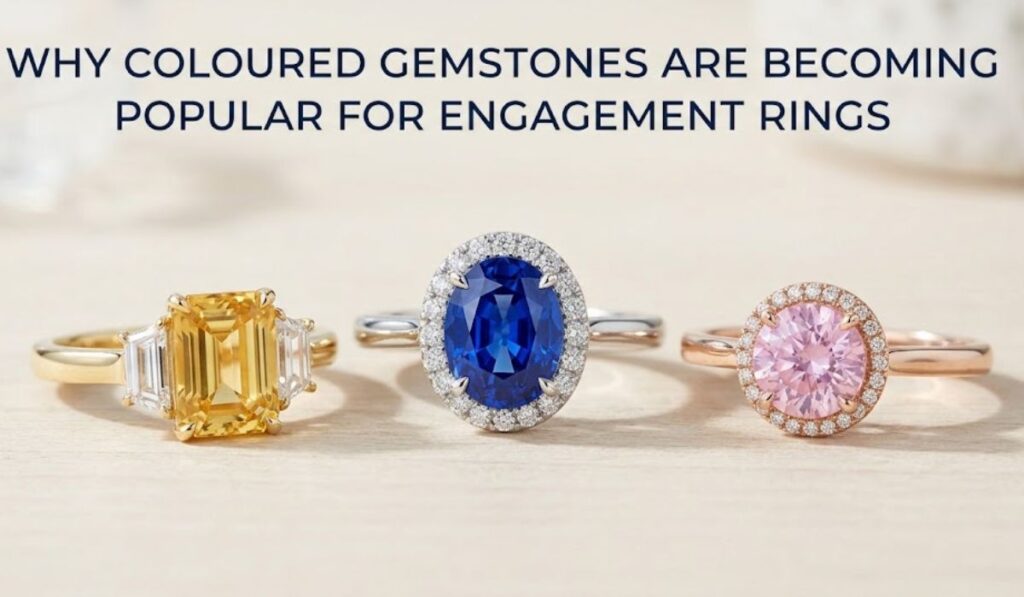
A coloured gemstone makes a ring feel like it belongs to you specifically, rather than something you picked because it’s what everyone picks. Instead of choosing purely on tradition, couples get to choose a colour, a stone, a design that actually reflects who they are. From deep blue sapphires to soft pink stones and vibrant golden yellows, engagement rings are becoming less about the formula and more about meaning something.
Engagement Rings Are Becoming More Personal
One of the biggest shifts in how people buy jewellery is this growing want for individuality.
A ring gets worn for decades, so a lot of buyers don’t want something that looks exactly like a thousand other rings sitting in a thousand other display cases. Colour changes that instantly.
A blue sapphire centre stone feels completely different to a diamond. A pale pink sapphire gives you something soft and romantic. A yellow sapphire with diamonds around it feels bright and current. A violet sapphire gives you something you genuinely won’t find sitting in a standard jewellery store window.
Because natural gemstones vary so much in colour, tone, inclusions, and cut, even two stones the exact same carat weight can look nothing alike. That variation is actually the whole point. It means you can find one that feels like it’s actually yours, not a catalogue photo.
Coloured Gemstones Are Not a New Engagement-Ring Idea
Even though this can feel like a modern trend, coloured gemstone rings have been around for centuries. Sapphires especially have a long history tied up in romantic jewellery.
The most famous example is probably the large blue sapphire that belonged to Diana, Princess of Wales, later passed on to Catherine, Princess of Wales. Long before modern marketing got involved, coloured gems were already wrapped up in relationships, royalty, and symbolism. The GIA notes that coloured gemstone engagement rings have deep historical roots, showing up again and again in jewellery worn by royals and prominent style figures over the years.
What’s actually changed is how much choice everyday buyers now have access to.
Colour Gives a Ring Personality
There’s something about colour that a diamond just can’t do on its own.
A diamond speaks through brilliance and sparkle, that’s its whole language. A coloured gemstone adds a second dimension entirely. The gap between a royal-blue sapphire and a pale cornflower one can completely shift the personality of a ring, and the same goes for pink, yellow, green, purple, any of it.
Colour can make a ring feel dramatic, understated, vintage, playful, sophisticated, before the setting’s even been designed. That’s a genuinely different level of creative freedom.
Instead of only asking which diamond shape to go with, couples get to start somewhere more interesting: which colour actually feels like us?
Sapphires Offer an Extraordinary Range of Colours
One of the reasons sapphires work so well here is that sapphire doesn’t just mean blue. Never has, really.
Natural sapphires come in blue, yellow, pink, orange, green, purple, violet, and colourless varieties too. Anything outside the classic blue range gets called a fancy sapphire. What that means practically is couples can go in very different directions while staying within the same gemstone family.
A traditional buyer might go deep blue. Someone after something more delicate might land on pastel pink. Somebody who loves warm tones could choose golden yellow. For anyone wanting something a bit unconventional, violet or green sapphire could be exactly the centrepiece they didn’t know they wanted. Not many natural gemstones offer this much colour variety while still holding up to daily wear.
Durability Matters for an Engagement Ring
Beauty’s important, sure, but an engagement ring isn’t something you wear occasionally. For most people it’s on their hand nearly every single day.
That’s where gemstone durability actually matters. Sapphire performs exceptionally well here. It’s a variety of corundum, sitting at 9 on the Mohs hardness scale, second only to diamond among the gemstones commonly used in jewellery. The GIA also points out that corundum has excellent toughness and no cleavage, which makes it well suited to a ring that’s getting knocked around in daily life.
That’s a big part of why sapphires have stuck around in engagement ring design for so long. Not every beautiful coloured gemstone handles daily wear this well, some scratch or chip more easily, or react to everyday conditions in ways you’d rather avoid. For anyone wanting colour without sacrificing practicality, sapphire is a genuinely strong option.
Coloured Gemstones Allow More Creative Ring Designs
Diamond rings can absolutely be creative too, don’t get me wrong. But coloured gemstones bring another design element into play before the jeweller’s even started with the metal.
Think about a blue sapphire set in platinum, then picture that exact same stone in yellow gold. White metal gives crisp contrast. Yellow gold pulls it warmer, more vintage. Now picture a pink sapphire in rose gold. Or a yellow sapphire wrapped in a white diamond halo. Or a violet sapphire sitting beside tapered diamond side stones.
Colour changes how every other part of the ring interacts with everything else. That opens the door to combinations that feel a lot more individual than the standard setup.
They Work Beautifully With Diamonds
Choosing colour doesn’t mean giving diamonds up entirely. Honestly, the contrast between the two is part of what makes these rings look so striking.
A sapphire centre stone can sit inside a diamond halo. Diamonds can flank an oval sapphire as side stones. A coloured stone can pair with a diamond in a two-stone design. Small diamonds can even run along the band. That white brilliance sets off the gemstone’s colour, and both materials end up standing out rather than competing. It bridges traditional and contemporary design in a way that actually works.
Buyers Are Looking Beyond the Traditional Solitaire
People today have access to way more inspiration than previous generations ever had. Independent jewellers, vintage pieces, unusual gemstones, custom designs, all a scroll away through social media and online jewellery platforms.
That exposure means buyers now see rings that look nothing like the standard jewellery-store solitaire. Elongated cushions, ovals, pears, emerald cuts, asymmetric settings, three-stone arrangements, vintage-inspired halos, the options keep growing. Add a coloured gemstone into that mix and the possibilities get even broader. The GIA’s recent guidance on diamond alternatives specifically calls out coloured sapphires as an established, durable option worth considering.
A Natural Gemstone Can Feel More Individual
Part of what makes natural coloured gemstones so appealing is their variation.
Natural sapphires can show subtle colour zoning, inclusions, or shifts in saturation. Rather than making every stone identical, those little quirks give each one its own character. Some buyers go looking for clean, evenly coloured stones on purpose. Others actually like the small natural imperfections, a reminder that the gemstone formed somewhere in the earth rather than rolling off a production line.
That individuality suits engagement jewellery particularly well, where the emotional side often matters just as much as the technical specs.
Coloured Gemstones Can Tell a Story
The gemstone itself can carry real personal meaning too.
Someone might choose a sapphire because it’s their partner’s birthstone. Someone else might go with a colour tied to a place, a memory, a specific moment in the relationship. A couple might pick a stone for its country of origin. Or, honestly, someone just falls in love with one particular gemstone the second they see it, no deeper reasoning required. That emotional connection can make picking a ring feel a lot more personal than comparing carat weights on a spreadsheet. The stone becomes part of the actual story.
Sri Lankan Sapphires Offer Particularly Diverse Choices
Sri Lanka, once known as Ceylon, has a long-standing reputation as one of the most important sources of natural sapphire in the world.
Ceylon blue sapphires might be the most famous, but Sri Lanka also produces yellow, pink, violet, purple, and other colours too. For anyone shopping for an engagement ring, that range gives you real creative freedom. A classic blue Ceylon sapphire gives you something elegant and timeless. A yellow sapphire looks completely different. Pink and violet sapphires can go soft or genuinely unusual, depending on what you’re after.
Even within one colour category, natural stones vary a lot in tone and saturation. Finding the right one ends up being part of the design process itself, not just ticking a box on a spec sheet.
Custom Jewellery Is Changing the Buying Experience
Coloured stones also work so well because custom jewellery has become so much more accessible.
Instead of starting with a finished ring, buyers can start with the gemstone itself. Find an oval sapphire you genuinely love, then build the ring around it. The jeweller works with the stone’s dimensions, colour, and shape before landing on a setting.
That flips the usual process on its head. Rather than asking which ring to buy, the question becomes how to design a ring around this particular gemstone. For a lot of couples, that feels far more personal than picking something off a shelf.
Coloured Gemstones Do Not Have to Look Traditional
Some people hear “sapphire engagement ring” and picture a big, dark-blue stone surrounded by a formal diamond halo. That’s just one version of it.
Modern sapphire rings can be genuinely minimal. A pale blue oval sapphire in a simple four-claw setting looks clean and contemporary. A champagne or yellow sapphire in yellow gold reads warm and understated. A small pink sapphire on a thin band gives you something else entirely. The gemstone itself doesn’t decide whether a ring looks traditional or modern, the combination of colour, shape, proportion, setting, and metal does that.
Value Is More Complicated Than Diamond vs Gemstone
People sometimes frame coloured gemstones as the cheaper alternative to diamonds. That’s an oversimplification, and worth being careful about.
Some coloured gemstones do offer attractive options at various price points, that part’s true. But exceptional natural sapphires, particularly larger stones with outstanding colour, desirable origin, or no evidence of heat treatment, can command genuinely significant prices. The GIA notes that sapphire value comes down heavily to colour, with intense, uniform colour generally pushing value higher.
The smarter approach isn’t assuming coloured gemstones are automatically cheaper. Set a budget first, then decide what actually matters most to you. Maybe that’s a smaller, rare, unheated sapphire. Maybe it’s a larger heated stone with beautiful colour instead. Neither one is automatically the better choice.
The Engagement Ring Is Becoming Less About Rules
Maybe the biggest reason coloured gemstones are finding a real place in engagement jewellery is that couples are simply more comfortable making their own calls now.
A ring doesn’t have to look one particular way. It doesn’t have to contain a specific gemstone. It doesn’t have to follow whatever previous generations picked. The traditional diamond solitaire is still a beautiful option, it’s just one option among several now.
For someone who’s always loved blue, a sapphire might feel like the obvious choice. For someone drawn to warmer tones, yellow sapphire might make more sense. And for someone who wants something almost nobody else will have, an unusual natural sapphire could be exactly right.
Choosing a Coloured Gemstone for an Engagement Ring
The most important starting point isn’t rarity or price. It’s simply whether you love the stone.
Look at how the colour changes under different lighting. Think about whether it’s durable enough for how you actually live day to day. Check whether treatments have been clearly disclosed, and how the stone will work once it’s set. For valuable natural gemstones, independent laboratory documentation is also worth having, it gives you clarity on identity and any detectable treatments.
Then there’s the emotional side, which honestly matters just as much. Can you picture looking at this stone every single day? Does the colour still pull you in after you’ve compared it against a few alternatives? Would you still choose it if nobody else in the world knew whether it was expensive, rare, or fashionable?
Those questions tend to reveal a lot more than a spec sheet ever could.
In the end
Engagement rings are becoming more individual, and coloured gemstones fit right into that shift. They let couples explore colour, personal symbolism, unusual design, and natural variation, moving past the idea that a ring has to follow one set formula.
Among the options out there, sapphire is especially well suited to engagement jewellery because it brings colour, durability, and genuine variety together in one stone. From traditional blue through to yellow, pink, and violet, natural sapphires give you the chance to build a ring around a gemstone, rather than picking a gemstone just to fit a ring you’d already decided on.
Ceylon Crown is one option for anyone wanting to look at natural Sri Lankan sapphires, selected individually for colour and character, either as loose stones or as the starting point for a custom ring built around one.
Because sometimes the most meaningful engagement ring isn’t the one everyone recognises.
It’s the one that feels unmistakably yours.

