
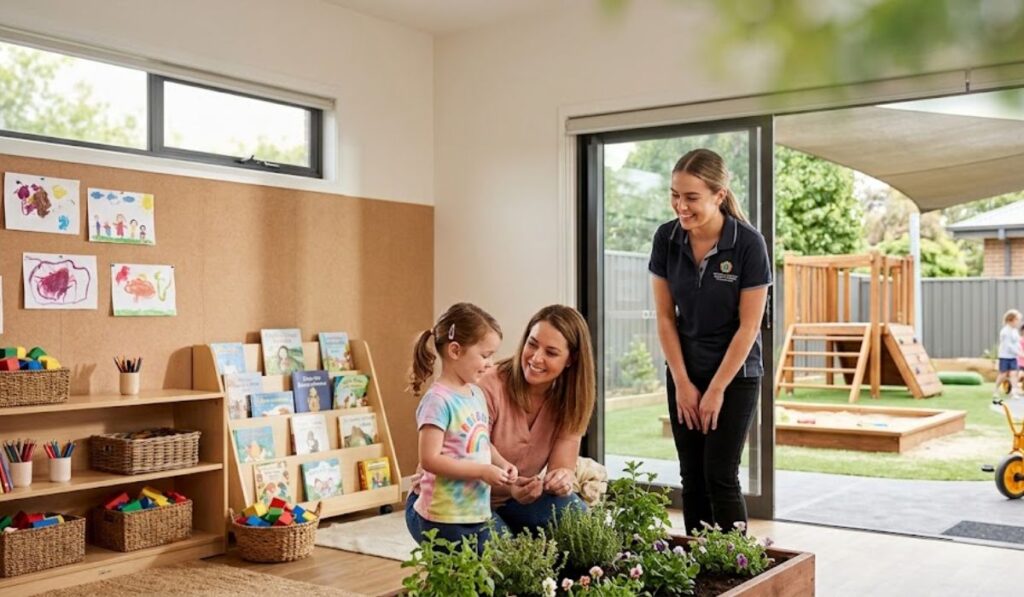
Somewhere around the third centre tour, most parents realise this decision was never really about convenience. It’s about who’s going to be there when your child takes those first wobbly steps toward independence, and whether that person actually notices when it happens. The right environment shapes confidence, communication, friendships, and how a child feels about learning, long before school enters the picture. And every family weighs it differently. Some parents care most about location and hours. Others are thinking about outdoor space, group size, or the whole philosophy behind how a place teaches. Rather than fixating on one factor, it helps to picture the full day a child will actually live inside.
Start With Your Child’s Needs
Before comparing centres, it’s worth pausing on the child in question.
Some walk into a room full of strangers and settle in within minutes. Others need longer, and do better with a slower pace than a loud playroom offers. Younger kids often need more consistency around naps and feeding. Older ones tend to come alive when there’s room to explore and bump into other kids’ games.
Worth sitting with for a minute: age and personality, the sleep and meal routines already in place at home, how easy they are around unfamiliar adults, any extra care needs, what they naturally gravitate toward, whether they’re an indoor kid or an outdoor one.
A good provider stays genuinely curious about all of this instead of expecting every child to fit the same mould.
Visit the Centre in Person
Websites and reviews help narrow a shortlist, but nothing replaces actually walking through the door.
Pay attention to what the room feels like the second you arrive. Do the kids look comfortable, or just occupied. Are the educators actually down there with them, or watching from across the room with a coffee in hand. Does the whole place feel organised without tipping into rigid.
A centre worth choosing will usually be glad to show you around and talk you through what an ordinary Tuesday there actually looks like.
For families researching childcare eaton and the surrounding area, seeing a place in person is worth the extra time. Photos flatten everything. Standing in the room tells you a lot faster whether it’s right.
Look Closely at the Educators
Buildings matter less than the people spending the day with your child, by a wide margin.
Young kids form real attachments to the adults around them, and warm, patient educators tend to give them the confidence to actually explore instead of hanging back. Watch how staff talk to the kids while you’re there. Do they crouch down to a child’s level, or talk over their heads. Do they actually listen when a toddler’s trying to say something garbled and urgent. How do they handle a meltdown, or two kids fighting over the same toy.
Fair game to ask about qualifications, training, experience. Worth asking about staff turnover too, since kids forming a bond with an educator who leaves three months later isn’t nothing.
Ask About the Learning Philosophy
Good early education rarely looks like a lesson for small children, and that’s usually a good sign rather than a red flag.
Most of it happens sideways, through play. Blocks teach problem-solving without anyone calling it that. Drawing builds fine motor skills. Running around outside builds coordination and, weirdly, confidence. Group games teach kids to actually get along, which is its own kind of hard-won skill at that age.
Worth asking how the program shifts across different ages, and whether there’s room for a kid to follow their own curiosity or whether the day runs on rails. The good ones usually hold a loose structure and let the kids lead more than people expect.
Consider Outdoor Play
Kids need to move, and that need doesn’t shrink just because it’s drizzling outside.
Look at the outdoor space with the same care given to the classrooms. Room to run, climb, dig in sand, get soaked playing with water, disappear into some imaginative game that makes sense to nobody but them.
Worth asking how often kids get out there, and whether that continues through winter or only on the nice days. Outdoor time works best when it’s treated as part of how kids grow, not something squeezed in if there’s a spare twenty minutes.
Review Safety and Security
Every parent wants real reassurance here, not a line buried in a brochure.
Ask how the centre handles entry and exit, and how authorised pickups actually work in practice. Worth covering too: first aid, evacuation plans, food allergies, medication, sun protection, supervision ratios, illness policies, hygiene.
Nothing on this list is too small a question to ask out loud.
Understand Meals and Nutrition
If meals are provided, it’s worth knowing what’s actually on the plate.
A varied menu exposes kids to different foods while giving them the energy an active day genuinely burns through. Ask how allergies and dietary needs get handled, and for babies and younger toddlers, whether feeding routines from home can carry over where that makes sense.
Find Out How Parents Are Kept Informed
Good communication tends to make the whole transition easier, for the kid and honestly for the parent too.
Ask how the centre keeps families in the loop, whether that’s daily notes on meals and naps, the odd photo, or updates on milestones. More than that, though, educators should feel like someone you could actually talk to. You should be able to mention something going on at home, or a worry about development, without it feeling awkward to bring up. Communication needs to run both directions, not just outward from the centre.
Think About Practicalities
Even the best centre in the world still has to fit into the shape of an actual week.
Worth checking: opening and closing times, distance from home or work, availability on the days needed, fees and what’s actually included, holiday arrangements, minimum attendance rules, drop-off and pickup logistics, waiting lists.
A centre a little further away might still end up the better fit. But a rough commute twice a day, every day, wears thin faster than people expect going in. Look for the balance that fits the actual routine, not just the place that looked best on the website.
Check the Centre’s Reputation
Reviews and word of mouth help when a few options start blurring together.
Ask people you trust what their experience was actually like. Online reviews help too, though they’re worth reading in context rather than taking one glowing or scathing comment at face value. Look for what keeps coming up again and again, and weigh your own gut feeling from visiting above almost anything written online, since that’s the one thing nobody else can hand you secondhand.
Pay Attention to How Your Child Responds
It’s easy to get swept up in facilities and qualifications and forget the one source of information that actually matters most, the kid.
Where it’s possible, let them spend a bit of time in the space before committing to anything. A little nervousness on the first visit doesn’t necessarily mean much, most kids feel that. Watch instead how the educators work to put them at ease, and whether curiosity starts creeping in toward the toys, the room, the other kids buzzing around.
The relationship between a child and their educators is usually the thing that ends up deciding how this whole experience goes.
Ask Plenty of Questions
There’s no such thing as a silly question here.
Worth raising before enrolling: what a typical day looks like, how new kids are helped to settle in, how naps get handled, how much time is spent outside, how challenging behaviour gets managed, how parents get updated through the day, what happens if a child gets sick, how individual interests get supported, what qualifications the educators hold, what a child should bring each day.
A centre worth its reputation will answer all of it without flinching.
The right child care centre is more than supervision with snacks. It’s somewhere a kid feels safe enough to explore, make a few friends, get things wrong sometimes, and slowly build a bit of independence. Weighing the educators, the space, the outdoor time, the communication, and the practical fit together matters more than chasing the lowest price or the shortest drive. And when the educators seem genuinely into the kids, parents feel welcomed rather than just tolerated, and the kids themselves look happy without anyone prompting them to, that’s usually as good a sign as you’re going to get.

