
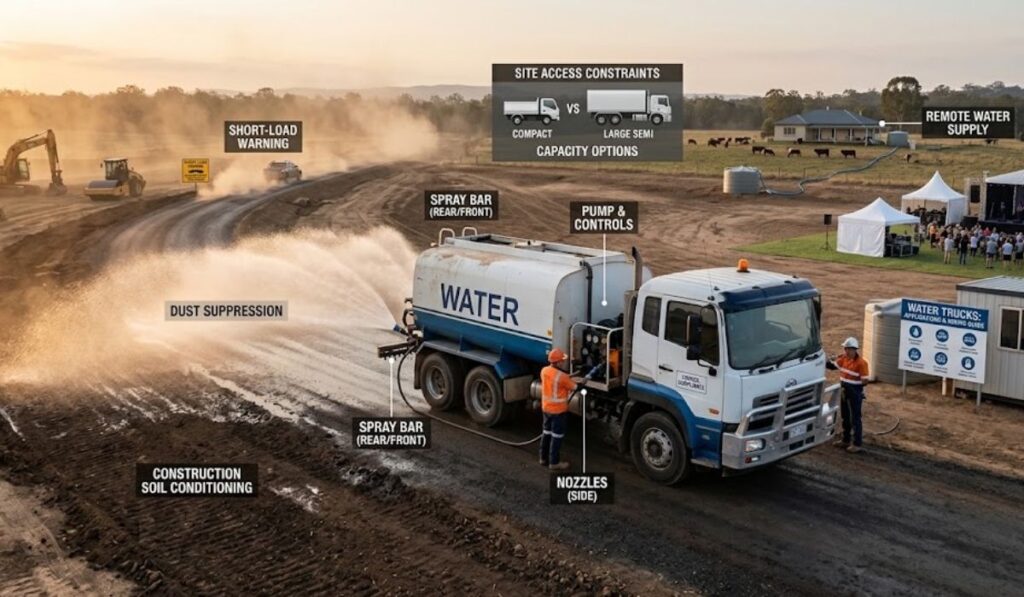

I only really noticed water trucks the summer I drove a long unsealed road to a friend’s property and spent twenty minutes inside a cloud of my own making. Every car ahead of me had left a haze hanging in the air, and by the end I could taste it. A few weeks later, on the same stretch, a water truck had been through. The road was dark, damp and calm. Same road, completely different drive.
Most of us see these vehicles on construction sites, rural roads and at outdoor events without ever stopping to think about what they’re for. Here’s a guide to what water trucks do and when it makes sense to hire one.
What a Water Truck Actually Is
At its simplest, it’s a truck with a big tank on it and a way to get the water out again. That usually means spray bars or nozzles for spreading it over the ground, and outlets for filling or delivering it somewhere else. They come in a range of sizes, from compact units that can get into tight spots to large ones built for big jobs.
The whole point is moving a lot of water to where it’s needed and putting it down in a controlled way. That’s the entire job, and it turns out to be useful in a surprising number of places.
Dust Suppression
This is the use you’ll see most often. Dry, bare ground throws dust the moment anything drives over it, and on a busy site that’s a real problem. It cuts visibility, it isn’t pleasant to breathe, and it drifts onto neighbouring properties where people understandably don’t love it.
A truck wets the surface and keeps it damp, so the dust stays on the ground. On many sites it’s also tied to safety and compliance rules, which is why it tends to be a routine part of the day rather than a nice extra. I’d check what’s expected for your particular site and council area, because requirements vary.
Construction and Earthworks
Water does more on a worksite than keep the dust down. During earthworks, it’s often used to condition soil so it compacts properly when you’re preparing and building surfaces. Too dry and the material won’t settle the way it should. Too wet and you’ve got a different problem.
Having water available right where the work is happening keeps things moving. Without it, someone ends up making trips back and forth, and that’s time nobody budgeted for. For plenty of civil and building projects, a water truck is closer to a necessity than a luxury.
Water Delivery and Supply
Sometimes the job is just getting water from A to B. Not every property or site has a mains connection nearby, and a truck can fill tanks, supply a remote worksite, or top up a water source that’s running low.
If you’ve ever lived somewhere that depends on tank water, you’ll know how quickly a dry spell turns into a logistics question. A delivery truck takes a large volume off your hands in one visit, which is a lot easier than any alternative I can think of.
Rural and Agricultural Uses
On the land, water trucks earn their keep in quieter ways. They deliver water to properties where mains supply isn’t available, and they help out during dry periods when tanks and dams need a hand. They can also support the everyday needs of a farm, from stock to general on-property use.
For people living and working out of town, it’s less about convenience and more about having a reliable option when it counts. That flexibility is why they turn up well beyond construction sites.
Events and Other One-Off Uses
Outdoor gatherings on unsealed ground can get dusty fast, especially once cars and crowds arrive. A truck can damp the area down beforehand and again during the day. They’re also handy any time you need a temporary, mobile source of water and don’t want to arrange a permanent one for a single occasion.
It’s a good example of why they’re so widely used. When the need is short-term, hiring is usually more sensible than trying to set up something fixed.
Sizes and Capacities to Think About
Picking the right size matters more than people expect. A larger truck carries more water and suits big jobs, while a smaller one copes better with tight access or lighter needs.
An undersized truck means constant refilling, and that’s where the delays creep in. An oversized one can be more than you need, and it may not even fit the site. Think about how much water the job really uses, how often it’ll need topping up, and what the access is like. Then ask the provider what they’d suggest. They’ll have seen similar jobs before, and a quick conversation can save you a wasted booking.
When It Makes Sense to Hire One
Consider hiring when you need to control dust, move a significant volume of water, or support construction, rural or event work where water has to be available on demand. If you’re not sure, a good test is whether the job would otherwise involve people hauling water by hand or putting up with dust you’d rather not have.
If that sounds familiar, a water truck is often the practical answer. And once you know what they do, you’ll probably start spotting them everywhere, just like I did.


