
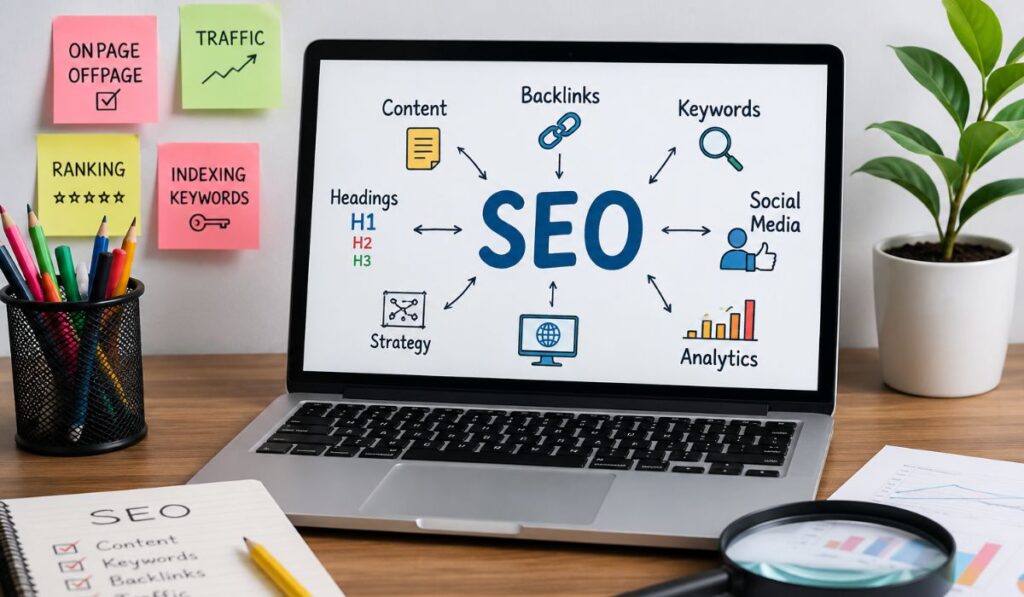

Having a website is only the beginning. It sits there, technically live, technically findable, and yet most of the people who might actually want what it offers never see it at all. That’s the gap SEO is meant to close. Search engine optimisation helps a business improve its visibility, attract the right kind of visitor, and build a real presence in search results instead of just existing somewhere on page four.
What Are SEO Services?
The term covers the strategies and activities aimed at improving where a website shows up in search engines like Google. That usually means keyword research, content optimisation, technical fixes, link building, website audits, and a handful of other activities that help search engines actually understand what a site is and who it’s for.
The goal was never just “more visitors.” It’s the right visitors, people already interested in whatever a business is offering, not just anyone passing through. A local web design company, for instance, wants to show up when someone searches “professional web design” or “website development services,” because those are the searches made by people already close to hiring someone. A well-built search strategy helps a business compete for exactly those moments.
Why SEO Is Important for Businesses
Search engines are one of the main ways people find businesses now, full stop. If a website doesn’t show up for the searches that matter to it, those customers usually don’t come back looking twice. They go to whoever did show up.
Done well, this kind of work builds organic visibility without leaning entirely on paid ads. Unlike a paid campaign, which stops the moment the spending does, organic SEO tends to keep generating traffic well after the initial work, as long as the content and technical performance hold up over time.
There’s a side effect worth mentioning too. The process of optimising a site for search usually improves the site itself. Better structure, faster loading, more useful content, easier navigation, all of it tends to happen alongside the SEO work rather than separately from it.
Key Areas of SEO
A real campaign like this isn’t one thing. It’s several areas working together rather than sitting as separate, disconnected strategies.
Keyword research identifies the terms and phrases people actually type when they’re looking for something. From there, content gets built and optimised around the search terms that genuinely matter. Good keyword research weighs search intent, competition, and relevance, not just volume. Chasing a keyword purely because it has a big search number attached to it often produces disappointing results, since high volume doesn’t always mean high relevance.
On-page SEO covers everything that lives directly on a website: page titles, headings, content structure, internal links, image optimisation, URLs, and keyword placement that actually makes sense. The point is making pages easier for search engines and real people to understand at the same time, not one at the expense of the other.
Technical work deals with the underlying foundation. Slow loading times, poor mobile performance, broken links, indexing problems, and awkward site structures can all quietly undercut visibility even when the content itself is good. A technical review usually surfaces these issues and builds a stronger base for everything else.
Content Optimization and SEO
High-quality content remains one of the most important parts of any search strategy, and that hasn’t really changed. Search engines are trying to hand users useful, relevant information, so content that genuinely answers the questions people are asking tends to perform well over time.
Content optimisation covers improving what already exists and building new resources around topics that matter. Blog posts, service pages, guides, FAQs, and informative articles all support visibility, provided they actually match what someone was searching for when they landed there.
Repeating the same keyword over and over stopped working a long time ago. Covering a topic properly, with related terms, real examples, clear headings, and language that reads naturally, tends to serve readers and search engines equally well.
The Importance of Website Speed
Website performance shapes the experience far more than most businesses assume. Visitors don’t hang around for pages that load slowly, especially on a phone, where patience runs out fastest.
As part of SEO services, businesses may review page speed, image sizes, unnecessary scripts, caching, and general mobile performance. Fixing these areas makes a site faster and genuinely easier to use, which matters for search rankings and for whether someone actually sticks around long enough to read anything.
A fast site also gives visitors a better environment to browse products, read through content, or get in touch, without friction getting in the way at every step.
Mobile-Friendly Optimization
A large share of online searches now happen on a phone, which means a site needs to work properly across screen sizes, not just look fine on a desktop monitor during a demo.
Responsive design lets content, images, menus, and buttons adjust to smartphones and tablets without breaking. Visitors need to be able to read content, move through pages, and complete whatever action they came for without fighting the layout to do it.
Mobile optimisation isn’t only about the visitor experience either. It’s become a core part of what keeps a site technically strong in the eyes of search engines too.
Link Building and Website Authority
Backlinks, links from other websites pointing back to a business’s own site, are another core piece of this work. Quality backlinks build credibility and authority, but only when they’re coming from relevant, genuinely trustworthy sources.
Chasing a large number of links for its own sake tends to backfire. Links from unrelated or low-quality sites add little value and can actually introduce risk rather than benefit. Guest posting, digital PR, genuinely useful resources, industry publications, and content worth linking to on its own merits all contribute to a link profile that builds naturally over time, rather than one that looks manufactured.
Measuring SEO Performance
Any of this needs regular measurement, not a one-time setup and a hope it holds. Organic traffic, keyword rankings, impressions, clicks, and conversions are all worth tracking on an ongoing basis.
Rankings alone don’t tell the full story. A keyword might bring in visitors, but the real value shows up once those visitors actually engage, request information, make a purchase, or become a lead worth following up on. Regular reporting also tends to reveal which pages are carrying their weight and where more work is actually needed, rather than guessing.
Local SEO for Businesses
For businesses serving a specific city or region, local optimisation carries particular weight. Optimising business information, building location-focused content, keeping contact details consistent everywhere they appear, and developing local signals all help a business show up for the customers nearby who are actually searching for it.
A company offering professional services in a specific city, for example, tends to benefit from dedicated service and location pages that clearly explain what’s offered and exactly where.
Choosing the Right SEO Approach
Every website has different goals, competitors, and challenges, which means the approach shouldn’t run the exact same playbook for every business regardless of where it’s starting from.
A brand-new website usually needs technical fixes and foundational content first. An established site with those basics already sorted often gets more out of content expansion, authority building, and conversion optimisation instead. The most effective starting point is usually a proper audit followed by ongoing performance analysis, so the work being prioritised is actually the work most likely to move the needle.
Building a Long-Term SEO Strategy
Growing organic visibility is a long-term process built from technical optimisation, useful content, keyword research, site performance, link building, and user experience, all pulling in the same direction rather than working against each other. Search engines need time to discover, evaluate, and understand any changes made. Businesses should therefore approach SEO services as a long-term investment rather than expecting immediate results from a handful of tweaks.
Final Thoughts
Professional support exists to organise all of this into a structured strategy rather than a loose pile of unrelated tasks handled whenever there’s time. With consistent monitoring, genuinely useful content, and steady improvement over time, a website has a real shot at becoming visible to the people who are already out there looking for exactly what it offers.