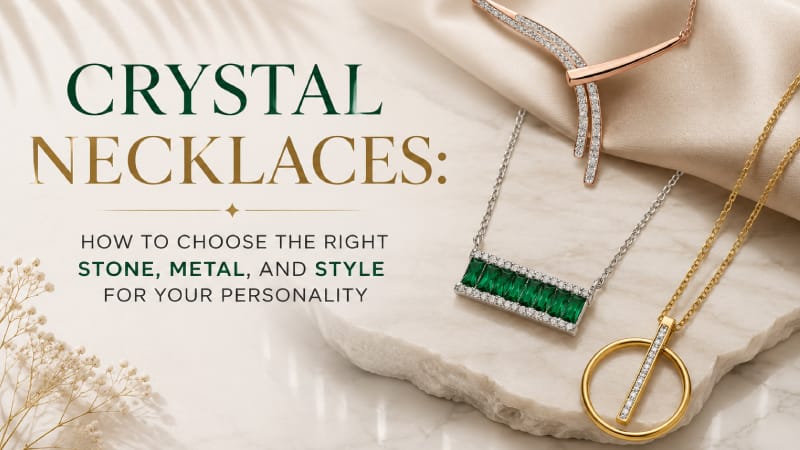

Crystal necklaces occupy an interesting space in jewellery. They carry personal meaning in a way that plain metal pieces often do not, they vary enormously in character depending on the stone, and they exist at every price point from genuinely affordable to considered investment. All of which makes choosing one harder than it looks from the outside.
The most common mistake is starting with the setting. The pendant, the metal finish, the chain length — these decisions feel concrete and shoppable, so people begin there. But they are all secondary. The stone comes first, and everything else follows from it.
The Crystal Comes First — Metal and Design Follow
Each crystal has its own character and its own relationship with different metals and occasions. Getting that part right makes every subsequent decision considerably easier.
Amethyst ranges from soft lavender to deep violet depending on the stone. It sits best against sterling silver or white rhodium finishes, which let the purple read clearly rather than getting muddied against a warmer metal. It is one of those stones that wears as comfortably on an ordinary Tuesday as it does somewhere more formal, which is part of why people tend to reach for it regularly rather than saving it for specific occasions.
Rose quartz is one of the more forgiving stones to work with. Its softness means it does not clash — rose gold IP, yellow gold, silver all sit naturally alongside it. It layers well with other pieces and tends to feel wearable across a wider range of outfits than stones with stronger colour.
Clear quartz is underestimated as a choice for anyone uncertain where to start. A well-cut clear crystal catches light and moves it around a room without dominating the outfit underneath it. Paired with polished stainless steel or yellow IP it becomes one of the most genuinely versatile pendant options available — works with almost anything, suits almost any occasion.
Labradorite is the most visually distinctive of the group. Its blue-green-gold iridescence shifts depending on the angle and the light source, which means it genuinely looks different at a dinner table than it does in morning daylight. That quality makes it a conversation piece, and it is beautiful for exactly that reason, though it is a more considered choice for daily wear than some of the others.
Citrine runs from yellow to warm golden brown and has a natural affinity with gold tones that most stones do not. Where warmer metals can flatten other crystals, citrine actually benefits from them. It is one of the few stones where a yellow IP or gold setting brings the stone forward rather than competing with it.
What the Metal Descriptions Actually Mean
The language around crystal necklace settings is confusing in ways that cost buyers money and clarity. A few things worth understanding before purchasing.
Sterling silver marked .925 is a genuine precious metal. It is softer than steel and requires more care but it is the real thing. Rhodium-plated sterling silver adds a protective layer over the top that maintains the bright white finish, helps prevent tarnishing, and improves contrast against coloured stones. Many pieces in quality crystal ranges use this combination for exactly that reason.
Stainless steel is hypoallergenic and more scratch-resistant than uncoated sterling silver. It holds its finish for longer without replating, which makes it a practical choice for pieces worn frequently and not treated with particular delicacy.
IP finishes — ion plating in yellow or rose — are electroplated colour finishes applied to stainless steel. They produce the warmth of gold or rose gold at a considerably lower price point and are more durable than traditional plating methods, though they do show wear at contact points over extended daily use.
Across BOLD Precious Metals crystal jewellery range, Preciosa crystals are precision-cut Czech crystals produced to optical clarity specifications that sit well above costume-quality glass. When a listing specifies Preciosa it is telling you something meaningful about the refraction quality and long-term clarity of the stone — it is not a generic marketing term.
The Practical Details That Actually Affect Wear
Chain length is one of those decisions that seems minor and turns out not to be. A 16 to 18 inch chain positions a pendant at the collarbone, which suits most necklines and works particularly well for smaller pendants or stones you want close to the face. A 24 inch chain sits at mid-chest, which reads differently — better suited to open necklines and layered arrangements. Most quality listings note whether the chain includes an extension, usually two to two and a half inches, which is worth checking because it gives the flexibility to adjust positioning for different outfits without needing a second chain.
Caring for crystal jewellery is straightforward when you know the basics. A damp lint-free cloth handles everyday dust and light residue. Warm water with mild dish soap works for anything more thorough. Two things to avoid consistently: harsh chemical cleaners, which can damage both the stone and the setting, and prolonged direct sunlight, which causes some stones to fade in colour intensity over time. Storing pieces in a soft pouch or in separate compartments prevents the surface scratching that happens when harder metals sit against each other.
On pricing — the gap between a piece at fifty dollars and one at several hundred is not primarily about mark-up. It reflects actual differences in materials: the crystal quality, the metal content, and the setting construction. A piece in the lower range using Preciosa crystals and stainless steel is genuinely a different object from one using Swarovski crystals set in 14k gold. Neither is a bad purchase but they are not comparable on the same terms because they are made for different priorities and different buyers.
Where to Start Looking
Within the crystal necklace collection at BOLD, the range runs from stainless steel pieces with Preciosa accents under sixty-five dollars through to emerald-cut nano crystal necklaces in sterling silver and 14k gold settings with Swarovski crystals. Each listing specifies the metal, the crystal type, and the chain length, which makes it considerably easier to compare pieces honestly than it is in most retail environments where that information is vague or buried.
A Decision Worth Making Carefully
The best crystal necklace is not the most expensive or the most immediately eye-catching in a product photograph. It is the one where the stone feels right for you, the metal suits both the stone and your existing pieces, the chain length works for how you actually dress, and the construction is honest about what it is made from.
Start with the crystal. Let the metal follow. Read the listing materials rather than making the decision based on how something looks in a studio photograph under ideal lighting. That approach produces a piece you reach for regularly rather than one that sits in a drawer because it never quite worked the way you hoped.