
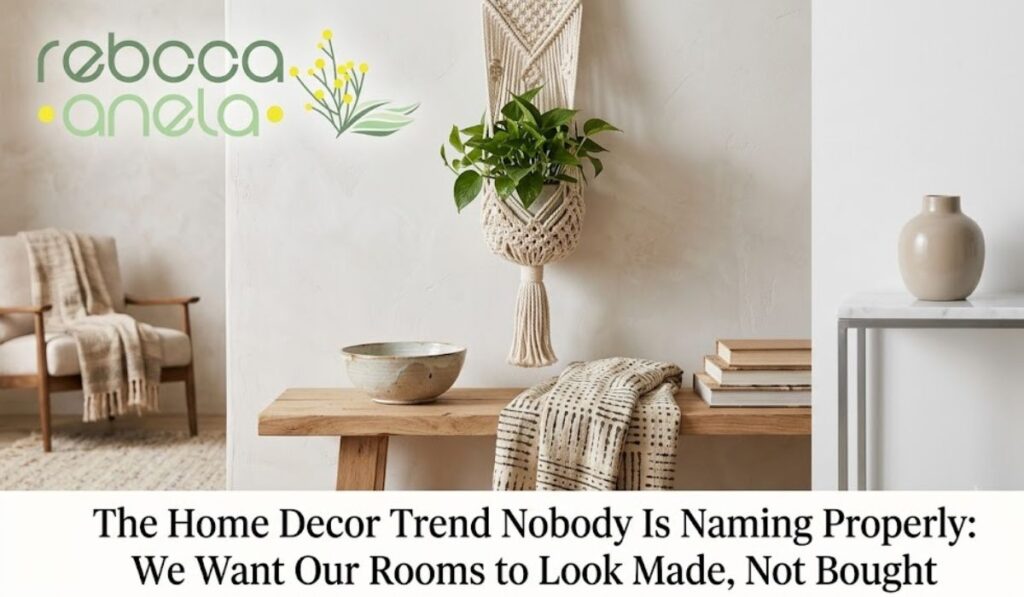

I have been reading a stack of interior design trend reports lately, the kind that come out every year promising to tell you what your living room needs. Most years they contradict each other within a paragraph. This year, oddly, they do not.
Report after report is describing the same shift, just in different language. One calls it “warm minimalism.” Another calls it “quiet luxury.” A third talks about a move away from “sterile minimalism” towards something “personalised.” Strip out the marketing language and they are all pointing at the same thing: we are tired of rooms that look like nobody lives in them, and we are furnishing our way back towards rooms that look like somebody made them.
I want to unpack what that actually means, because I think the trend reports are dancing around the real story rather than naming it.
What the reports are actually saying
Pull the language apart across this year’s crop of design coverage and a few phrases turn up constantly.
Grain, texture and variation are celebrated rather than concealed. Homes are becoming more expressive, but in a quiet and considered way. Mass-produced decor is slowly being replaced by handmade and artisanal elements… these details celebrate imperfection and authenticity. Comfort has become the primary metric by which homeowners are evaluating their homes.
Notice what none of these sentences say. None of them say bigger, none of them say more expensive, none of them say more of anything. They are all describing a search for evidence of a person somewhere in the room — a mark left by a hand, a material that was not stamped out identical eleven thousand times, a piece that means something because of where it came from rather than only how it looks.
Why minimalism started to feel cold
The minimalism of the last decade had a very particular look. Sparse, controlled, everything hidden away, surfaces with no history written on them at all. It photographed beautifully. Several design writers this year have made the same observation about actually living in those rooms day to day: they were designed to be looked at rather than lived in, and after a while that starts to feel less like calm and more like absence.
I understand the appeal of that look completely. There is real relief in a room with nothing shouting at you. But there is a difference between a room that is calm and a room that has simply had every trace of a person removed from it, and I think a great many of us spent the last decade mistaking the second for the first.
What seems to be happening now is not a rejection of calm. It is calm with evidence of a life in it — texture you can feel with a hand, a piece with a slightly uneven edge because someone’s hands, not a mould, made it.
The material that keeps coming up
Every single report I read this year leans on the same handful of words: timber, stone, linen, wool, rattan, ceramics — kept close to their raw state rather than polished into uniformity. Left as untouched as possible, so the grain, the variation, the small imperfections stay visible instead of being sanded and lacquered away.
There is a fairly obvious reason natural materials do this and manufactured ones cannot. A printed timber-look laminate is identical in every sheet off the roll. Real timber is not — every plank responds to light slightly differently, ages differently, can be repaired and refinished rather than simply replaced when it wears. The industry term for what people are increasingly rejecting is the “uniform, polished, mass-produced feel” of manufactured surfaces, and what they are asking for instead is exactly the opposite: a surface with a memory in it.
Handwoven textiles turn up in this conversation constantly, and for the same reason. A woven throw, a knotted wall hanging, a hand-thrown ceramic bowl — the appeal is not that they look expensive. It is that they look like a specific pair of hands was involved, at some point, doing something slowly.
What “handmade” actually gets you
I want to be honest about what this trend can and cannot do for a room, because “authenticity” gets thrown around in decor writing until it stops meaning anything.
What a handmade or natural-material piece genuinely adds is texture that changes with light and touch, in a way a flat manufactured surface does not. It adds a small amount of visible imperfection, which — counterintuitively — tends to make a room feel more settled rather than less, because a room with zero variation in it reads as staged. And it adds a story, which is not nothing. A macrame hanging you knotted yourself, or a piece you bought from someone whose name you know, sits differently in a room than something identical to what is in forty thousand other living rooms this year.
What it will not do is fix a room with poor light, bad proportions, or furniture in the wrong scale for the space. Texture is a layer, not a foundation. The fundamentals still matter first.
How to bring this into a room without overspending
You do not need to replace anything to lean into this. A few genuinely low-cost moves do most of the work.
Swap one manufactured surface for one natural one. A laminate side table for a solid timber one, even secondhand. You do not need to redo a whole room — one honest material in a space full of manufactured ones is often enough to shift how the whole room reads.
Bring in one handmade textile. A woven throw, a knotted plant hanger, a set of hand-thrown mugs on open shelving rather than tucked in a cupboard. This is the cheapest entry point into the whole trend, and it is genuinely the one I would start with.
Stop hiding the joins. Visible stitching, a slightly uneven glaze line, a knot you can see the structure of — these used to be things manufactured decor tried to disguise. Leave them visible. That is precisely what reads as made rather than bought.
Choose fewer, more specific things over more generic ones. A single piece with a real maker’s name behind it does more for a room than a shelf of things bought purely because they matched.
Where craft and decor genuinely meet
I think this is worth saying plainly, because it is the part decor writers tend to skip over: the easiest way to get a genuinely handmade piece into your home is to make it yourself.
You do not need to be an experienced maker to produce something that fits exactly the aesthetic these reports are describing. A macrame plant hanger, knotted from natural cotton cord, is precisely the kind of textured, slightly imperfect, evidently handmade object that every one of these trend pieces is circling around — and it costs a fraction of buying the equivalent from a boutique. Rebecca has written a proper beginner’s guide to starting with macrame if you would like to try your own hand at exactly this trend rather than paying someone else for it.
The same logic applies to a hand-thrown ceramic piece, a length of block-printed fabric, a simply woven basket. None of it needs to be perfect. Perfect, in fact, defeats the point.
A word of caution
One thing worth flagging, because the design industry is very good at selling a reaction against itself back to you at a markup.
“Handmade” and “artisanal” are now marketing words as much as descriptive ones, and a mass-produced object with a deliberately uneven glaze, made in a factory to look handmade, is not actually the thing this trend is describing — it is minimalism’s opposite wearing the same manufactured processes underneath. If a piece is meant to carry the story of a hand having made it, the honest version of that is a piece an actual hand actually made, whether that hand belongs to you or to a maker whose name you can find.
That, more than any specific material or colour, seems to be what 2026 is actually asking for. Not a look. Evidence that a person was involved.
Has your own home been drifting this way without you quite naming it? I would love to hear what natural or handmade piece has made the biggest difference in a room of yours — tell me in the comments below.