
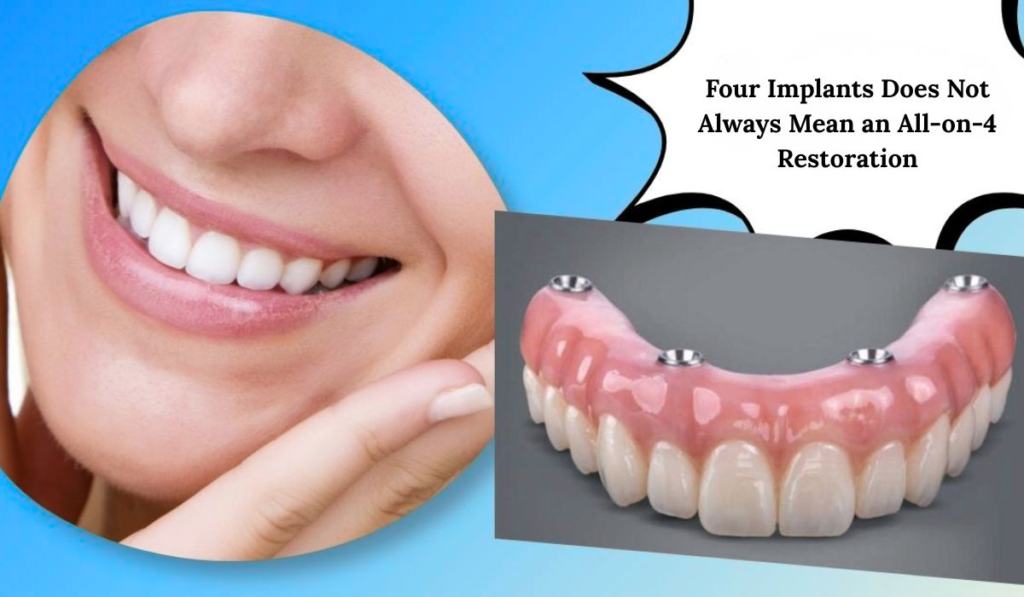

Ask around a dental implant forum and you’ll see it constantly: someone posts “I’m getting four implants, so it’s All-on-4, right?” It’s an easy assumption to make, and an understandable one, but it’s not actually how the clinical side of this works. The number of implants doesn’t define the restoration by itself. Four implants can support several genuinely different types of dental work, depending on how many teeth are missing, where they sit in the mouth, the condition of what’s left, and what the final restoration is actually designed to achieve.
Understanding the real distinction between four implants and All-on-4 treatment helps patients ask sharper questions and compare treatment plans properly, rather than assuming two very different proposals are the same thing just because a number matches.
All-on-4 Describes a Full-Arch Restoration
An All-on-4 restoration replaces a complete upper or lower arch of teeth. Four implants get positioned within the jaw to support one connected full-arch prosthesis, and the visible teeth form part of that single restoration rather than being fitted as four separate crowns sitting independently of each other.
The actual scope of treatment is a lot bigger than the implant count alone suggests. Those four implants act as the load-bearing foundation for an entire row of replacement teeth, not four individual repair jobs happening to share a jaw.
International patients considering treatment through VNDentalTravel should confirm early on whether a proposed plan covers one full arch, both arches, or only specific missing teeth. This isn’t a technicality. It genuinely changes the clinical process, the restoration design, how long treatment takes, and what the total cost ends up being.
Four Implants Can Be Used in Other Ways
A patient can walk away with four implants and never have had an All-on-4 restoration at all. Four implants might replace four individual teeth scattered across different parts of the mouth, each one carrying its own crown with no connection between them.
Four implants can just as easily support two separate bridges instead. In another case, they might simply help hold a removable implant-supported denture in place, rather than a fixed full-arch bridge. This is exactly why comparing multiple tooth implants against full-arch treatment purely by counting the implants involved can lead someone badly astray. The question that actually matters is what those implants are going to support once treatment is finished, not how many of them there are.
Information about VNDentalTravel dental implants can help patients work out what to raise with the treating dentist, but the right restoration still has to come out of an individual clinical assessment. No general overview substitutes for that.
Ask the Dentist to Define the Restoration
A proper written treatment plan describes more than just the number and brand of implants going in. It should identify exactly which area is being treated and spell out the proposed final restoration in plain terms.
Worth asking the dentist directly: will the implants support individual crowns, bridges, or a full-arch prosthesis? Is the restoration fixed or removable? Does the treatment cover one jaw or both? How many replacement teeth are actually included? Will there be a temporary restoration in the meantime? What material is proposed for the final one? And is there any chance the plan changes once scans or an in-person exam happen?
The dentist should be the one answering these, not a salesperson, a travel coordinator, or an interpreter standing in. Support staff can absolutely help communicate along the way, but the clinical call stays with the treating professional, full stop.
Implant Numbers Do Not Determine Candidacy
Even when a patient’s lost most or all of their teeth in one arch, a four-implant approach isn’t automatically the right call. A properly qualified dentist has to weigh available bone, jaw anatomy, bite forces, existing oral conditions, and general health before recommending anything at all.
Three-dimensional imaging and a hands-on examination can reveal that a different number or position of implants actually suits the case better than the initial assumption. Additional procedures sometimes come up too, where clinically necessary, which is exactly why a quotation drawn up before travel should be treated as preliminary unless the dentist has already completed the required assessment. It’s worth asking plainly which parts of the proposal are locked in and which are still pending examination once you’re physically there.
Review Cases With Confirmed Treatment Details
Before-and-after photos can be genuinely useful, but appearance alone doesn’t tell you how a restoration was actually built. A photo of a finished smile can’t confirm the number of implants used, whether the restoration is fixed or removable, or whether one arch or both were treated.
When looking through patient cases, it’s worth seeking out examples where the treatment type has actually been confirmed by the dental team behind it, rather than just inferred from a photo. Useful case detail tends to include the original dental condition, the diagnostic process, the number and location of implants, the type of restoration, and the treatment stages involved from start to finish.
A case shouldn’t get labelled All-on-4 purely because four implants got mentioned somewhere in the write-up. The defining feature is a complete arch of replacement teeth supported by those implants. Nothing less qualifies.
Where This Leaves You
At the end of the day, “four implants” only answers one small piece of the treatment question. Patients still need to know which teeth are actually being replaced, how the implants connect to each other, and what restoration they’ll end up with once everything’s finished. Confirming those specifics directly with the dentist, in writing, makes treatment plans far easier to understand, and stops two genuinely different procedures from being compared as though they were interchangeable.

