

Planning a trip across Europe brings excitement and a handful of small headaches, and staying connected is usually near the top of that list. Roaming charges from a home provider can add up quickly, airport SIM kiosks tend to charge a premium, and finding a local shop after a long flight is rarely appealing. An eSIM can remove much of that friction, because a plan can be installed digitally and used when the plane lands, provided the phone supports it.
Choosing a plan comes down to matching data limits, price and coverage to how someone actually travels. For travellers weighing up the best Europe eSIM setup for a phone and a tablet on one budget, the useful criteria are hotspot support, how many countries a plan covers and how clearly the data terms are written. The details differ between providers and change often, so it is worth confirming current terms on the provider’s own site before paying.
What to Look for in an Affordable eSIM Plan
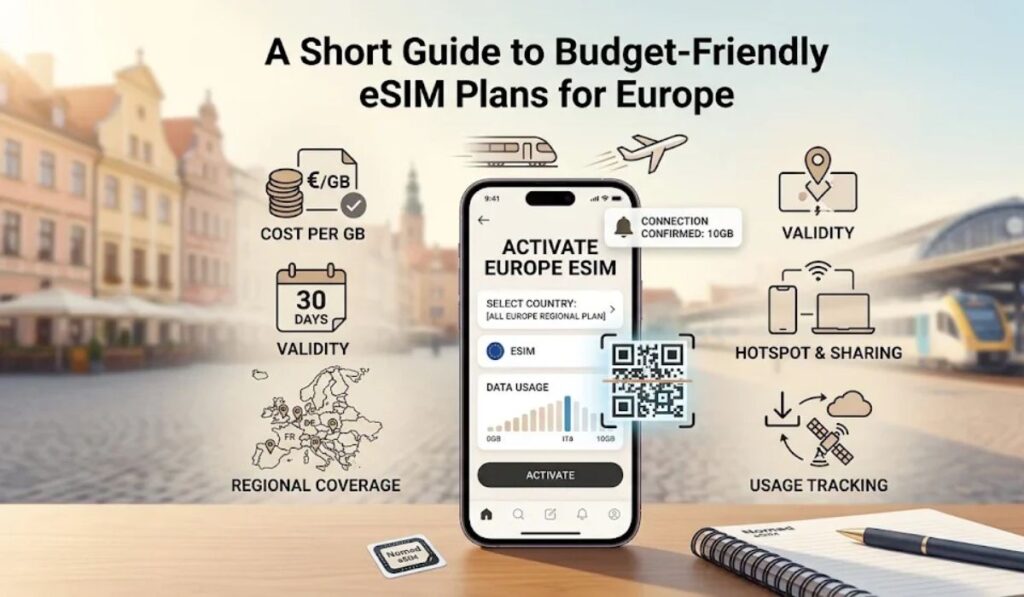
Price tags can be misleading. A cheap plan with a small data cap can end up costing more once top-ups are bought halfway through a trip. A more reliable comparison looks at the cost per gigabyte, not only the headline price. Validity matters as much, because a plan that expires after five days is of little use on a two-week itinerary.
A few points are worth checking before buying:
- whether the plan covers a single country or a wider region, and which countries are on the list
- the total data allowance and what happens when it runs out
- how long the plan stays valid after activation
- whether customer support is available if activation fails
- compatibility with the specific phone model
- whether the plan is data-only, or whether calls and text messages are included
That last point is easy to miss. Many travel eSIMs provide data only, so calls and SMS continue to run through the home number, or through apps that use data.
Understand Data Limits and Coverage Across Countries
Coverage varies depending on the network partners behind each provider. A plan that performs well in Germany may be weaker in rural Croatia. Checking which local carriers a plan connects to gives a clearer picture of what to expect. Cities generally have strong signal whichever provider is used, while small towns and mountain regions are where gaps tend to appear.
“Europe” is also not a single, fixed list. Some plans include countries outside the European Union, such as the United Kingdom, Switzerland or Turkey, while others do not. EU roaming rules apply to plans from EU operators and do not automatically apply to a travel eSIM sold by a third party, so the coverage list is worth reading carefully, particularly for any country on the itinerary that sits outside the EU.
Data limits deserve the same attention. Streaming video and video calls use far more data than browsing or messaging, so an allowance that looks generous for texting can disappear quickly on a long train ride. Estimating daily usage from actual habits, instead of guessing, leads to a more accurate choice.
Hotspot and Multi-Device Sharing Options
Travelling with a laptop, tablet and phone is common, and buying separate plans for each device adds up. Hotspot, or tethering, lets one eSIM plan share its data with other devices. That can suit small groups or families who want to split one strong connection across several screens.
A few reasons the option is popular:
- one data pool instead of separate plans for every device
- setup through the phone’s existing settings
- a laptop can be used for video calls while the phone stays free
- potential savings compared with buying a SIM for every gadget
One caution applies. Some plans restrict or exclude hotspot use, or limit it to a fair-use allowance, so the terms should be checked before purchase and not assumed.
Set Up Your eSIM Before You Land
Setting up an eSIM before departure removes one more task after a long flight. Many providers send a QR code by email after purchase, and scanning it in the phone’s mobile network settings installs the plan, often within a few minutes. Keeping the new data line switched off until landing, and leaving the home SIM as the main line, helps avoid accidental roaming charges during the flight and the transit.
Compatibility needs checking first. Older phones can lack eSIM support, and some phones are locked to a carrier and will not accept a plan from another provider. A quick search of the phone’s settings for “add eSIM” or “mobile data” shows whether the device qualifies, and the home carrier can confirm whether the phone is unlocked. Skipping this step is a common reason travellers end up looking for a physical SIM at the last minute.
It also helps to keep the home SIM active for calls and for text-message verification codes from banks and other services, since a data-only plan will not receive them on the home number.
Tips for Saving Money on Data While Abroad
Downloading offline maps, playlists and shows before leaving cuts data use without much inconvenience. Wi-Fi in cafes, hotels and stations covers a large share of casual browsing, which leaves the eSIM data for moments when a connection is genuinely needed. Public networks carry security risks, so sensitive tasks such as banking are better done over mobile data or through a VPN. Turning off automatic app updates and background refresh also stops silent data use that often goes unnoticed until a usage tracker shows it.
A regional plan can be cheaper than separate country plans for anyone crossing several borders in one trip. Where hotspot sharing is permitted, splitting a plan with a travel companion can reduce individual spending, although it also means sharing one data allowance.
Choosing With Evidence
Staying connected across Europe does not have to strain a travel budget. The best plan is the one that fits actual travel habits, whether that is a single-country pass or a regional bundle covering several stops. Checking data limits, validity, hotspot terms, the country list and phone compatibility before buying saves both money and frustration once the trip starts. Reading the refund and support terms is also worthwhile, in case activation fails.
A little preparation at home, from downloading offline maps to installing the plan early, usually makes the journey smoother. Providers’ own pages remain the most reliable source of current prices and conditions, so those should be confirmed rather than taken from any single guide.

