

Solid wood furniture does something that manufactured alternatives cannot quite replicate. It brings warmth, character, and a sense of weight to a room that feels genuinely different from everything around it. Whether it is a hand-carved dining table, a custom bookshelf, or a dresser that has passed through several generations of a family, solid wood earns its place in a home in a way that tends to become more apparent rather than less over time.
What most people do not realise until something goes wrong is how sensitive that wood is to the environment around it. Summer creates particularly challenging conditions — rising outdoor temperatures, frequent storms, and heavy air conditioning use combine to produce humidity fluctuations inside the home that quietly cause serious and expensive damage. Understanding how to monitor those conditions with a reliable portable hygrometer and thermometer and responding to what the readings show is one of the most practical things a furniture owner can do to protect pieces that might otherwise last for decades.
Why Summer Humidity Threatens Your Furniture
Wood is hygroscopic. Its cellular structure expands as it absorbs moisture from the surrounding air and contracts as it dries out. This movement is happening constantly, responding to every shift in the indoor climate, even when nothing looks visibly different.
During summer, outdoor relative humidity routinely surges past 70 percent across much of North America. When that moist air enters a living room, dining area, or basement, wooden furniture absorbs the excess water vapour in the same way a dense sponge would. The problem is not a single humid day. It is the sustained exposure over weeks and months that causes real damage.
What Happens When Indoor Humidity Is Too High
When indoor relative humidity stays above 55 or 60 percent for extended periods, several damaging things begin to happen.
Wood grain swells unevenly across different board faces, causing warping and cupping. Cabinet doors begin to stick. Table tops develop subtle curves. Drawers expand until they jam. As individual wood planks swell at different rates, immense stress builds on dovetailed joints, dowels, and glue lines — table legs loosen, seam joints crack open. Moisture trapped underneath clear coats, lacquers, or oil finishes causes milky white discolouration or makes protective topcoats check, craze, and eventually peel. And in darker corners of antique pieces, mold spores find ideal conditions when humidity remains consistently above 60 percent.
None of these things happen overnight. They build gradually, which is part of why they go unnoticed until the damage is already done.
What Is the Ideal Indoor Climate for Solid Wood Furniture
Museum conservators and professional woodworkers agree on a clear standard for solid wood care. Keep indoor relative humidity between 35 and 55 percent — ideally centred around 40 to 45 percent — and ambient temperatures between 60°F and 75°F.
Maintaining a stable environment within these ranges minimises the dimensional wood movement that causes warping, joint failure, and finish damage. Stability is the goal as much as any specific number — dramatic swings between dry and humid conditions are as damaging as sustained high humidity over time.
Why You Must Actively Monitor Indoor Humidity
Many people assume that running air conditioning through summer is sufficient to control indoor dampness. AC units do extract water vapour as they cool the air, but they rarely manage relative humidity with precision. On mild summer days or during humid rain, an AC unit may cycle off once the temperature target is reached, leaving elevated humidity trapped inside long after the air has cooled.
The other problem is human perception. Bodies are unreliable at detecting humidity changes until moisture becomes uncomfortably thick. By the time the air feels noticeably damp, the furniture has already been absorbing it for some time. You cannot manage what you are not measuring.
How to Monitor Indoor Humidity for Protecting Your Wooden Furniture
For anyone with valuable solid wood pieces, precision matters more than a rough sense of whether the air feels comfortable. The TempPro TP359 Bluetooth Indoor Hygrometer Thermometer is engineered to provide real-time accurate ambient monitoring so you can take action the moment indoor conditions shift into dangerous territory.
The device uses Swiss Sensirion sensors that read relative humidity with an accuracy of ±2 percent RH and temperature within ±0.9°F, updating every ten seconds. That responsiveness matters when a sudden storm sends indoor humidity spiking faster than a slower-updating device would catch.
Wireless Bluetooth 5.0 connectivity allows the device to sync with iOS or Android smartphones up to 260 feet away, which means you can check the humidity in a formal dining room, upstairs study, or basement from wherever you happen to be in the house without walking around to inspect readings manually.
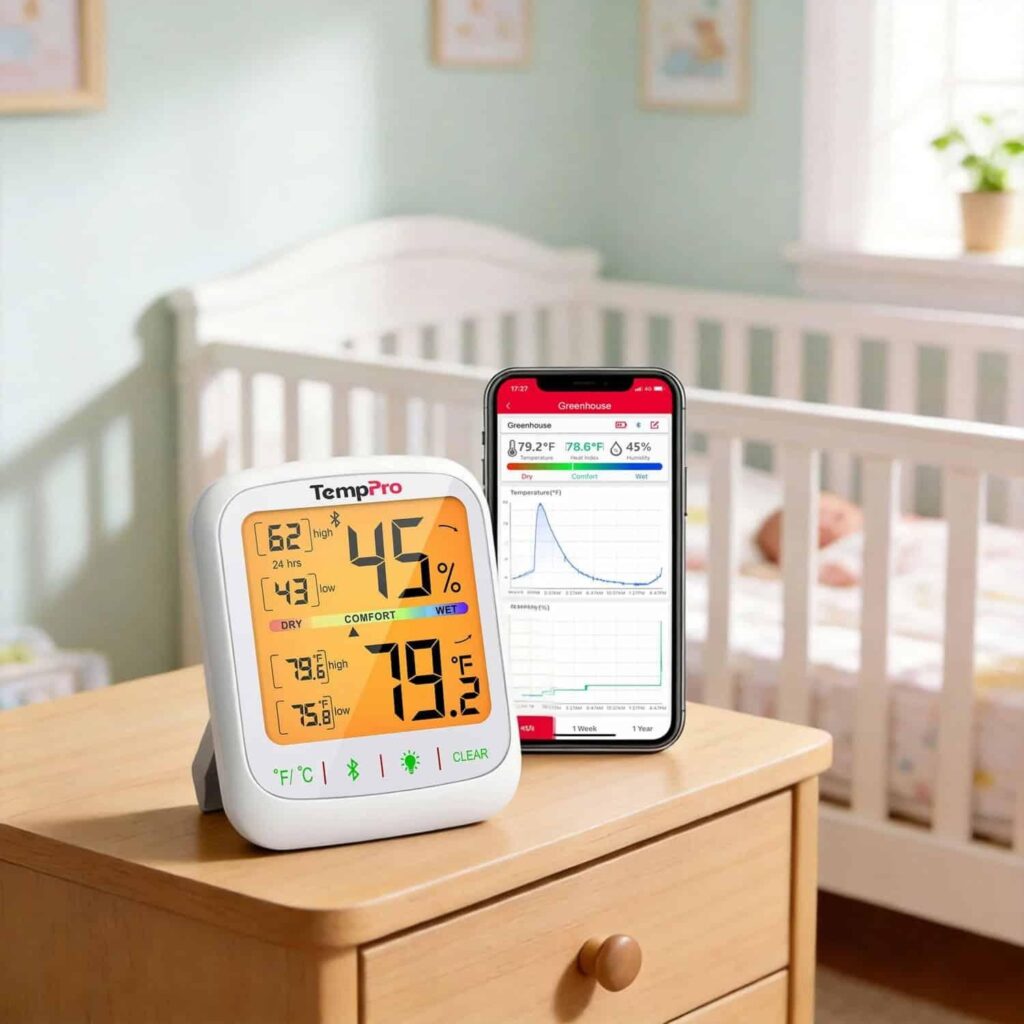
Custom alerts let you set upper and lower humidity thresholds — a notification if humidity exceeds 52 percent, for example — so a July rainstorm does not go unnoticed while you are elsewhere in the house. The accompanying app stores temperature and humidity history for up to 12 months, allowing you to identify patterns in your indoor climate over time and make better decisions about dehumidifier placement and use. A large 3.5-inch backlit screen displays a visual comfort indicator — DRY, COMFORT, or WET — so the current status of your indoor environment is readable at a glance from across the room.
Practical Tips to Protect Your Wood Furniture
Monitoring provides the information. These habits provide the protection.
If readings consistently show humidity above 50 percent in your living space or basement, a portable or whole-home dehumidifier is the most direct intervention. Running one proactively during high-humidity periods is considerably less expensive than repairing furniture damage after the fact.
Never position solid wood tables or storage pieces directly over air conditioning supply vents or in paths of direct summer sunlight through windows. Direct airflow and localised temperature drops accelerate uneven wood movement in ways that consistent ambient conditions would not.
Solar shades or curtains drawn during peak sun hours reduce both UV exposure and ambient heat. UV rays combined with heat break down protective finishes faster than humidity alone and the two together accelerate damage considerably.
Leave two to three inches of space between the backs of large wooden pieces and exterior walls. Damp air tends to collect in those gaps and the furniture absorbs it from the back — a side that rarely gets attention during routine care.
A thin layer of natural beeswax or paste wax on raw or oiled wood surfaces creates a subtle protective barrier that slows the rate at which wood absorbs atmospheric moisture. It works well alongside proper climate management rather than as a standalone solution.
An Investment Worth Making
Solid wood furniture represents craftsmanship, family history, and the kind of beauty that only improves with time when it is properly cared for. The conditions that threaten it most — summer humidity fluctuations — are also the ones most quietly overlooked because the damage builds invisibly before it becomes obvious.
Monitoring indoor climate accurately and responding to what the data shows is the most practical thing a furniture owner can do. The cost of a good hygrometer and thermometer is minor relative to the value of the pieces it protects. And the peace of mind that comes from knowing your indoor environment is stable is worth more than most people expect until they have it.