
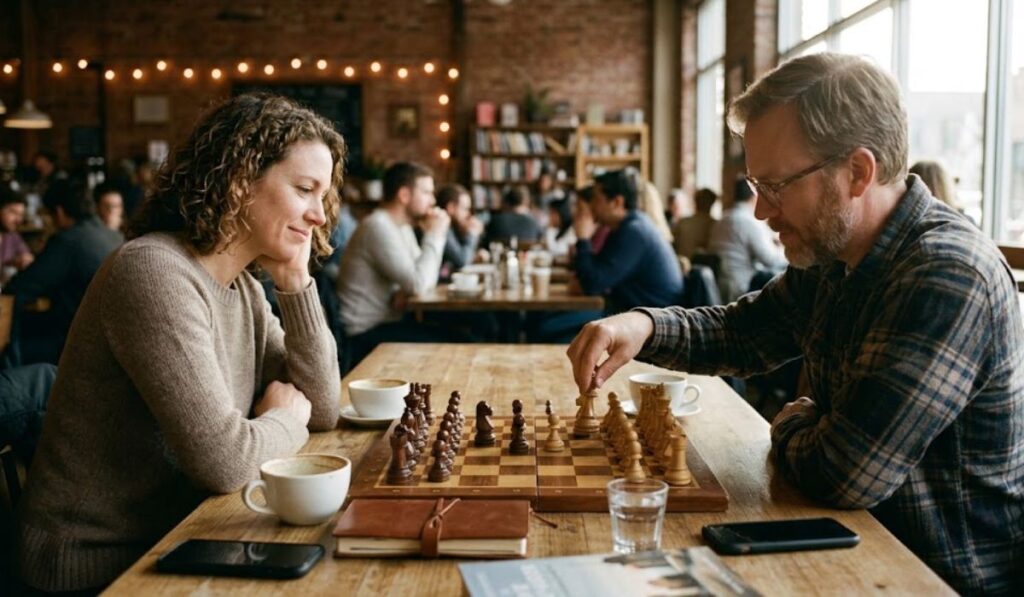
I know a handful of people who picked up chess again in their thirties and forties, and every single one of them says roughly the same thing. They wish they’d started sooner, and they can’t quite explain why they stopped in the first place. It’s not really about winning. It’s something closer to the feeling of a genuinely quiet hour, one where your phone stays face down and your brain does something it hasn’t done in a while.
That quiet resurgence isn’t just anecdotal either. Chess has had a real cultural moment over the past few years, and a lot of it has nothing to do with grandmasters or tournaments. It’s ordinary people rediscovering a board game that somehow feels both old-fashioned and completely relevant to how scattered most of our attention has become.
The Appeal Isn’t Really About Strategy
Ask most adult beginners why they came back to chess, and the answer usually isn’t “I wanted to improve my strategic thinking.” It’s something closer to wanting a single, focused task in a day otherwise full of half-attention. Chess doesn’t let you multitask. You either think about the board or you don’t, and that binary is oddly restful once you get used to it.
There’s also something genuinely satisfying about a game with no hidden information. Everything’s visible on the board. No luck, no dice, no cards you can’t see. Whatever happens is entirely the result of the decisions both players made, which makes losing feel instructive rather than random, and winning feel actually earned.
It’s Cheaper Than Most Hobbies, and That Matters
A decent chess set costs less than a single session of most other hobbies people take up in adulthood. No subscription, no recurring cost, no equipment that needs replacing every season. Buy a solid board once and it can genuinely last decades, outliving several other hobbies you might pick up and drop along the way, whichever specialist retailer, like Chess and Board, or general shop you end up buying from.
That low barrier to entry matters more than people give it credit for. A lot of adult hobbies quietly demand a serious upfront investment before you even know if you’ll enjoy them. Chess asks almost nothing of you at the start beyond a willingness to lose a few games while you’re learning, which tends to happen fast and painlessly compared to most skills worth picking up.
The Social Side Nobody Expects
What surprises a lot of adult beginners is how social chess actually is once you get past the first few weeks. Local clubs exist in almost every city, often meeting weekly in the back of a café or community hall, full of people ranging from complete beginners to genuinely serious players who are happy to explain a mistake rather than just capitalise on it.
Online play changed things too, obviously. Sites and apps built around fast games mean you can play a five-minute match on a lunch break, or settle into something longer on a weekend evening. But the people I know who stuck with it long-term all say the same thing: the in-person games are what actually kept them coming back. There’s something about sitting across from another person, watching them think, that a screen just doesn’t replicate.
A Genuinely Good Board Makes a Difference
This is the part people underestimate until they’ve experienced it. A cheap set with light plastic pieces and a flimsy board feels completely different to play on than a properly weighted set with a board that sits flat and solid on a table. It’s a small thing, but it changes how the whole experience feels, closer to a proper ritual than a quick distraction.
If you’re buying your first real set, it’s worth spending a bit more than the bare minimum. Weighted pieces that feel substantial in your hand, a board with clear contrast between the squares, something that looks good enough to leave out on a table rather than shoved in a drawer between games. It sounds like a minor detail, but it’s often the difference between a set that gets used regularly and one that quietly disappears into a cupboard after the first month.
You Don’t Need to Be Good at It
Maybe the most freeing part of picking up chess as an adult is realising you’re allowed to just be bad at it for a while. Nobody expects a beginner to play well. There’s no social pressure the way there sometimes is with other hobbies where everyone else already seems to know what they’re doing. You can lose twenty games in a row and still genuinely enjoy every single one of them, because the point was never really the winning.
That’s probably the real reason so many adults are coming back to it. In a world full of hobbies that demand constant improvement and visible progress, chess quietly offers something different: an hour where the only thing that matters is the board in front of you, and whatever you decide to do with it next.

