
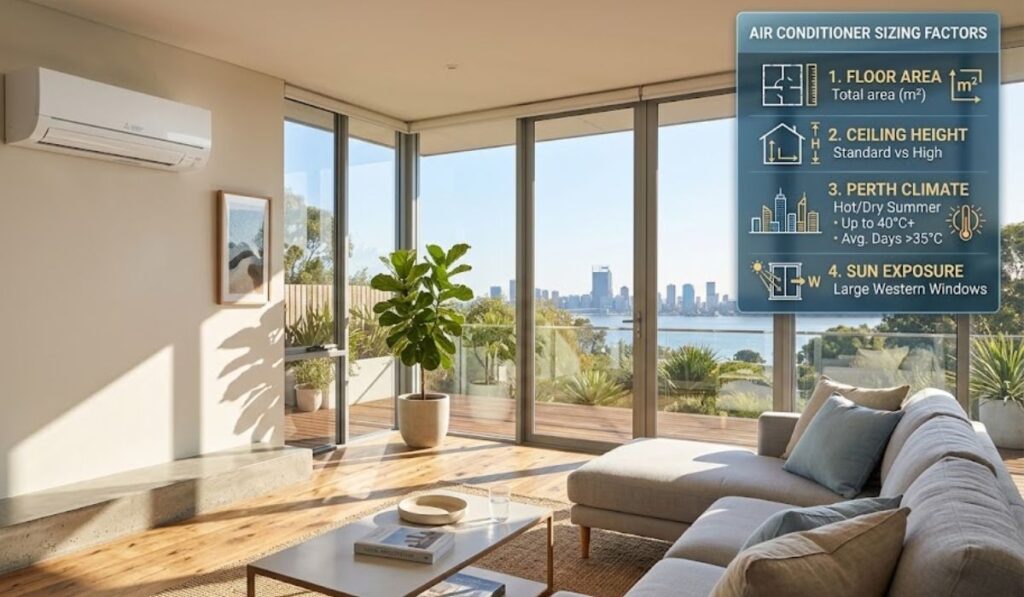

Choosing an air conditioner isn’t just about the type. Getting the size right matters just as much. Airconditioning in Perth that’s too small will struggle to cool your home, while one that’s too large wastes money and energy. For Perth homes facing hot summers, the right size makes a real difference to comfort and running costs.
It’s four in the afternoon in late January. The sun has been on the western windows since lunch, the floorboards are warm underfoot, and the split system in the living room has been running for hours. The air coming out is cold enough, but the room still feels stuffy and nobody wants to sit in it. Somewhere in the house, a meter is quietly ticking over.
Here’s a guide to working out what size air conditioner your Perth home needs.
Why Size Matters So Much
Capacity decides how well a unit can cool a space. Miss in either direction and you feel it, either in poor performance or in wasted money.
An undersized unit runs flat out and still can’t keep up when the heat builds. An oversized one costs more upfront and more to run, and it can switch on and off in short bursts without ever settling the room properly. Matching the size to the space is the whole goal.
The Size of the Space
The most obvious factor is the area you want to cool. A bigger room needs a more powerful unit, and a smaller one needs less.
What you’re cooling matters just as much as how big it is. A single bedroom, an open-plan living area and an entire home need very different capacities, so it helps to settle that question before comparing any models.
Ceiling Height and Layout
Floor area tells only half the story. You’re really cooling a volume of air, so ceiling height comes into it. Higher ceilings mean more air to cool and a higher capacity than a standard-height room would need.
Layout counts too. A wide open space that flows into the kitchen and hallway behaves very differently from a closed-off room with a door. Measuring the floor and stopping there leaves a lot out.
Windows and Sun Exposure
Windows can let in a surprising amount of heat, and Perth has plenty of sun to send through them. Rooms with large windows or heavy direct sun heat up faster and need extra capacity to compensate.
Which way the room faces is worth a thought. A room that cops the afternoon sun asks far more of an air conditioner than a shaded room of exactly the same size.
Insulation and the Home Itself
A well-insulated home holds on to cool air and puts less strain on the unit. A poorly insulated one lets that air escape, so the system works harder to make up the difference.
Construction and shading play a role as well. Two houses with the same floor area can have quite different cooling needs, which is why the whole home should be considered, not just the room dimensions.
Perth’s Climate
Perth’s summers are hot, and your air conditioner has to manage the worst days, not only the average ones. Sizing for local conditions means the unit can still keep you comfortable when it’s under the most pressure.
A system that’s fine in a milder climate may struggle through a Perth heatwave. A capacity chosen for local conditions is what keeps the cooling dependable when you need it most.
Why Professional Sizing Helps
With this many factors, it isn’t something to guess at. A professional can assess your space, your home and how you use it, then calculate the capacity that actually fits.
That removes the guesswork and helps you avoid the costly mistake of an undersized or oversized unit. It’s also reasonable to ask how they arrived at their recommendation, since understanding the reasoning makes quotes much easier to compare.
Getting It Right
Sizing an air conditioner for your Perth home means weighing the space, the ceiling height and layout, the windows and sun, the insulation and the local climate. Each one shapes the capacity you need.
Rather than guessing, get proper advice and size the system correctly. Do that, and the four o’clock scene in late January looks very different: a cool, settled room and a power bill you can live with.


