
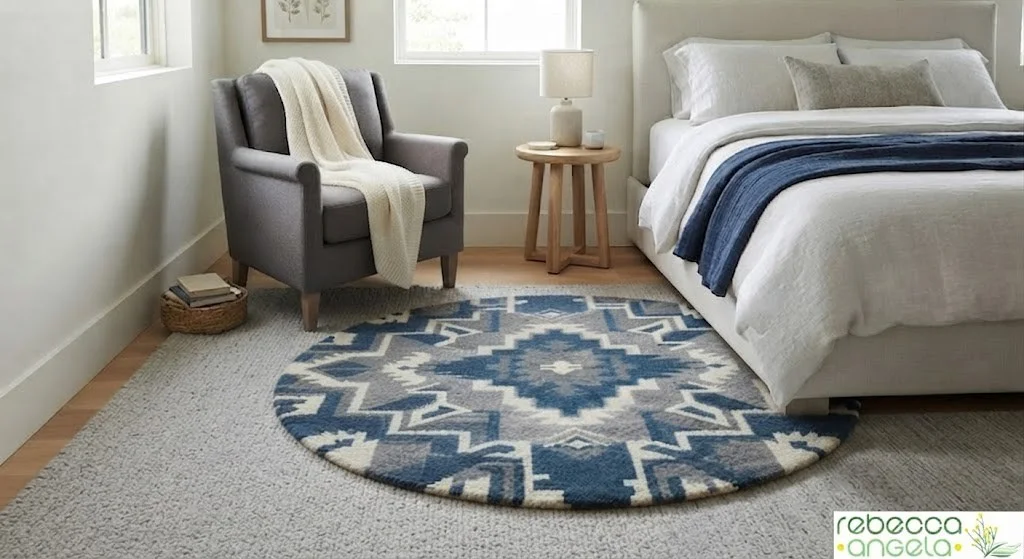

Why a Round Wool Rug Changes a Bedroom More Than You’d Expect
A rug gets treated as an afterthought in a lot of bedrooms — something to fill the gap between the bed and the wall once everything else is chosen. That’s backwards for a round wool rug specifically. Shape and material both change how a room reads, and wool in particular earns its place for reasons that have nothing to do with looks.
Benefits of Using Wool Rugs Over Other Materials
Synthetic fibres and cotton have their place, but wool holds up to daily wear in a way most alternatives don’t. It resists staining and moisture better than people expect, and it doesn’t flatten or fade the way cheaper fibres do under a few years of foot traffic. It also insulates — genuinely holds warmth underfoot in winter, stays comfortable rather than sticky in summer. In a bedroom, where bare feet hit the floor more than almost anywhere else in the house, that difference is felt daily rather than admired occasionally.
Traditional or Modern, Natural or Synthetic

Shopping for a round wool rug for cozy areas usually means picking a lane between two decisions that get lumped together but aren’t really related.
One is style: traditional designs lean into detailed patterning and richer, more layered colour, while modern designs tend toward bolder or more abstract shapes that read cleaner in a contemporary room. Neither is objectively better — it depends entirely on what’s already in the space.
The other is material honesty. Natural wool, sourced from sheep’s fleece, costs more but delivers on softness and durability in a way synthetic blends generally can’t match. Synthetic isn’t a bad option — it’s a budget one, and a reasonable one if the rug is getting replaced every few years anyway. It’s just a different product being sold under a similar name, and worth knowing which one you’re actually buying.
How to Choose the Right Size of Rug for Your Bedroom
Rug sizing mistakes are common enough that it’s worth measuring properly before falling for a pattern or colour. Start with the room itself — furniture layout first, rug second. As a rough rule, leave around 18 inches of visible floor between the rug’s edge and the walls; it keeps a room from feeling either cramped or oddly empty.
Larger bedrooms can support a rug big enough to sit fully under most of the furniture. Smaller ones usually work better with just the front legs of the bed resting on the rug, or a smaller round shape tucked between bedside tables rather than stretching to cover the whole floor. Forcing a large rug into a small room tends to shrink the space rather than warm it up.
Tips for Selecting the Perfect Color and Pattern of Cool Rugs for Bedroom Decor

Choose cool rugs for the bedroom with the existing colour scheme in mind rather than picking whatever looks best on its own — a rug that fights the walls or the bedding rarely settles into the room the way it’s meant to.
It helps to decide early whether the rug is meant to be noticed or meant to disappear into the background. A smaller rug in a bolder pattern works as a genuine accent piece, drawing the eye without dominating the floor. A larger rug in a simpler design does the opposite job — it grounds the room without competing for attention.
Busy walls or strong existing colours generally call for a quieter, more neutral rug underneath them. Plain walls and simple furniture are where a round wool rug gets to do more of the visual talking — bolder colour, more pattern, without the room feeling overloaded.
Mixing shapes is worth considering too, even though it’s the one most people skip. A round rug layered with a rectangular one nearby — under a reading chair, say, rather than trying to cover the same footprint — adds depth that a single rug on its own usually can’t manage.
How to Properly Care for and Maintain Your Round Wool Rug
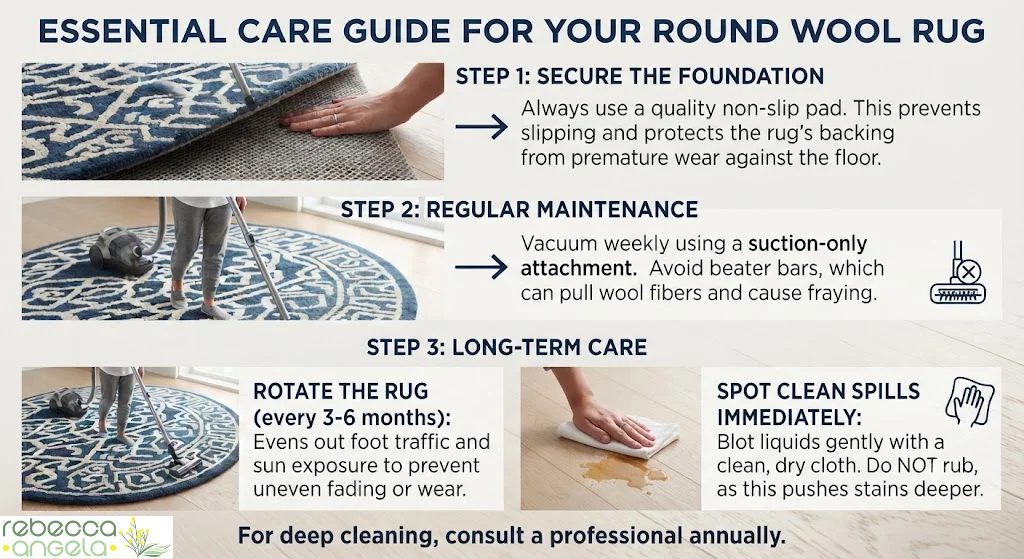
Wool holds up well, but it still needs basic upkeep to stay that way.
Regular vacuuming keeps dust and debris from working their way down into the fibres, where they do more damage than dirt sitting on the surface. A non-slip pad underneath does two jobs at once — stops the rug shifting underfoot and takes some of the wear off the backing. Rotating the rug every few months evens out foot traffic and sun exposure that would otherwise fade or flatten one section faster than the rest.
Spills need attention immediately, not eventually — blot rather than rub, since rubbing pushes the stain further into the fibres instead of lifting it out. Beyond that, day-to-day care is mostly vacuuming and rotation; a professional clean once a year handles what regular maintenance can’t reach.
A Rug Worth Getting Right
A round wool rug isn’t just filling space next to the bed. Done properly — right size, right colour relationship to the room, right material for how the space actually gets used — it’s one of the few pieces in a bedroom that changes how the whole room feels underfoot, not just how it looks from the doorway.