
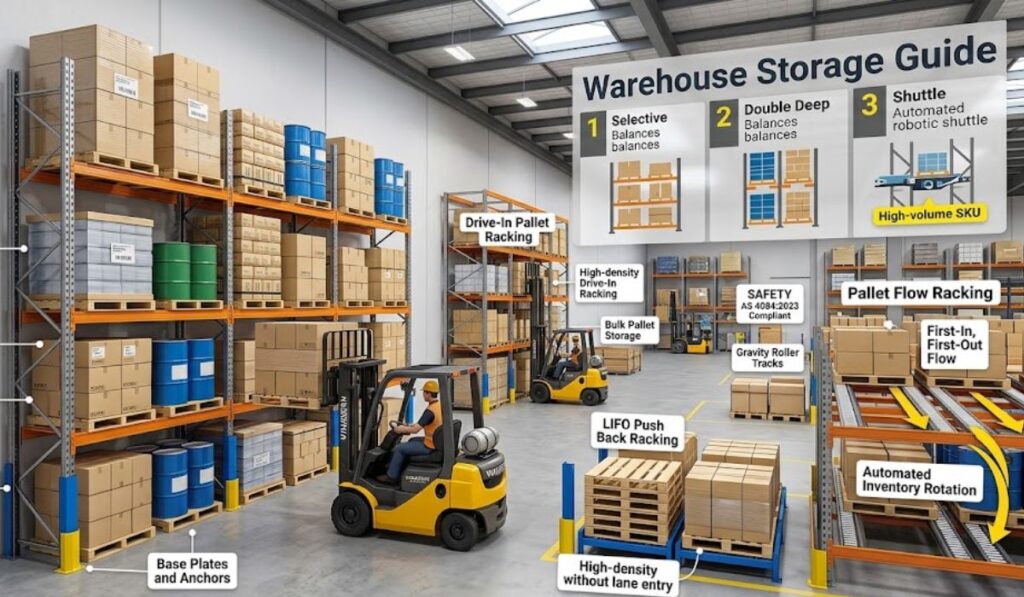

Pallet racking is one of the most widely used storage solutions in Australian warehouses and distribution centres, and for good reason. Vinatech Australia explains what it actually is, how it works, the common types available, and what businesses should weigh up when planning a warehouse storage solution that genuinely fits how they operate.
What Is Pallet Racking?
Pallet racking is an industrial storage system designed to hold palletised goods across multiple horizontal levels, supported by steel upright frames. It lets businesses make proper use of warehouse height while keeping pallets organised and accessible to forklifts and other material handling equipment, rather than stacking everything at ground level and hoping for the best.
Depending on the racking configuration chosen, a warehouse can prioritise different operational goals, including direct access to individual pallets, higher pallet storage density, FIFO or LIFO inventory rotation, faster loading and retrieval, reduced forklift travel, better use of warehouse height, and integration with semi-automated or automated handling systems.
For that reason, pallet racking shouldn’t really be thought of as just steel storage infrastructure sitting in the background. Its configuration directly shapes warehouse capacity, forklift movement, inventory accessibility, and overall operational efficiency, sometimes more than any other single decision in the facility.
Common Types of Pallet Racking
No single racking system suits every warehouse. Each configuration creates its own balance between storage density, pallet accessibility, inventory rotation, and handling requirements, and picking the wrong one usually shows up as a bottleneck somewhere down the line.
1. Selective Pallet Racking
Selective pallet racking is one of the most common and versatile warehouse storage systems around. Pallets are stored one position deep, giving forklift operators direct access to every pallet location without having to move anything else first.
Best suited for warehouses with multiple SKUs, fast-moving inventory, distribution centres, 3PL operations, and businesses that genuinely need high pallet accessibility over raw density.
2. Double Deep Pallet Racking
Double Deep racking places pallets two positions deep instead of one. By cutting down on the number of forklift aisles needed, it can offer greater storage density than standard Selective racking, though at the cost of direct access to every single pallet.
Best suited for medium SKU ranges, multiple pallets per SKU, warehouses after higher density, and operations that can tolerate somewhat reduced direct pallet access.
3. Drive-In Pallet Racking
Drive-In pallet racking is built for high-density storage specifically. Rather than working from a conventional aisle, forklifts drive into dedicated storage lanes within the racking structure itself to place and retrieve pallets.
Best suited for bulk pallet storage, low SKU counts, large quantities per SKU, cold storage, and food and beverage operations where density matters more than picking individual pallets quickly.
4. Push Back Pallet Racking
Push Back racking stores multiple pallets deep on inclined rails or nested carts. When a new pallet loads in from the front, the existing pallets get pushed backwards automatically. When the front pallet gets retrieved, the remaining pallets roll forward toward the picking face on their own.
Best suited for high-density storage, multiple pallets per SKU, LIFO inventory management, and warehouses wanting density without forklifts having to enter the rack structure itself.
5. Pallet Flow Racking
Pallet Flow racking, also known as gravity flow racking, uses inclined roller tracks to move pallets from the loading side through to the retrieval side automatically.
Goods get loaded from one end and retrieved from the other, which makes the system particularly effective for First-In, First-Out rotation. Best suited for food and beverage, FMCG, pharmaceutical products, perishable or date-sensitive goods, and high-throughput distribution operations that live and die by rotation discipline.
6. Shuttle Pallet Racking
Shuttle pallet racking combines high-density pallet storage with a battery-powered shuttle that moves pallets within deep storage lanes on its own. Instead of forklifts travelling into the racking structure directly, the forklift positions pallets at the lane entrance while the shuttle handles transporting them to the right storage location.
Best suited for high-volume pallet storage, large quantities of similar SKUs, cold storage facilities, high-throughput distribution centres, and operations actively moving toward warehouse automation.
What Are the Main Components of Pallet Racking?
Most warehouse pallet racking systems are built from a handful of core structural and safety components.
Upright frames form the vertical structure of the rack, typically built from upright columns connected by horizontal and diagonal bracing. Their exact specifications depend on rack height, load requirements, and overall system configuration.
Load beams are the horizontal structural members that connect the upright frames and create the actual storage levels for pallets. Beam specifications depend on pallet loads, beam span, and rack configuration.
Base plates and anchors connect the uprights to the warehouse floor and secure the racking structure to the concrete slab beneath it.
Bracing covers the horizontal and diagonal members that connect the upright columns and add to the stability of each frame.
Beam connectors and safety locks connect beams to the upright frames and help stop beams from being unintentionally dislodged during day-to-day warehouse operations.
Rack protection, things like column guards and upright protectors, helps reduce damage from forklift impacts, which happen more often than most warehouse managers would like to admit.
Safe working load signage displays the designed load limits and rack configuration, helping operators keep the system within its specified capacity rather than guessing.
How to Choose the Right Warehouse Pallet Racking
Choosing between different warehouse pallet racks should start with the operation itself, not the rack. Before settling on a system, it’s worth working through:
- Pallet dimensions and weight — the rack has to be designed around the actual pallets and loads being stored, not a generic assumption.
- SKU profile — a warehouse handling hundreds of SKUs requiring direct access needs a very different configuration from one storing thousands of identical pallets.
- Inventory turnover — fast-moving products generally need greater accessibility, while slower-moving bulk stock benefits more from higher-density storage.
- FIFO or LIFO requirements — these shape which systems make sense, influencing whether something like Pallet Flow, Push Back, or Drive-In racking is actually appropriate.
- Forklift type — reach height, turning radius, and equipment capability all directly affect aisle dimensions and rack configuration.
- Warehouse clear height — effective racking design accounts for usable vertical space, not just floor area.
- Columns and building constraints — structural columns, doors, fire services, pedestrian routes, and other building elements all need incorporating into the layout.
- Future growth — storage requirements change over time, so a warehouse layout should consider potential changes in stock volume and operations, not just current pallet numbers.
The goal was never simply cramming in as many pallet positions as physically possible. An effective design balances storage capacity, accessibility, material flow, and operational requirements, similar to how vertical storage gets used to maximise available space in other storage environments entirely.
Where This Leaves You
Choosing the right pallet racking system really comes down to matching a configuration to how a warehouse actually operates, not fitting the operation around whatever rack looks impressive on paper. A good provider will work through building dimensions, pallet loads, clear height, structural columns, forklift aisles, and future growth before recommending anything, often visualising the proposed layout in 2D or 3D so the design can be reviewed before installation begins.
In Australia, applicable pallet racking systems should be engineered in line with AS 4084:2023, which sets out the relevant requirements for safe, dependable warehouse storage, something Vinatech Australia designs its racking systems around as standard practice. Whether the project is a new facility, an expansion, or fixing a storage layout that’s stopped working, the process should start with actual warehouse dimensions and operational requirements, not a rack catalogue.


