
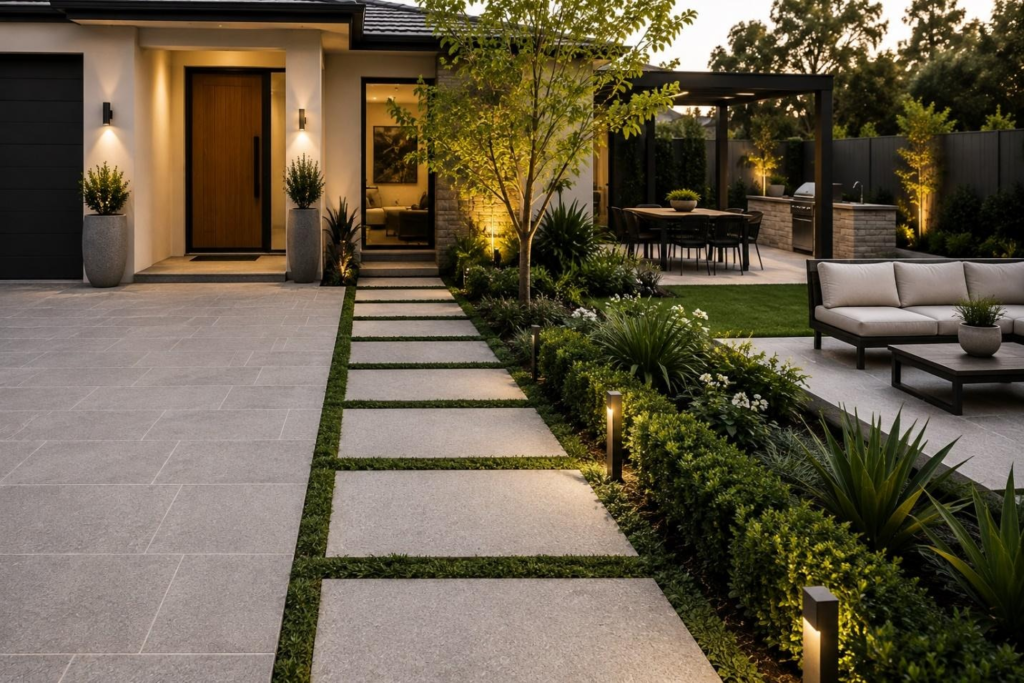

Ever walked around a property and felt like something was a bit off, without being able to say exactly what? Nine times out of ten it’s not the plants, and it’s not the furniture either. It’s what’s underfoot. A driveway in one finish, a path in another, a patio that looks like someone else designed it entirely. On their own each bit might look fine. Put together, they read as three or four separate decisions rather than one home.
Once you notice it you can’t really unsee it.
The fix usually isn’t adding more. Most of the time it’s the opposite. Fewer materials competing for attention, and a bit more thought behind the ones that stay.
Start With One Material Family Instead of Mixing Too Many
A pattern I keep running into: concrete on the driveway, brick along the path, timber sleepers around the garden bed, pavers on the patio. Nothing there is technically wrong. It just doesn’t settle anywhere.
Natural stone gets around this because granite, limestone and sandstone already share a lot of the same tonal ground. You can mix two or even three types across a property and it still reads as connected rather than matchy. That’s really the aim: connected, not identical. Everything in the exact same tile tends to look flat after a while. Related but not identical tends to look like someone actually planned it.
Granite floor tiles work well in covered spots, like alfresco dining areas or a patio that gets used through summer. They cope with foot traffic, they don’t turn into a hot plate underfoot the way some darker stone does, and there’s enough range in finish that you’re not stuck picking between too glossy or too rough.
Cobblestone pulls more weight than it gets credit for
It gets filed under “decorative” a lot, which undersells it. It’s one of the few materials that can tie a whole property together without being loud about it.
On a driveway it’s usually the first thing anyone notices, so it ends up setting the tone for everything that comes after. On an entry path it does the same functional job as concrete or pavers but with a bit more character in it. Along garden borders it holds an edge cleanly, which matters more than people expect. Anyone who’s had a garden bed slowly bleed into the lawn knows why a defined line is worth having.
Courtyards are maybe where it works best. They’re meant to feel calm, somewhere you’d actually sit rather than just pass through, and cobblestone gives that texture without cluttering the space visually. If you’re looking to source it, a cobblestone pavers supplier in Sydney will usually have enough tone and size variation to match whatever’s already on the property, so you’re not starting the whole palette from scratch.
Match the colour rather than the stone itself
A lot of people assume every zone needs the exact same stone to look finished. In practice that’s rarely true, and pushed too far it can actually make a place feel sterile.
Tone matters more than product. Cream, beige and sandy shades sit next to each other fine even when they’re different materials. Same with greys. Light, medium and charcoal can spread across different areas of a property without clashing, as long as the undertone stays consistent. Texture works the same way. A smooth granite tile on the patio next to a coarser sandstone on the path isn’t a conflict, it’s just two surfaces doing different jobs in a similar colour range.
Give Every Outdoor Zone Its Own Purpose
Not every outdoor area gets used the same way, so it doesn’t make sense to finish them all the same way either.
Entertaining areas see a lot of foot traffic and furniture being dragged around, so something smoother is the practical choice, easier on bare feet and easier to clean. Garden walkways can afford more texture since nobody’s wheeling a dining table across them; a bit of grip actually adds something to the walk. Driveways take the most punishment, cars, weather, years of use, so durability has to come first there, though the better stones don’t really force you to trade that off against how it looks.
Create Small Feature Spaces Without Breaking the Theme
A fire pit, a reading nook, a water feature, maybe a stone ring around a specimen tree. These are the details that give a garden personality. But treat each one as its own little design project and you can unravel everything else you’ve built.
One accent stone, kept close to the rest of the palette, is usually plenty. You don’t need a new material every time you add a feature. Restraint here is what makes a garden look like it was planned rather than assembled over a few unrelated weekends.
Where this leaves you
A connected property isn’t really about using one material everywhere. It’s about choosing materials that were clearly thought about together. Natural stone makes that easier than most alternatives, since it naturally comes in families that share colour and character without being identical.
Give each area a clear job, keep the tones talking to each other, and hold back on introducing something new every time you add a feature. Stone types, finishes and how well something holds up can all shift depending on the project, the climate and how a space actually gets used day to day, so it’s worth running the specifics past a supplier or landscaper before committing to anything.

