
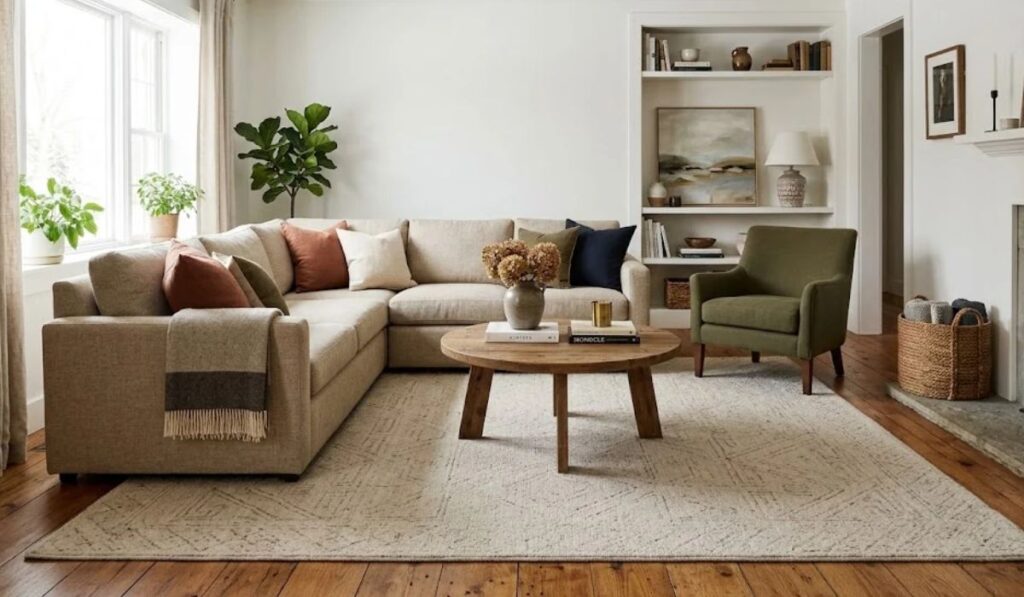

Walk into enough living rooms and you start spotting the same thing. A rug roughly the size of a beach towel sits stranded in the middle of the floorboards, with the sofa pushed back against one wall and the armchair hiding in a corner as if they’d had a falling out. Nobody sets out to do this. It’s usually the result of buying the rug that was on sale, in the size that looked “big enough” on the website, at about eleven o’clock on a Sunday night. I’ve done it myself.
Rugs are weirdly hard. They’re big, they cost enough that a dud stings, and the one on your phone is never quite the one the courier leaves at the door. To make this concrete, picture a fairly ordinary rental: two bedrooms, scuffed Tassie oak boards, a three-seater off Marketplace, an armchair somebody’s nan donated and a kelpie who sheds like it’s a full-time job. We’ll work through it from there.
Size Comes Before Pattern
Pattern is the fun part, so of course that’s where everyone starts. Size is what makes or breaks the room, though, and in our example house the rug almost certainly needs to be bigger than whatever number first comes to mind.
Many stylists work to one rule, and it’s a good one. The front legs of the sofa go on the rug, and the armchair’s too, and suddenly the pieces look like they belong together. Leave a strip of bare boards around the edge, somewhere between 30 and 45 centimetres. Any less and it starts to look like carpet that went through a hot wash.
For the Marketplace three-seater, that works out to about 200 x 300. I’ve seen small Fitzroy apartment lounges get away with 160 x 230, because the couch legs only just made it on. If you’re torn between two sizes, go up. It’s very rare to hear anyone wish their rug were smaller.
Mark Out the Shape With Tape
Honestly, 200 x 300 is just two numbers until it’s on the floor. Grab some painter’s tape from Bunnings, or on carpet use cushions and a few paperbacks as corners, and mark it out. Leave it down for a couple of days. Sit on the sofa with a cup of tea and look at it. Walk in from the hallway. Open the door that swings into the room.
You’d be surprised what turns up. The front door might catch the corner every time. The coffee table might end up well off centre. Or the edge might land exactly where the robot vacuum likes to get itself stuck, which it will then do every morning for the next five years. A couple of days with tape on the floor is the cheapest mistake you’ll ever make.
Fibre and Pile for the Way You Live
What the rug is made of matters more than whether it’s this year’s colour, and the answer depends on who’s actually walking on it.
Wool is the dependable choice for most living rooms. It’s soft, it copes with spills better than you’d expect and furniture dents tend to spring back, although a new wool rug will shed for a few months and fill the vacuum canister alarmingly. Jute and sisal look wonderful in a relaxed, coastal sort of room, but they’re scratchy on bare feet and don’t love a knocked-over glass of red. Cotton flat-weaves are light and often machine washable, which is handy in a casual space, even if they’re not especially long-lived. Then there’s polypropylene: cheap, tough and a favourite with families who have toddlers and a golden retriever, even if it can look a little plasticky up close.
Pile height is the second question. Deep shag is heaven on bare feet until the kelpie moults into it and someone drops Vegemite toast face down. Low pile and flat weaves are easier: one pass with the vacuum and done, and doors glide over them. After-school snacks tend to get eaten on the lounge floor in front of Bluey whether you allow it or not, so dark or patterned low pile it is.
Colour and Pattern: Check Them in Your Own Light
Then there’s colour, which is honestly where online shopping falls over. Soft terracotta in a thumbnail becomes brick orange across six square metres of floor, and it happens all the time. Pale grey is another trap. In a south-facing Hobart lounge in June, under whatever cool white downlights the landlord fitted, it goes about as cheerful as a wet bus shelter.
Seeing a rug at real scale in an actual room helps heaps. Many rug brands now show each design under a sofa or down a hallway, and a fair few of those room shots come from carpet rendering rather than a photo shoot, which is how one design gets shown in eight colourways without hiring a studio eight times. It’s a useful guide to scale and mood. Flick between those images and the flat top-down shot to judge the size of the pattern, but remember they’re a picture, not the product, and the colour on your screen will vary with the screen.
Even so, nothing beats a sample. Put it where the rug is going and look at it over breakfast, again around four in the afternoon once the sun has moved round, and after dinner with the lamps on. Bold, large prints want space and a plain couch. Small, busy ones can look fussy from the doorway, but they’re unbeatable for hiding muddy kelpie prints.
Don’t Skip the Underlay
It sounds like an upsell. It isn’t. Without an underlay the rug creeps across the boards a centimetre at a time, the corners curl and grit underneath slowly sands the finish off your floor, which anyone who has lifted an old rug at the end of a lease will recognise. Get the underlay a few centimetres smaller than the rug so it stays hidden. If you’re renting or have a delicate floor finish, check the underlay is suitable for that surface, since some types can mark certain finishes.
Before You Hit Order
Go back to the tape one more time. Do the sofa legs sit on the rug? Does the fibre suit the dog, the kids and the housemate who never takes their boots off? Have you actually seen the colour in your own home? Read the returns page as well, because posting a 200 x 300 rug back costs a bomb and some shops refuse anything that’s been unrolled.
Do all that and the rug should still be on the floor in five years, not rolled up in the garage next to the old futon by autumn.

