
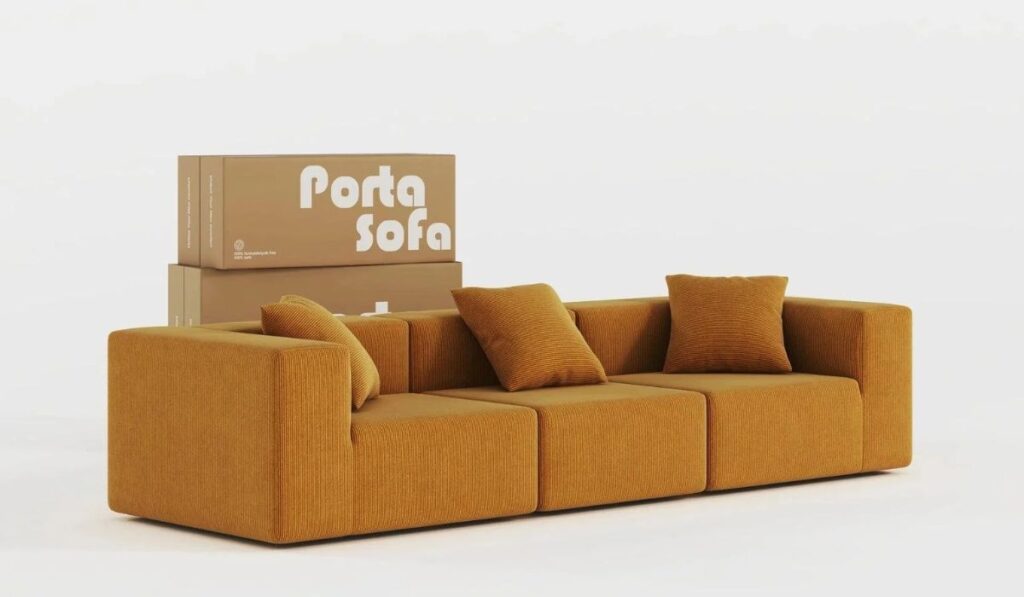

Two people are stuck on the third-floor landing, a three-seater wedged at the turn of the stairs, and neither wants to say what happens if it won’t budge. Downstairs, a neighbour carries the same kind of sofa up in a few manageable boxes without breaking stride. That contrast is the whole argument for a compressed sofa, and it’s why the format has caught on in flats.
Renters and apartment owners in Australian cities know the problem well. Older walk-ups have narrow landings, newer blocks have lifts that must be booked, and a rigid frame leaves no margin for error. Once the delivery question is solved, the real one is whether the sofa itself is any good.
Plenty of compressed sofas aren’t. That’s where the format either earns its reputation or loses it.
How a compressed sofa gets through the tightest doorway
A conventional sofa travels fully built, so it has to be tilted, pivoted and sometimes stood on end to clear a corner. A low ceiling or a handrail makes that geometry brutal. When the manoeuvre fails, the choices are a crane, a balcony or a return trip to the shop.
A compressed design avoids the fight. The foam is the part that gets squeezed into the box, and it expands back towards its full shape once everything is inside the room. A box a person can manage on the stairs will usually fit through a door that stops a finished sofa dead.
Weight is the other half of the story. Compressed doesn’t mean light, and a carton holding part of a three-seater can still be a two-person carry. Ask the seller for the carton weight and dimensions, and decide who’s lifting and where the boxes will rest on the way up. Lift with a second person, bend your knees and don’t carry a heavy carton alone up a staircase.
Some modular ranges are built around this idea. The seller of the range linked above describes a minimalist square design with compressed packaging for easy transport and no assembly, using high-density cold foam modules that expand once they’re out of the box. That’s the seller’s description, so it’s worth confirming the details for the exact pieces you plan to buy.
Ahead of delivery day, walk the route the boxes will take and run through a few checks:
- Measure the narrowest point on the route, usually a stairwell turn or a door frame, then compare it with the carton size the seller quotes.
- Book the lift or loading zone if your building requires it. If you live in a strata building, check the by-laws or ask your building manager about moving times and any bond.
- Clear more floor than the finished sofa needs, because unboxing and unrolling the modules takes space.
- Leave time for the cushions to open out. Compressed foam takes a while to reach full shape, so don’t judge the seat in the first hour.
- Open the room’s windows while unboxing. New foam can have a smell at first, and good airflow helps it fade.
What compressed sofa Australia buyers can expect from a modular range
Australian homes make a tough test. Many people rent, move every couple of years and live in blocks with strict rules about when furniture can go up or down. A sofa that turns up in cartons suits that way of living far better than one that needs a crew and a closed lane.
The range linked above is a useful reference for what modular systems can offer. It’s listed as including single seats, ottomans, middle sections and both two- and three-seat sofas, so a lounge can grow in stages. For a renter, that can mean a sofa that suits a one-bedroom today and can be extended after the next move. Availability and pieces change, so check the current range before you plan around a particular add-on.
Layout is worth sketching before you buy. A three-seater and an ottoman can sit as one long run along a wall, or the pieces can be split to define two zones in an open-plan room. Tracing the footprint with masking tape on the floor shows quickly whether the proportions work, and whether you’ll still have room to walk past.
Finish matters as well, since a boxed sofa is judged by what comes out of it. The three-seater in that range is described as fine-ribbed corduroy, which gives a plain square shape some texture. Corduroy suits many rooms, but ribbed fabric can collect crumbs and pet hair, so ask about care instructions before you commit, and request a fabric sample if the seller offers one.
What defines the best compressed sofa Australia has to offer
Searches for the best compressed sofa tend to return a wall of price tags. Price alone says little, because a bargain and a good buy can look identical online and part ways within a few months.
In practice, a good compressed sofa is one whose foam recovers fully, whose shape holds and whose fabric still looks tidy after a year of Sunday afternoons. Four checks help separate a well-made one from a disappointment:
- Foam that bounces back. Ask how dense it is and how quickly it recovers, because slow recovery shows up as sagging seats.
- A shape that holds. Seats and arms should stay firm and not sag when someone perches on the arm.
- Fabric described plainly. A named material such as fine-ribbed corduroy tells you more than vague wording like “premium fabric”. If a listing can’t say what the cover is made of, ask.
- Pieces you can add later. This suggests the maker is designing a system rather than a one-off.
Returns and warranty terms deserve a careful read as well, since foam and fabric can’t be judged from a photo. Under the Australian Consumer Law, products must be of acceptable quality, but a change-of-mind return is up to the seller’s own policy, and repacking a sofa into its compressed cartons isn’t always practical. Check what happens if something arrives damaged, who pays for return freight and how long you have to report a problem.
Where product pages describe their foam as high density, treat it as a starting point and not a guarantee. Exact foam density often isn’t listed, so ask for it, as you would with any seller, and read independent customer reviews that mention how the sofa looked after several months.
Where compressed sofas fall short
A sofa that ships compressed isn’t magic. Foam needs time to expand, so some pieces look their best a day or two after unboxing. If you’re hosting dinner the night it arrives, that’s worth knowing.
Some compressed sofas leave assembly to you, while others need none, but unboxing still calls for a clear patch of floor and a calm stretch of time. Taste matters too. Someone after a deep, heavily curved, overstuffed sofa may find a minimalist square design firmer and cleaner-lined than they expected.
Set side by side, the trade-offs are fairly clear:
- Delivery gets easier, most noticeably in walk-ups, small lifts and any building where a sofa has to turn a corner.
- Setting up still needs planning, because the foam needs time to settle, ideally before guests are booked.
- The look is particular, so if you want deep, curved seating, check the shape closely before you order, and if you can, sit on a similar sofa in a showroom first.
Before ordering, note the narrowest point on the delivery route, the floor space where the sofa will sit and a free afternoon for unboxing it and letting the foam expand. With those in hand, it’s much easier to compare ranges honestly and pick the one that will still feel right when the next move comes around.

