
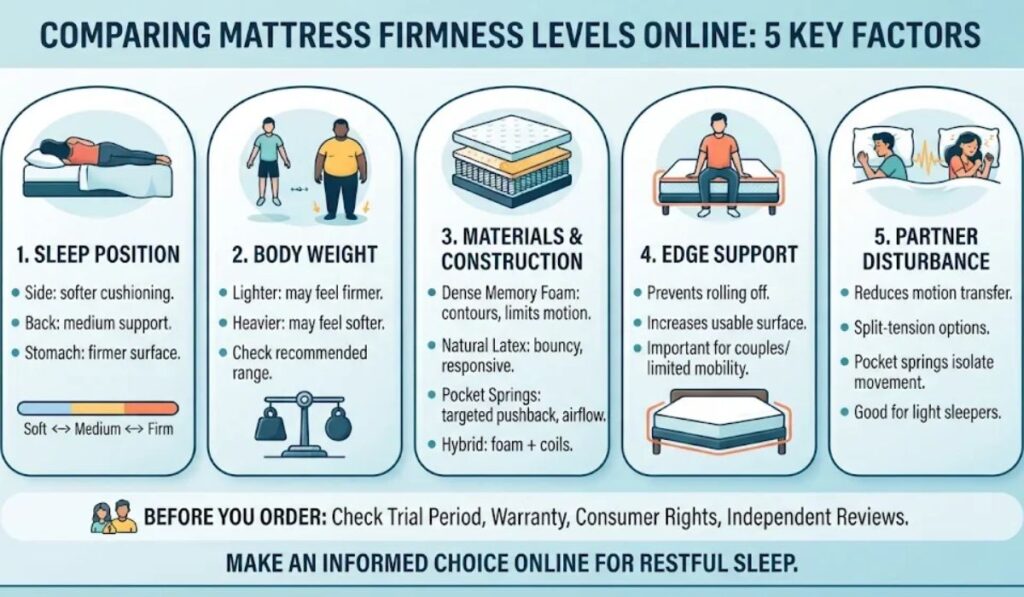

Choosing a bed you can’t lie on first takes some careful research. Plenty of people sleep badly because the surface under them doesn’t suit their body, and a poor match can leave you restless or waking up stiff. Understanding the different support structures makes it easier to avoid the guesswork, though it’s worth saying that firmness is personal and no specification can guarantee comfort.
Shopping online gives you a wide selection, but you need to know which details matter. Here are five practical things to check when comparing firmness levels.
1. Evaluating Your Primary Sleep Position
The way you usually sleep affects how much resistance your body needs. As a general guide, side sleepers often prefer softer cushioning to relieve pressure on the hips and shoulders. Back sleepers tend to do well with medium support that keeps the spine aligned and supports the lower back. Stomach sleepers usually need a firmer surface so the hips don’t sink down overnight.
Many retailers let you filter options by sleep position, and browsing an online mattress store can make that comparison quicker. Treat the categories as a starting point, because plenty of people change position through the night. If you move around a lot, a medium feel is often the safest compromise.
2. Assessing Your Body Weight Distribution
Body weight changes how a mattress responds. Lighter people often find a standard medium bed too firm because they don’t sink in enough. Heavier people sink deeper into the top layers, which can affect spinal alignment on softer beds.
That’s why firmness ratings need interpreting. A “firm” rating can feel more like a medium to a heavier sleeper, and firmer to someone lighter. There’s no industry-wide scale, so one brand’s “medium” may not match another’s. Read the description and the reviews from people of a similar build, and check whether the retailer lists a recommended weight range.
3. Reviewing Material Construction Types
Different internal materials give different kinds of resistance and contouring. The construction affects how the bed adapts to your body through the night, and manufacturers combine layers to achieve a particular feel. Here’s how the common types compare.
- Dense memory foam: contours to the body and tends to limit motion transfer, which can suit restless sleepers. Some people find it warm.
- Natural latex: offers responsive, bouncy support that resists deep sinking.
- Pocket springs: give targeted pushback and allow airflow through the mattress.
- Hybrid designs: combine foam or latex comfort layers with a supportive coil base.
Each has trade-offs in price, weight, temperature and durability, and none is best for everyone. If you have allergies or sensitivities, check the materials and any certifications the manufacturer claims.
4. Checking Edge Support Features
A soft mattress often lacks strength around the perimeter. If you sit on the side of a soft bed to put on your shoes, the edge may compress, and poor edge support reduces the usable sleeping area and can create a rolling feeling near the sides.
High-density foam encasements or thicker perimeter coils add stability at the edges, which lets you sleep closer to the side and gives you a firmer place to sit. It can also affect how well the mattress holds up over time. Edge support matters most for couples, for people with limited mobility who sit on the bed to get up and for smaller bedrooms where every centimetre counts.
5. Examining Partner Disturbance Factors
Couples often disagree, with one preferring a firm surface and the other softer cushioning. A continuous coil system also passes movement across the bed when someone turns over. Finding a balance means both people can sleep without waking each other.
Features that can reduce movement transfer while keeping support include:
- Split-tension designs: allowing different firmness levels on each side of the same bed.
- Independent pocket springs: absorbing movement locally so it doesn’t ripple across the surface.
- Thick comfort layers: dampening sudden movements before they reach the support core.
- Responsive memory foam: absorbing impact while contouring to different body shapes.
Before You Order
A few extra checks reduce the risk of an expensive mistake when you can’t try the bed in person.
- Trial period and returns: read the policy carefully. Some retailers offer a sleep trial, but conditions such as fees, minimum trial lengths and return rules vary.
- Warranty: check what’s covered and what voids it, such as the base or the way the mattress is supported.
- Your consumer rights: under the Australian Consumer Law, a product must meet consumer guarantees, but a change of mind isn’t automatically covered, so don’t assume a refund.
- Independent reviews: look at reviews on sites the retailer doesn’t control.
- Give it time: a new mattress can take a few weeks to feel right, so allow an adjustment period before judging it.
If you have ongoing back, neck or hip pain, speak to a GP or physiotherapist as well. A mattress can influence comfort, but it isn’t a treatment for a medical condition.
Choose the Right Firmness for Restful Sleep
Buying a bed online removes showroom pressure and gives you a wide range to choose from. Comparing firmness descriptions against your sleep position and body weight, along with construction, edge support and partner needs, can help you avoid common mistakes. Treat the specifications as a guide, read the return terms and don’t rely on a single factor.
Take some time to think about how you actually sleep before making a final decision. Your own experience over several weeks is the best test of whether a mattress suits you.

