
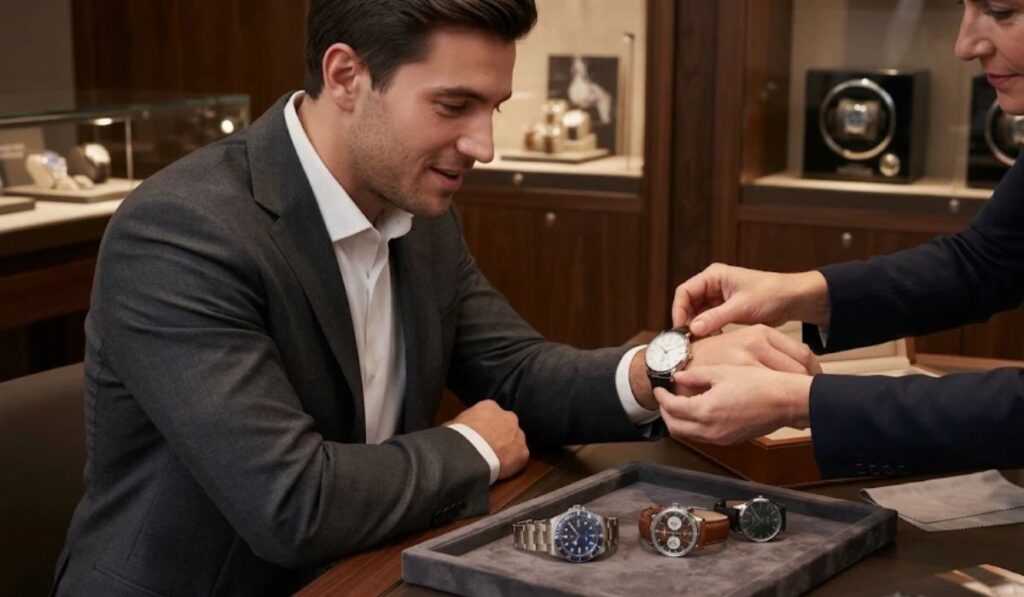

There’s something special about the moment you fasten a fine watch around your wrist for the first time. It feels different from a smartwatch or a fashion piece. The weight is reassuring, the details catch the light, and inside the case a lot of tiny parts are working together in rhythm. For many people, a first luxury watch marks a milestone: a promotion, a big birthday, a wedding, or simply years of hard work paying off.
Choosing one can feel overwhelming, though. There are hundreds of brands, thousands of models and plenty of jargon. This guide breaks down what to look for so you can find a piece that suits your style, your lifestyle and your budget.
Start With Your Personal Style
Before you think about brands, think about how you dress and how you live. A watch is an accessory you’ll wear almost every day, so it needs to feel like you.
If your wardrobe leans classic and polished, a dress watch with a slim case, a clean white or silver dial and a leather strap is a timeless choice. It slides under a shirt cuff and pairs well with tailoring.
If you prefer a relaxed, effortless look, a sports watch might suit better. Dive watches and chronographs tend to have bolder cases, steel bracelets and features such as rotating bezels. They work as well with denim and a linen shirt on the weekend as they do with a blazer at a long lunch.
For those who like to make a statement, there are coloured dials, gem-set bezels and unusual case shapes. Deep greens, rich blues and salmon tones have been popular in recent years, adding personality without going over the top.
Size matters too. Case diameters usually range from around 34 to 44 millimetres, and smaller wrists often suit cases under 38 millimetres, while larger wrists can carry something bolder. The best way to know is to try a few on and see what feels balanced. Browsing a range of luxury watches from an Australian specialist retailer is one way to compare styles and sizes side by side before you commit, ideally alongside a visit to a shop where you can try the watch on in person.
Understand What Makes a Watch Luxurious
Luxury in watchmaking is about more than a famous name. It comes down to craftsmanship, materials and the movement inside.
The movement is the engine of a watch. Quartz movements run on a battery and are very accurate, but many collectors prefer a mechanical watch, which is powered by a wound spring and a system of gears. Automatic movements are a type of mechanical movement that wind themselves with the motion of your wrist. Watching the smooth sweep of the seconds hand on a mechanical piece is part of the appeal. Mechanical watches are usually less accurate than quartz and need more care, so it’s a matter of taste as much as quality.
Materials matter as well. Most luxury watches use high-grade stainless steel, but you’ll also find gold, platinum, titanium and ceramic. Sapphire crystal, which is highly scratch resistant, is standard on quality pieces.
Origin plays a role in value and reputation. Watches marked Swiss made must meet legal requirements under Swiss law, which cover things such as where the movement is made, where the watch is cased up and inspected, and how much of the manufacturing cost is Swiss. Swiss brands have long set the benchmark for fine watchmaking, and Japanese and German makers also produce exceptional pieces with their own distinctive approaches.
Set a Budget and Shop Wisely
Luxury watches cover a huge price range. Entry-level Swiss automatics can be found for a few thousand dollars, while pieces from the most famous houses can cost tens of thousands or more. Setting a budget early keeps the search focused and enjoyable.
It also helps to think about value over time, with some care. Some models hold their value or even rise on the secondary market, particularly when demand outstrips supply, while others lose value once they leave the boutique. Past performance doesn’t predict the future, and a watch is best bought because you love it, not as an investment. If resale matters to you, research how a particular model has performed over several years.
Where you buy is as important as what you buy. Counterfeits are a real problem, and some are convincing enough to fool casual buyers. Choose reputable retailers that specialise in authentic pieces and give clear information about condition, papers and warranty. Check how returns, repairs and consumer guarantees are handled before you pay.
When buying pre-owned, ask about the service history, whether the watch comes with its original box and papers, and whether a qualified watchmaker has inspected it. Where possible, confirm the serial number and model details with the brand or an independent watchmaker.
Caring for Your Watch
A well-made watch can last for generations with the right care. Mechanical movements generally need servicing every five to ten years, depending on the brand and how often the watch is worn, and the manufacturer’s guidance is the best source for your model. A service involves cleaning, oiling and adjusting the movement so it keeps accurate time.
A few simple habits help day to day:
- Wipe the case and bracelet with a soft cloth to remove sweat and sunscreen.
- Check the water resistance rating before swimming, and make sure the crown is screwed down. Seals can wear, so have water resistance tested periodically.
- Keep your watch away from strong magnets, such as speakers and phone cases with magnetic clasps.
- Store it in a watch box or soft pouch when you’re not wearing it.
- If you own an automatic and don’t wear it daily, consider a watch winder.
Many collectors also keep a small notebook or digital record with purchase details, serial numbers and service dates. It’s useful for insurance, and it adds to the watch’s story if you ever pass it on. Check whether your home insurance covers a watch of that value, or whether it needs to be listed separately.
Choosing One That Means Something
The best luxury watch is the one that means something to you. It might mark a career milestone, celebrate a relationship or simply reflect your love of good design. Take your time, try on different styles and choose something you’ll be proud to wear.
Years from now, that watch will carry the memory of the moments you wore it through. That’s what makes a fine timepiece more than a way of telling the time.

