
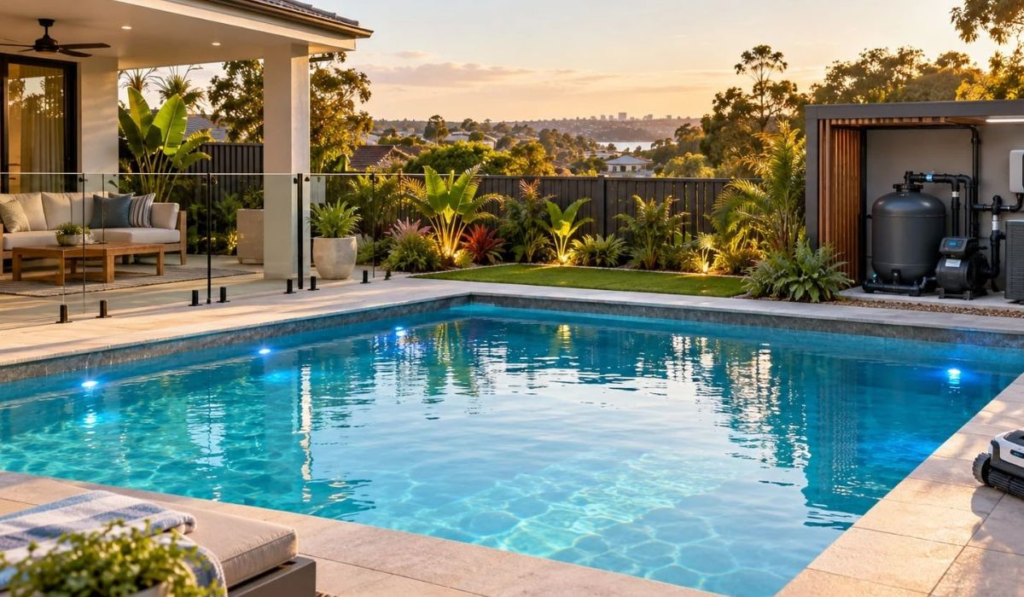

A pool shell in good condition doesn’t need tearing up just because the pool itself has stopped being enjoyable to use. If the structure around it is sound, an inefficient pump, an unreliable chlorinator or an outdated filtration system is often where the real improvement is hiding, not the tiles. Heating, robotic cleaners and automation can shift the whole experience too, without anyone touching the backyard layout or moving a single paver.
The part that actually matters is working out what the existing equipment does poorly, then choosing replacements that work with each other rather than against each other. Buying the newest pump or the most powerful heater without thinking about the rest of the system tends to end in unnecessary cost and a result that still disappoints.
Identify What Actually Needs Replacing
Worth starting with a proper look at the equipment area before planning anything. Most residential pools run a circulation pump, a filter and a sanitising system, with heating and automation layered in where the owner’s wanted it.
Each part does a different job, so the symptoms matter more than the guesswork. A noisy pump might have worn bearings, but noise on its own doesn’t prove the whole unit needs replacing. Cloudy water could point to weak filtration, poor circulation or a chemistry issue that has nothing to do with either. An ageing salt chlorinator might just have a worn cell rather than a genuinely failed controller.
The plumbing itself is worth a look too. Leaking valves, restricted pipework or equipment that’s simply configured wrong can cause problems even when the main components are perfectly fine. An honest assessment should sort out what’s actually faulty, what can be serviced, and what would genuinely benefit from being replaced, which saves the frustration of buying something new only to find the original problem is still sitting there.
Replace an Inefficient Pool Pump
The pump is usually the first thing worth assessing properly. A lot of older installations still run single-speed pumps, and a variable-speed replacement gives far more control over circulation, letting the pump run at different speeds depending on what’s actually needed at the time.
Running an appropriately sized pump at a lower speed can meaningfully cut electricity use compared with constant high-speed running, though how much depends on the hydraulic system, the hours it runs and what the connected equipment needs in terms of flow. Variable-speed pumps also tend to run quieter at lower speeds, which matters a fair bit when the equipment sits near a bedroom, an outdoor dining area or a neighbour’s fence line.
What to compare when buying a new pump
Starting from the pool’s actual circulation requirements makes more sense than choosing by motor horsepower alone. Worth considering:
- Flow and pressure. The pump needs to deliver suitable flow against the resistance of the installed plumbing and filter.
- Energy efficiency. Comparing the Australian Energy Rating Label and estimated annual electricity consumption helps, though label values come from standardised testing, so actual usage will vary.
- Equipment compatibility. Chlorinators, heaters and other connected components may need a minimum water flow to function properly.
- Noise. Published sound specifications are worth comparing where available, with operating speed taken into account.
- Serviceability. Warranty coverage, replacement parts and future maintenance access all matter more than they seem to at purchase time.
A larger pump isn’t automatically an upgrade. Excessive flow can create unnecessary pressure loss, waste electricity and push past the operating limits of other equipment in the system. If a pump’s still in good shape and properly matched to the pool, replacing it might not be the first priority at all.
Upgrade Filtration and Salt Chlorination Together
Filtration and sanitisation are closely linked, but they’re doing different jobs. The filter pulls suspended particles and debris out of the water. The chlorinator, or whatever sanitising system is in place, keeps the water safe by supplying disinfectant. Replacing one without looking at the other can leave the original problem only half solved.
When does a pool filter need replacing?
Cartridge and media filters both show up regularly in Australian residential pools. Cartridge filters use removable elements that need regular cleaning and eventual replacement. Media filters hold particles in a filter bed and are usually cleaned by backwashing instead.
Which one suits a given pool comes down to water flow, available space, maintenance appetite and the existing plumbing arrangement. A blocked cartridge or exhausted filter media doesn’t automatically mean the whole filter needs replacing, but a damaged pressure vessel, deteriorating components, or a filter that’s simply undersized for the required flow, that’s usually a genuine case for a new unit. Worth checking the manufacturer’s recommended flow range, servicing requirements and the space needed to safely open the filter when comparing replacements.
What matters when buying a salt chlorinator?
For saltwater pools, chlorinator capacity deserves real attention. Manufacturers usually express chlorine output in grams per hour, which is useful for comparing models but shouldn’t be looked at in isolation from the pool’s actual requirements.
Chlorine demand shifts with sunlight, water temperature, swimming activity and a few other factors, and daily circulation time also affects how much chlorine a unit can actually produce. A replacement chlorinator should be chosen against pool volume, expected chlorine demand, the operating schedule and compatibility with the existing circulation system. If it’s just the salt cell that’s failed, a compatible replacement cell is often more economical than changing the whole chlorinator. Where the controller’s become unreliable, parts aren’t available or capacity simply isn’t enough, a full upgrade tends to make more sense.
Add or Replace Pool Heating
Heating can genuinely change how much use a backyard pool gets, particularly in Melbourne, where cooler conditions limit comfortable swimming for a decent chunk of the year.
Electric heat pumps are often the first thing owners look at when they want regular heating across an extended swimming season. They pull heat from the surrounding air and transfer it into the pool water, and their efficiency and heating capacity shift with outdoor conditions, so advertised output figures are worth reading carefully rather than taking at face value.
Gas heaters tend to suit households after a faster temperature increase, or occasional short-notice use. Whether gas makes sense depends on the available gas supply, installation requirements and the operating costs that come with it.
What to check before purchasing heating equipment
The right unit depends on more than just the pool’s dimensions. Worth weighing up pool volume, target water temperature, desired heating time, seasonal use and heat loss.
For heat pumps specifically, it’s worth comparing the rated heating capacity at relevant operating conditions, electrical requirements, the permitted water-flow range and the airflow clearances the unit needs. A pool cover is also worth considering here, since reducing evaporation can meaningfully cut heat loss and help an appropriately chosen heating system hold its target temperature.
The equipment’s location matters too. A heat pump needs adequate ventilation, condensate drainage and service access, and nearby fences, walls and windows can affect both performance and noise. New electrical circuits, hard-wired connections and gas work all need to go through appropriately licensed trades, no shortcuts there.
Reduce Routine Cleaning With a Robotic Pool Cleaner
A robotic pool cleaner is a fairly simple way to upgrade maintenance without touching the main circulation system at all. Most models run independently of the pool pump, collecting dirt and debris in their own onboard filter.
Cleaners vary a fair bit in what they can actually do. Some stick to the pool floor, others climb walls or clean along the waterline too, and they differ in how well they handle larger leaves, fine sediment, steps and irregular pool shapes. Worth thinking through the pool’s surface finish, depth, size and typical debris before choosing one.
Cordless units skip the hassle of managing a floating power cable, but battery runtime and charging arrangements become the thing to watch instead. Corded models come with their own cable-management considerations. Either way, a robotic cleaner won’t replace water testing, chemical balancing or routine filter maintenance, but it can take a real chunk out of the time spent manually vacuuming and collecting debris.
Is Pool Automation Worth Upgrading?
Automation earns its keep when it removes genuinely repetitive work, rather than just adding one more controller to manage. Depending on the system, it might offer scheduled filtration, compatible pump-speed control, heating schedules or remote equipment management.
Compatibility ends up being the deciding factor more often than people expect. An older heater or chlorinator may not support what a modern automation controller is advertising, and additional interfaces might be needed, or some older components simply won’t integrate at all. For a straightforward residential pool, a programmable timer paired with a properly configured variable-speed pump can provide plenty of control on its own. More advanced automation starts to make sense once several compatible devices need coordinating together.
Which Pool Equipment Should You Replace First?
There’s no single upgrade order that suits every pool. The sensible starting point is whatever’s actually affecting daily use, maintenance or reliability right now.
| Current problem | Equipment to assess first |
|---|---|
| Noisy pump or excessive pumping electricity use | Pump, operating speeds and schedule |
| Poor filtration or repeated filter problems | Filter condition, media and circulation |
| Unreliable chlorine production | Salt cell, chlorinator and operating time |
| Pool stays too cold | Heating equipment and pool cover |
| Frequent manual vacuuming | Robotic pool cleaner |
| Inconvenient equipment settings | Timers and compatible automation |
This table points to what’s worth investigating, not what has to be automatically replaced. Weak return flow, for instance, might come from a blocked filter, a closed valve or a suction restriction, not necessarily a defective pump. It’s also worth planning purchases together when several components are approaching replacement around the same time, rather than tackling each one in isolation.
For homeowners in Melbourne, choosing the right pool equipment involves matching pumps, filters, chlorinators and heating systems to the existing installation, rather than simply buying whatever has the highest advertised capacity. A supplier who genuinely understands complete pool circulation systems can help work out which components are worth keeping and which replacements need to be chosen together.
What to Check Before Buying Replacement Pool Equipment
Two products can carry near-identical advertised specifications and still have very different installation requirements. A replacement that fits the existing plumbing and electrical arrangement can be a fairly straightforward install. Another model might need new valves, pipework, controls or electrical work before it’ll fit at all.
When comparing quotes, it’s worth looking past the equipment price alone.
- Total installed cost. Worth asking exactly what a quotation includes. Equipment supply, fittings, installation materials, commissioning and removal of the old unit might all be listed separately, and electrical upgrades or other licensed work can shift the total project cost considerably.
- Compatibility with existing equipment. Model specifications are worth checking against the current pump, filter, chlorinator, heater and controller, including physical dimensions, connections, required flow and supported communication interfaces where relevant.
- Warranty and replacement parts. A manufacturer’s warranty is useful, but local access to parts and servicing matters just as much. Worth checking whether replacement salt cells, filter cartridges or pump components are actually easy to get hold of.
- Maintenance access. Equipment should be easy to isolate, inspect and service, with enough clearance to remove filter lids, access pump baskets and replace chlorinator cells. A crowded equipment area makes routine maintenance harder than it needs to be.
- Real operating costs. The cheapest purchase isn’t always the least expensive option over a few years. Worth comparing expected electricity consumption, cleaning requirements, replacement consumables and likely servicing needs, rather than assuming an efficiency improvement will produce a particular dollar saving without factoring in the pool’s actual operating conditions and electricity tariff.
Plan Equipment Changes Around Your Backyard
A pool equipment upgrade is also a chance to rethink the layout of the equipment area itself. Older installations sometimes have exposed pipework crossing access paths, awkward valve positions, or components squeezed in between a fence and a wall with barely room to move.
If the surrounding landscape is being renovated at the same time, coordinating the equipment work before new paving, decking or screening goes in tends to save a lot of backtracking later. Worth thinking through where replacement units will actually sit, how water will drain, and whether a technician can reach everything safely down the track. Screening can tidy up the look of the equipment area, but it has to avoid obstructing heat-pump airflow, ventilation or the clearances servicing needs. Thoughtful placement tends to make maintenance easier while keeping the backyard looking the way it’s meant to.
A More Enjoyable Pool Starts With the Right Equipment
Modernising a pool doesn’t have to mean replacing everything in sight. A well-matched variable-speed pump can cut both noise and running costs. A reliable chlorinator simplifies water treatment considerably. Better heating stretches the comfortable swimming season, and a robotic cleaner takes a fair bit of the manual work off the table.
The best results tend to come from addressing whatever’s genuinely limiting how the pool performs, rather than replacing things in whatever order feels satisfying. Assess the existing system honestly, compare replacement options against specifications that actually matter, and account for installation requirements before anything gets ordered. With the right combination of upgrades, an established backyard pool can become easier to maintain and genuinely more enjoyable to use, without the cost and disruption of a major renovation.
