
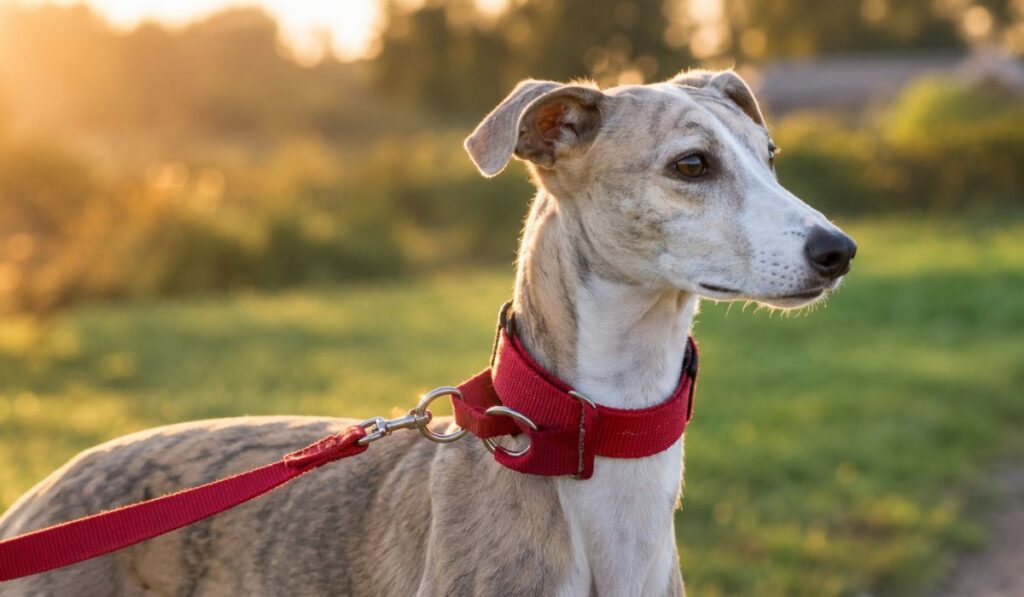

I’ve watched it happen more times than I’d like to admit, and I suspect most dog owners have too. A lead goes taut, a dog plants its feet, ducks its head, and suddenly the collar’s lying empty on the footpath. It takes seconds. It always seems to happen at the worst possible moment too, near a road, at the vet, in an unfamiliar park where nobody’s braced for it.
Collars that tighten under tension were built for exactly this scenario. The category covers some genuinely different pieces of gear though, from gentle limited-slip designs through to correction tools most modern trainers have quietly moved away from entirely. Understanding how each one actually works, and where the line sits between security and discomfort, makes it a lot easier to choose the right option for a dog that keeps finding a way out.
How a Tightening Collar Actually Works
The most common design is the martingale, sometimes called a limited-slip or greyhound collar. It has two loops. The larger loop sits around the dog’s neck, and a smaller loop connects to the lead. When the dog pulls or tries to back out, the small loop draws the large loop snug.
Snug, not tight. That distinction is really the whole point. A properly fitted martingale can only close to a preset limit, roughly the natural circumference of the dog’s neck. It can’t keep constricting the way a slip or choke chain does. The result is a collar that stays loose and comfortable on a relaxed walk, then firms up just enough to stop the dog’s head sliding through the moment tension actually hits.
Slip collars and choke chains work on a different principle entirely. They form a single loop with no stopping point, so they keep tightening for as long as the dog pulls, which is a genuinely different mechanism from what a martingale does. Prong collars add inward-facing metal links on top of that pressure again. Veterinary and behaviour organisations, including the American Veterinary Society of Animal Behavior, advise against aversive tools like these because of the real risk of injury and fear-based side effects. For everyday walking and escape prevention, the limited-slip design gets the job done without any of that risk attached.
Why Some Dogs Slip Out of Collars So Easily
If your dog slips out of collar gear regularly, it’s almost always anatomy rather than disobedience. Sighthounds like greyhounds, whippets, and Italian greyhounds have heads narrower than their necks, so a flat collar has next to nothing to anchor against. Huskies, shibas, and some spitz breeds combine thick neck fur with a genuine talent for twisting free that seems almost deliberate. Puppies and slim adolescent dogs of any breed can wriggle out of gear that fit perfectly well a month earlier.
Behaviour plays into it too. Dogs that panic at loud noises tend to throw themselves backwards, which happens to be exactly the motion that pops a flat collar over the ears. Reactive dogs that lunge, spin, and thrash on lead put their equipment under far more varied pressure than a calm walker ever would. For these dogs, the moment of escape is rarely predictable, which is really why the gear itself needs to be the safety net, not luck, and definitely not a firm grip on the lead.
When a Harness Alone Isn’t Enough
A well-fitted harness is often the first thing recommended for pullers and escape artists, and for good reason. It spreads pressure across the chest instead of the throat. But even a genuinely well-built harness has limits. Dogs with deep chests and narrow waists can shrug backwards out of standard Y-front designs, and a harness that felt impossible to slip out of in the shop can loosen considerably after months of regular wear.
For the truly determined escapers, a lot of trainers recommend pairing the harness with a secondary backup, or switching to gear built specifically for the problem. One option worth considering is a martingale dog collar, which tightens just enough to prevent slipping without choking, making it a practical choice for dogs that have already outsmarted their regular collar or harness at least once. A common setup is clipping the lead to the harness and running a short connector strap to the martingale, so if one piece of gear fails, the other’s still holding.
Fitting One Correctly
A tightening collar only works safely when the fit’s right, and the margin for error here is genuinely smaller than with a flat collar.
Measure the neck at its widest point, usually just behind the ears, since that’s exactly where the collar must never slide over. Set the limit properly too. At full tension, the two ends of the small loop should nearly meet but not touch. Touching means it’s too loose to stop an escape. A wide gap under tension means it’s too tight for comfort. Check that two fingers fit under the collar when it’s relaxed, and go back and recheck monthly, since growing dogs, seasonal coat changes, and normal webbing stretch all shift things quietly over time.
Martingales are walking equipment, not everyday wear, and that’s worth remembering. The loose design that makes them comfortable also makes them a snag hazard on crates, fences, and other dogs’ teeth during play, so the safest habit is putting the collar on for the walk and taking it off again at home. The RSPCA’s guidance on collar safety covers this and other fit basics in more detail if you want to dig deeper.
What a Tightening Collar Will Not Do
Worth being honest about the limits here. A martingale is escape-prevention gear, not training gear. It’s not an anti-pull collar in the sense of teaching a dog to walk politely. A dog that pulls hard is going to keep pulling, just without slipping free while doing it. Loose-lead skills still come from actual training, ideally reward-based work on a normal collar or front-clip harness.
It’s also not a fix for the underlying panic that drives a lot of escapes in the first place. A noise-phobic dog that bolts at thunder needs behaviour support alongside better hardware, not instead of it. The collar buys the seconds that keep the dog on the lead while the real, longer-term work happens quietly in the background.
Where This Leaves You
Collars that tighten when pulled range from genuinely humane to genuinely harsh, and the difference really comes down to the mechanism, not the marketing. A limited-slip martingale closes to a fixed point and stops there, which is exactly why it’s become the standard recommendation for narrow-headed breeds, backup security, and dogs with a history of slipping free. Unlimited slip and prong designs just keep tightening, and modern behaviour science has moved firmly away from them, for reasons that make sense once you understand the mechanics.
For most escape-prone dogs, the practical answer is a properly fitted harness for daily walking, a correctly adjusted martingale as backup, and training that actually addresses whatever’s driving the escapes in the first place. Get those three pieces sorted, and that empty-collar-on-the-footpath moment turns into a story you tell rather than something you’re quietly bracing for on every single walk.

