

Finding the right OEM clothing manufacturer is not about choosing the largest factory or the lowest quotation. The better question is whether a supplier understands your product, order stage, quality expectations, and target market. This guide compares 15 OEM clothing manufacturers and production partners serving different types of apparel brands. The list is not a quality ranking. It’s a practical starting point for building a shortlist, checking production models, and deciding which companies deserve a sample request.
I’ve watched enough brands go through this process to know where it usually goes wrong. It’s rarely the factory itself. It’s a founder assuming “OEM” means the same thing at every company they contact, then discovering three months in that the supplier they picked handles sewing beautifully and nothing else, while the actual bottleneck was sourcing fabric the whole time.
What Is an OEM Clothing Manufacturer, and How Does OEM Production Work?
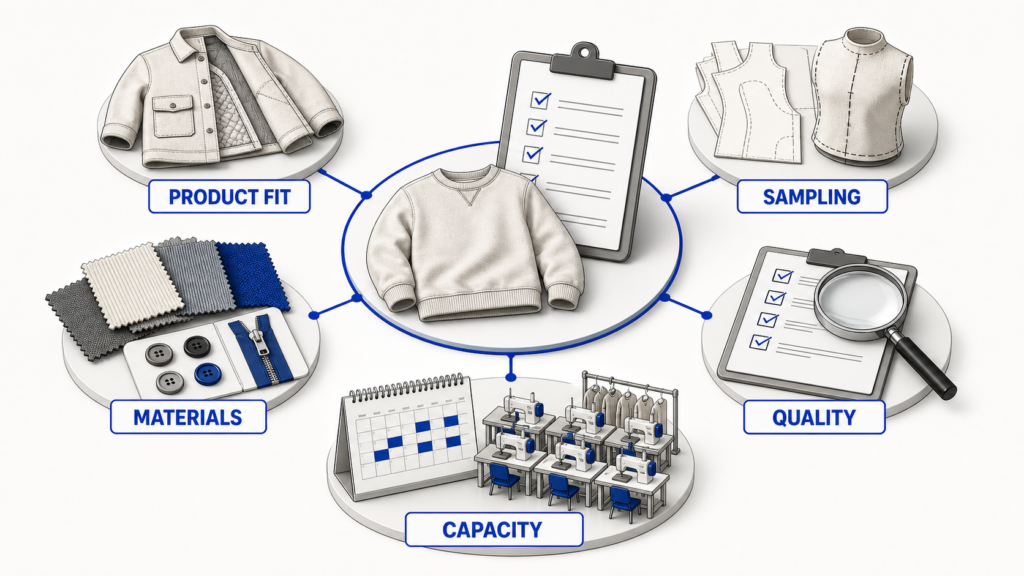
An original equipment manufacturer, or OEM, produces garments from specifications supplied by a clothing brand. The buyer usually provides a design, tech pack, measurement chart, approved reference sample, or some combination of these. The manufacturer then converts those instructions into samples and, eventually, repeatable bulk production.
The division of work varies more than the label “OEM” suggests. Some factories expect production-ready patterns and buyer-nominated materials, and that’s the whole arrangement. Others will source fabric and trims, make patterns, grade sizes, develop samples, apply prints or embroidery, attach labels, pack finished garments, and coordinate shipping, essentially running the entire development pipeline. These responsibilities need to be written into the quotation and manufacturing agreement rather than assumed from the term OEM itself. That single assumption is where a lot of early friction comes from.
OEM is different from private label. With private label, a brand typically selects an existing supplier style and changes elements like color, logo, or packaging. ODM sits somewhere between the two, since the supplier contributes more of the actual product design. OEM usually hands a brand more control, but it also demands clearer technical instructions and considerably more development work on the brand’s end.
How Did We Select the Best OEM Clothing Manufacturers for Clothing Brands?
The companies below serve different order sizes, categories, and development needs. A small Los Angeles production studio shouldn’t be judged by the same yardstick as a multinational group built for large recurring programs, so I didn’t try to force them into one ranking. Inclusion was based on public evidence available from company websites and, for listed businesses, corporate disclosures.
The main screening criteria were:
- A traceable operating company and identifiable production model
- Published OEM, custom manufacturing, development, or cut-and-sew services
- A recognizable product specialization or buyer profile
- Information about sampling, materials, production, or related support
- Coverage of different countries, order stages, and apparel categories
- Enough public information for a buyer to begin independent verification
Capabilities and availability change constantly in this industry. Buyers should confirm the legal entity, factory location, subcontracting structure, current minimums, sample process, and production schedule before placing an order, not after.
How Do the 15 Best OEM Apparel Manufacturers Compare?
| Manufacturer | Main base or production model | Public product focus | Potential buyer fit |
|---|---|---|---|
| HAPA Garments | Guangzhou, China | Kidswear and detail-heavy fashion products | Children’s clothing brands with custom designs |
| Billoomi Fashion | Delhi NCR, India | Multi-category fashion and kidswear | Emerging brands needing full-service development |
| Thygesen Textile Vietnam | Vietnam, full-package manufacturing | Technical knits, activewear, underwear and kidswear | Established brands with fabric or performance requirements |
| Steve Apparel | U.S.-registered, Karachi production | Streetwear, sportswear and branded basics | Brands developing custom casualwear |
| Appareify | Guangzhou, China | Broad multi-category apparel | Brands consolidating several product categories |
| Lefty Production Co. | Los Angeles development and production | Fashion, swimwear, activewear and accessories | Brands wanting hands-on U.S. development |
| The Evans Group | Los Angeles development and small-volume production | Designer and premium fashion | Emerging designers with complex development needs |
| Fall River Apparel | Massachusetts contract manufacturing | Cutting, sewing, grading and fulfillment | U.S. brands with developed products or patterns |
| Portland Garment Factory | Portland design and fabrication studio | Garments, soft goods and experimental projects | Creative teams developing unconventional products |
| Prototype | Managed global supplier network | Multi-category fashion development | Brands wanting coordinated sourcing across suppliers |
| FUSH | Serbia, OEM and full-package production | Sportswear, activewear and casualwear | European brands seeking regional custom production |
| Audimas Supply | Lithuania | Performance, sportswear and outdoor apparel | Brands with technical garment requirements |
| TAL Apparel | Multi-country enterprise manufacturing | Shirts, tailoring, pants and outerwear | Established brands with structured programs |
| Shenzhou International | Vertically integrated Asian production platform | Activewear, athleisure and casualwear | Large brands with scaled knit programs |
| Crystal International | Multi-country manufacturing platform | Lifestyle, denim, intimate, sweaters and sportswear | Global brands with multi-category programs |
For a deeper supplier-by-supplier framework, brands can use this guide to compare OEM clothing suppliers and manufacturers before requesting quotations.
Which OEM Clothing Manufacturers Are Best for Different Brand Needs?
1. HAPA Garments: Best for Kidswear and Detail-Heavy Collections
HAPA Garments is based in Guangzhou and publicly focuses on OEM, ODM, and private-label children’s apparel. Its stated services cover product development, sampling, material and trim decisions, production, labels, and packaging. The narrower kidswear focus can matter to brands developing size-sensitive garments or products with embroidery, appliques, sequins, and other decorative details. Buyers should confirm the applicable factory, project-specific minimum, sample plan, testing responsibility, and production schedule before committing.
2. Billoomi Fashion: Best for Small-Batch Multi-Category Development
Billoomi Fashion describes itself as an India-based made-to-order manufacturer serving womenswear, menswear, and kidswear. Its published services include pattern making, grading, material sourcing, sampling, printing, embroidery, labels, and packing. That breadth may suit an emerging brand with a clear design direction that still needs one team to coordinate everything. Worth verifying the current minimum for every style and identifying which decorative processes actually happen internally versus outsourced.
3. Thygesen Textile Vietnam: Best for Technical Knit Products

Thygesen Textile Vietnam presents full-package OEM and ODM support across activewear, underwear, fashionwear, kidswear, workwear, and related knit categories. Its public materials also emphasize fabric development and sourcing specifically. This model tends to suit established brands where material performance and product engineering matter as much as sewing quality. Before proceeding, confirm the nominated facility, fabric minimums, testing plan, capacity window, and which documents apply to the specific order.
4. Steve Apparel: Best for Streetwear and Branded Basics

Steve Apparel states that it’s registered in Ohio and operates a manufacturing facility in Karachi, Pakistan. Its published scope includes sample development, cut-and-sew production, private labeling, streetwear, sportswear, and casual basics. It tends to appeal to brands wanting a U.S.-facing commercial contact while production happens in Pakistan. The contract entity, beneficiary bank account, factory address, material specification, decoration method, and subcontracted processes should all be confirmed in writing before any order is placed.
5. Appareify: Best for Multi-Category Clothing Production in China

Appareify publishes OEM, ODM, CMT, cut-and-sew, private-label, and packaging services from Guangzhou. Its website covers products ranging from T-shirts and hoodies to denim, activewear, swimwear, underwear, and children’s clothing. Broad category coverage simplifies sourcing on paper, but it also creates a real verification task. Worth asking which facility will actually make each style, which processes get outsourced, and whether the proposed team has recent experience with the exact construction you need.
6. Lefty Production Co.: Best for Los Angeles Product Development

Lefty Production Co. operates as a Los Angeles development house and apparel manufacturer. Its public services include design support, sourcing, patterns, samples, grading, cutting, production, and packing across several garment and accessory categories. The model can help brands wanting in-person fittings or close development contact within the United States specifically. Request a detailed development budget, production range, revision policy, material responsibilities, and current order requirements before committing.
7. The Evans Group: Best for Emerging Fashion Designers

The Evans Group, also called TEG, is a Los Angeles fashion development and production house. It publishes support for design, fabric and trim sourcing, patterns, samples, and small-volume production. TEG tends to fit premium or design-led projects where the main challenge is turning a concept into a production-ready garment rather than scaling something already proven. Brands should clarify pattern ownership, development deliverables, revision limits, production location, and how pricing changes if volume later moves to another facility.
8. Fall River Apparel: Best for U.S. Contract Cutting and Sewing

Fall River Apparel operates a cutting and sewing facility in Massachusetts. Its published services include sample making, marking, grading, computerized cutting, stitching, warehousing, and shipping. This makes it a practical candidate for brands that already have patterns or need defined contract-manufacturing services within the U.S. It’s worth confirming whether the company sources materials and manages development itself, or expects the buyer to supply production-ready inputs directly.
9. Portland Garment Factory: Best for Experimental Soft Goods

Portland Garment Factory is a design and fabrication studio whose work includes custom cut-and-sew manufacturing, prototyping, installations, and unusual soft goods. Its creative model is genuinely different from a conventional high-volume clothing factory, and that’s the point. It tends to fit brands, artists, and agencies developing unfamiliar materials or technically unusual products. Worth discussing how experimentation becomes a repeatable specification, who owns the prototype, and what production scale is actually realistic for the project.
10. Prototype: Best for Managed Multi-Supplier Production

Prototype currently presents itself as an American-owned apparel development and manufacturing partner working through a global network of suppliers. It’s better understood as a managed production platform than as one disclosed factory. The model can help brands wanting one project team to coordinate development, sourcing, and production across categories rather than managing several vendors directly. Ask which supplier receives the order, where production actually occurs, how subcontracting is disclosed, and who carries responsibility if quality falls short.
11. FUSH: Best for European Custom Sportswear and Casualwear

FUSH describes two garment factories in Serbia and publishes OEM, full-package, CMT, sampling, labeling, fabric production, printing, packing, and delivery services. Its stated specialties include sportswear, activewear, casualwear, and streetwear. It tends to suit European buyers seeking regional production and access to custom knit fabrics without shipping across continents. Current minimums, sample costs, lead times, certificate scope, and product eligibility should be checked for the specific order rather than copied from a general website page.
12. Audimas Supply: Best for Performance Apparel Manufacturing in Europe

Audimas Supply is a Lithuanian manufacturer focused on sportswear, outdoor clothing, athleisure, and other performance products. Its public capabilities include product development, sourcing, manufacturing, and technical processes. This focus tends to suit brands needing experience with functional construction rather than fashion basics alone. Worth confirming the production location, current onboarding requirements, material program, sample timeline, testing responsibilities, and order scale accepted for the category.
13. TAL Apparel: Best for Enterprise Shirts, Tailoring, and Outerwear
TAL Apparel is a multi-country garment manufacturing group with public business units covering business attire, lifestyle apparel, outerwear, tailoring, and made-to-measure products. Its current disclosures show a category range including shirts, blouses, polos, suits, jackets, and pants. TAL is more relevant to established brands with formal vendor-management processes than to a founder testing a handful of units. New-customer eligibility, division fit, forecast requirements, and nominated factory should all be confirmed first.
14. Shenzhou International: Best for Large-Scale Knitwear Production

Shenzhou International operates an integrated textile and apparel platform with production bases across Asia. Its official materials emphasize activewear, athleisure, and casualwear, alongside oversight from raw materials through to finished garments. This structure tends to fit mature brands managing large, forecastable knit programs. It shouldn’t be approached as a default low-volume startup factory. Buyers need to confirm whether customer onboarding is even open, what scale is expected, and which country and facility would actually handle production.
15. Crystal International: Best for Global Multi-Category Apparel Programs

Crystal International operates a multi-country manufacturing platform covering lifestyle wear, denim, intimate apparel, sweaters, sportswear, and outdoor products. Its divisions and regional facilities make it relevant to large brands needing category specialization and production diversification at scale. The practical first questions concern customer eligibility, the responsible division, expected order scale, material development, factory allocation, audit requirements, and whether styles may move between facilities during the relationship.
How Do You Choose an OEM Clothing Manufacturer for Your Brand Stage?
What Should a Startup Look for in an OEM Clothing Manufacturer?
A startup usually needs more than sewing. Pattern correction, material guidance, sample feedback, and someone willing to actually explain things can be more valuable than the lowest unit price on the quote. Smaller development studios and flexible full-service factories tend to be easier to access, but low minimums don’t remove the cost of fabric, trims, labels, testing, and repeated sampling. The best early-stage partner is the one that explains those dependencies upfront, before taking any payment.
What Do Growing DTC and Wholesale Clothing Brands Need?
Growing brands should look beyond launch support and start testing for repeatability specifically. The supplier needs to reproduce approved fit and construction consistently, manage more colors and sizes, reserve realistic capacity, and document quality checks properly. Ask how reorder materials are controlled, what happens when a fabric gets discontinued, and how the factory handles late changes. A manufacturer that’s excellent at prototypes isn’t necessarily equally strong at recurring bulk orders, and that gap catches a lot of growing brands off guard.
When Does an Enterprise Apparel Manufacturer Make Sense?
Enterprise groups become relevant once a brand can provide demand forecasts, structured product data, compliance requirements, and meaningful recurring volume. Their advantages tend to include specialist divisions, material programs, automation, and multi-country capacity. Their onboarding process is also considerably more demanding. A large factory is not a shortcut for an incomplete tech pack, uncertain quantities, or a product still changing after every single sample.
Why Do Many Established Clothing Brands Work With OEM Factories in China?
China remains important to apparel sourcing because it combines garment factories with dense networks of textile mills, dye houses, trim suppliers, printing and embroidery operations, packaging companies, equipment providers, and export services. China’s Ministry of Industry and Information Technology describes industrial clustering as a defining feature of the textile and apparel sector, since clusters help allocate production resources and improve supply-chain coordination.
Access to a complete apparel supply chain. Geographic concentration can make it easier to source fabrics, replace trims, develop packaging, or move a specialized process to a qualified partner nearby. That doesn’t mean every factory owns every process though. Brands still need to ask which work is completed internally and which gets subcontracted out.
More options for materials and customization. China’s supplier base supports a wide range of fibers, constructions, finishes, labels, packaging formats, and decorative processes. That variety genuinely helps product development, especially when a collection includes several garment types. The benefit depends entirely on accurate specifications and disciplined approvals though. More choice can just as easily create more room for inconsistency if the bill of materials is vague.
A path from sampling to repeat production. Many Chinese OEM suppliers support pattern work, sample development, material sourcing, production, and packing within one coordinated project. For a growing brand, that can reduce the number of vendors being managed at once. Flexibility is still product-specific though. Fabric minimums, dye lots, decoration setup, and factory scheduling can still make a small order impractical regardless of the supplier’s overall capability.
Established export and production infrastructure. Factories in major apparel regions often have real experience with export documentation, overseas communication, inspection, and international shipping. Buyers shouldn’t confuse export experience with automatic compliance though. The brand remains responsible for confirming market requirements, product testing, labeling, and documentation with qualified advisers and testing partners.
China isn’t the best answer for every order. Transit time, tariffs, intellectual-property controls, communication, minimums, and diversification goals can all point a buyer toward another country entirely. The sourcing decision should follow the product and risk profile, not a general country reputation.
How Can You Find the Right OEM Clothing Supplier for Your Brand?
Define Your Product and Order Requirements First
Supplier searches become a lot more productive when the initial brief is specific. Before contacting factories, prepare product category, design files, construction details, and target quality level; estimated quantity by style, color, and size; fabric composition, weight, finish, and performance requirements; printing, embroidery, wash, hardware, label, and packaging needs; and destination market, testing expectations, target cost, and required delivery window.
A supplier genuinely cannot provide a meaningful quotation when the product is described only as a premium hoodie, a sustainable dress, or a high-quality children’s set.
Search in the Right OEM Supplier Channels
Useful sources include industry associations, trade shows, specialist manufacturing directories, sourcing professionals, material suppliers, and referrals from designers or brands with similar products. Search by category and process, not only by country. “Cut-and-sew activewear manufacturer with bonded seams” produces a far more relevant shortlist than “best clothing factory” ever will.
Check Whether the Supplier Matches Your Product Category
Ask for anonymized examples, construction photos, sample records, or material references for comparable products. A factory that makes jersey T-shirts isn’t automatically equipped for tailored coats, bonded sportswear, structured bras, or embellished children’s dresses. Category fit affects machinery, operators, pattern knowledge, quality checkpoints, and sourcing relationships more than people expect.
Verify the Company, Factory, and Production Model
Match the website name with the company signing the agreement, issuing the invoice, and receiving payment, which sounds obvious but gets skipped constantly. Confirm the production address and ask about outsourced processes directly. A live video call, third-party audit, or factory visit can provide useful evidence, but it should be matched with company records and written order terms, not treated as a substitute for them.
Compare Sampling Support Before Bulk Prices
Send the same sample brief to the strongest candidates. Compare how they interpret the tech pack, identify missing information, document changes, and explain material or construction risks. Sample quality matters, but so does process discipline. A polished sample made outside the intended bulk line doesn’t actually prove that production will be equally consistent once volume ramps up.
What Should You Ask an OEM Garment Factory Before Sharing Your Tech Pack?
A tech pack can contain valuable design, measurement, artwork, and commercial information. A staged review protects that information and prevents time being spent on suppliers who were never going to be a fit anyway. Start with: what legal entity will sign the agreement and receive payment; where will sampling and bulk production take place; which processes are subcontracted, and how are those vendors controlled; what’s the MOQ by style, color, and material; who owns the patterns, molds, artwork files, and approved samples; how are sample revisions documented and charged; who’s responsible for material approval, testing, inspection, and export documents; and what payment milestones, production dates, and shipping terms will appear in the order.
Share the complete file only once the supplier’s identity, category experience, and intended production model are reasonably clear.
How Can Clothing Brands Compare OEM Manufacturing Quotes Beyond Unit Price?
Unit prices only mean something when quotations describe the same garment, materials, services, packaging, quality plan, and trade term. A lower quote may simply exclude pattern development, testing, labels, inspection, freight, or duties, which makes the comparison meaningless on its own.
| Comparison factor | Suggested weight | What to review |
|---|---|---|
| Product-category experience | 20% | Evidence from comparable constructions and materials |
| Sample quality and accuracy | 20% | Fit, measurements, workmanship and change control |
| Material capability | 15% | Sourcing options, minimums, traceability and approvals |
| Quality-control plan | 15% | Checkpoints, records, defect handling and inspection access |
| Communication | 10% | Technical understanding, response quality and documentation |
| Production schedule | 10% | Realistic dates, dependencies and capacity confirmation |
| Landed cost | 10% | Product, development, packing, freight, duties and risk |
Don’t use a weighted score to excuse an uncertain legal entity, undisclosed factory, or mismatched payment account. Those are screening gates, not minor scoring deductions, and no amount of scoring elsewhere should paper over them.
What Is the Step-by-Step Process for Working With an OEM Clothing Manufacturer?
Step 1: Prepare the tech pack and sourcing brief.
Define the design, measurements, construction, materials, colors, artwork, labels, packaging, quantity, quality criteria, target market, and delivery objective. Mark any open decisions clearly. A factory can’t control a requirement that’s never been specified in the first place.
Step 2: Request a quotation and confirm scope.
Ask the supplier to separate development, samples, materials, bulk production, testing, packaging, and shipping wherever possible. Confirm what the buyer must provide and what the factory will manage. Record assumptions about fabric consumption, size mix, wastage, and trade terms while they’re still fresh.
Step 3: Develop and review samples.
Review measurements, fit, construction, color, hand feel, artwork, and workmanship against the tech pack. Return one consolidated comment sheet with photos and measurements rather than scattered messages. Track every approved change so the next sample isn’t judged from memory.
Step 4: Approve materials and the pre-production sample.
Approve fabric, trims, color standards, print or embroidery strike-offs, labels, packaging, and the final size specification. Keep an identified approval sample as the production reference. State clearly which changes require written buyer approval after production begins.
Step 5: Confirm the purchase order and calendar.
The purchase order should match the approved specification and quotation exactly. Confirm quantities, size breakdown, price, payment stages, production dates, inspection access, packing, shipping term, and remedies for agreed quality failures or avoidable delays.
Step 6: Monitor production and quality.
Quality control can include incoming-material checks, first-piece review, inline inspection, finishing checks, measurement audits, and pre-shipment inspection. The right sequence depends on the garment and the risk involved. Inspection should verify an agreed standard rather than introduce new preferences after the fact.
Step 7: Ship, review, and improve the reorder.
Check shipping documents before dispatch and inspect received goods against the approved standard. Record defects, customer returns, fit feedback, and production issues. Use that evidence to improve the next tech pack, material choice, order allocation, and quality plan.
A good OEM relationship becomes more valuable over repeated orders, because both sides build clearer specifications and more reliable operating routines over time. That value starts with a well-matched supplier, not with a generic “best factory” label pasted onto a homepage.
Common Questions
Is OEM or private-label manufacturing better for a new clothing brand? OEM suits brands with original designs that want control over fit, construction, materials, and detail. Private label is simpler when a brand is comfortable adapting an existing supplier style rather than building from scratch. A new brand should choose based on product differentiation, development ability, budget, and launch speed, not by assuming one model is universally better.
What is a typical MOQ for an OEM clothing manufacturer? There’s no reliable universal MOQ, no matter how often that question gets asked. The practical minimum depends on fabric, color, size range, construction, decorations, material supplier minimums, and the factory’s own production model. Ask for the minimum by style and color, then confirm whether fabric or trim minimums create a larger commitment than expected.
How much does OEM clothing manufacturing cost? Cost depends on materials, consumption, labor, complexity, order volume, development, testing, packaging, trade terms, freight, duties, and quality requirements. Send comparable specifications to shortlisted suppliers and calculate landed cost properly. A unit price without scope and assumptions attached isn’t a sound basis for comparison, no matter how tempting it is to just pick the smallest number.
How long does OEM clothing production usually take? The timeline includes sourcing, pattern work, samples, revisions, material booking, production, inspection, and shipping. Each stage depends on the product and the supplier’s own schedule. Ask for a project calendar with dependencies mapped out, rather than relying on one general lead-time promise that rarely survives contact with reality.
How can you verify that an OEM supplier operates a real factory? Check the legal entity, address, contract party, and beneficiary account. Request a live factory walkthrough or arrange an audit or visit if the order justifies it. Confirm which processes actually happen at that location and which are outsourced elsewhere. Verification should be tied to the factory proposed for your specific order, not just to a glossy company brochure.
Which country is best for OEM clothing manufacturing? No country is best for every product, and anyone claiming otherwise is oversimplifying. China offers broad supply-chain depth and customization. Vietnam is strong in several scaled and technical categories. India supports diverse fashion development, while U.S. and European facilities can offer proximity and smaller-scale collaboration. The right country follows the garment, order size, target market, logistics, and risk strategy, in that order.

