
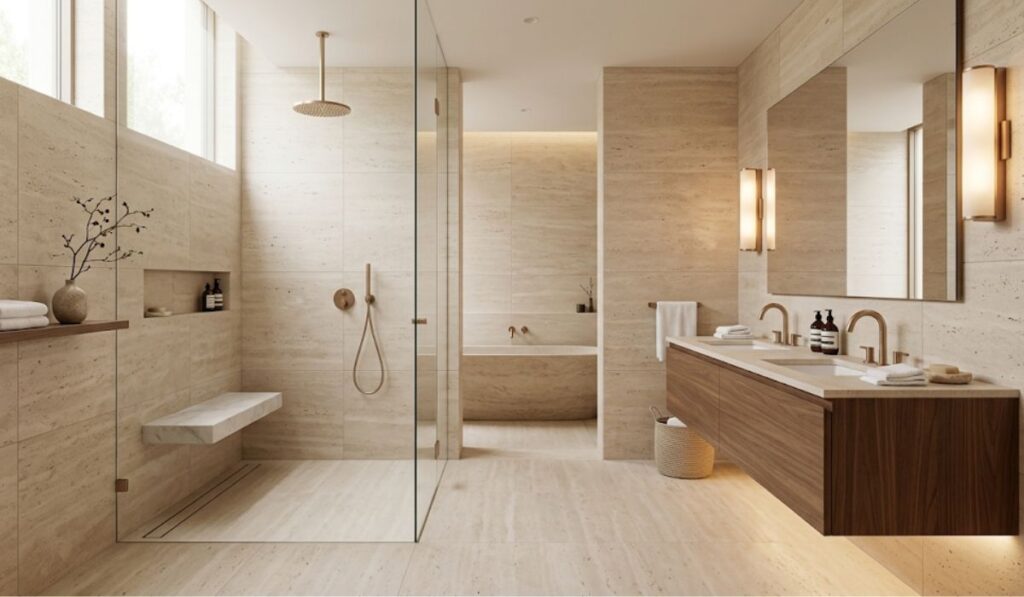

You know the feeling. You step into a high-end hotel bathroom and something in your shoulders relaxes almost immediately. Calm, order, a quiet sense of luxury that’s hard to pin down at first glance. It’s not really about expensive towels or a branded soap dispenser. It’s a series of deliberate, architectural choices that prioritise function and sensory experience over decoration. Recreating that “hotel effect” at home means moving past surface-level decor and getting into structural details, lighting layers, and how materials actually perform over time.
Based on nationwide remodeling data, getting this right takes real planning, not just a good eye. Here are the nine details that actually separate an average residential bathroom from something closer to a five-star retreat.
1. The Curbless Shower (Continuous Flooring)
Nothing says luxury hotel louder than a glass shower enclosure with no threshold at all. Running the primary floor tile straight into the shower basin creates one unbroken visual line, which can make even a cramped 5×8 post-war bathroom feel considerably more expansive.
The reality check: you can’t just skip the curb and call it done. Getting this look right means dropping the floor joists by at least two inches to pitch the subfloor toward the drain. In older historic downtown brownstones specifically, that joist modification often requires sistering framing members just to meet code. It’s worth checking with the local municipal building department early, since waterproofing inspections tend to be enforced strictly for zero-entry showers, particularly in coastal and multi-family jurisdictions.
If there’s any doubt about whether the floor joists can handle a curbless conversion, that’s a conversation worth having with a structural specialist before demo day, not after.
2. Large-Format Slab Tile
Busy mosaic floors and endless grout lines are on the way out. High-end hotels tend to use large-format porcelain, think 24×48 inches or bigger, or continuous stone slabs across both walls and floors. Less grout means less visual clutter, and it cuts maintenance time roughly in half compared to a small-tile layout.
3. Layered, Eye-Level Lighting
Overhead recessed can lights cast harsh shadows straight down across the face, which is exactly the opposite of flattering. The hotel effect relies on layered light instead of a single source doing all the work.
Vertical sconces mounted at eye level on either side of the mirror give shadow-free, genuinely flattering task lighting. An LED strip tucked into a ceiling cove or under a floating vanity adds depth without competing with the main light source.
A good chunk of high-end remodels now include layered task lighting with dedicated dimmers, moving away from the single-overhead-fixture approach almost entirely.
4. Floating Vanities with Undermount Lighting
Mounting the vanity to the wall rather than resting it on the floor exposes more continuous floor space, which tricks the eye into reading the room as larger than it actually is. Dense urban properties tend to lean on this trick constantly just to make tight spaces work, while larger suburban homes often use the same floating design purely to show off custom tile work underneath.
5. Radiant Floor Heating
Stepping out of a hot shower onto freezing tile immediately breaks the whole illusion of luxury, no matter how nice everything else looks. Electric radiant heat mats installed beneath the tile have become close to a non-negotiable comfort feature in premium builds now.
The value anchor: radiant heating materials run around $10 to $15 per square foot. The dedicated 20-amp electrical circuit needed to power it, though, can add another $500 to $1,500 to the budget depending on the panel’s existing capacity.
6. Concealed Linear Drains
A standard center-point circular drain interrupts the tile pattern and forces the installer to cut small, angled tiles just to create the necessary slope. A linear drain tucked against the back wall or shower threshold sidesteps that entirely, letting the same large-format tile run across the shower floor as the rest of the room. It’s a subtle architectural change, but it noticeably elevates the overall look.
7. PVD Hardware Finishes
That matte black or brushed brass fixture looks fantastic on day one. The real question is how it holds up to daily use and whatever cleaning products end up near it. Luxury hotels tend to use hardware treated with Physical Vapor Deposition, a process that binds the finish at a molecular level, making it far more resistant to tarnishing, scratching, and corrosion over time. In areas with notably hard water, a standard matte finish will show mineral scale almost immediately, while a PVD finish holds up and protects the investment properly.
8. The Smart Washlet / Bidet Toilet
What used to be a European standard is now a genuine luxury expectation in American homes too. Wall-mounted toilets with concealed in-wall tanks, the Geberit system being a common example, save up to 10 inches of floor space and give the room a sleek, minimalist look. Pair that with a high-end washlet seat featuring a heated ring, auto-open lid, and warm water cleansing, and it’s worth having an electrician wire an outlet behind the toilet location during the rough-in phase, before the walls close up.
9. Soundproofing and Solid-Core Doors
The unsung hero of the hotel bathroom is acoustics, something almost nobody thinks about until it’s missing. A hollow-core door transmits every sound through it without much resistance. Upgrading to a solid-core wood door and adding acoustic insulation, Rockwool being a common choice, into the interior bathroom walls makes the space feel genuinely secluded, private, and quiet. That’s really what turns a bathroom into a sanctuary rather than just another room in the house.
Putting the Data Into Action
None of these nine details work in isolation. The curbless shower needs the right framing, the radiant heat needs the right electrical capacity, the linear drain needs the tile plan built around it from the start. Getting the sequencing and the trades right is usually what separates a bathroom that feels like a hotel from one that just has hotel-adjacent fixtures scattered through it.
For homeowners ready to take this from a wish list to an actual plan, MrRemodel.com connects you with licensed, insured local contractors who provide real price estimates rather than ballpark guesses, with no obligation to hire anyone. It’s a straightforward way to get a clear, data-backed quote before committing to the investment.
