
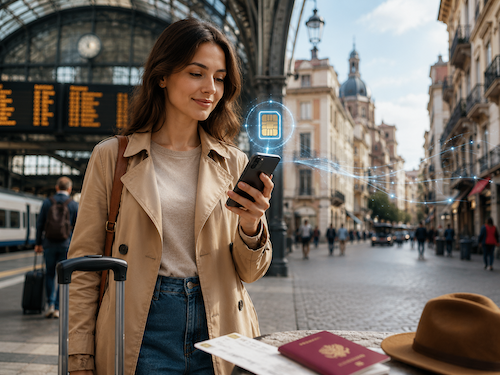

There’s a particular kind of travel stress that only shows up after landing. You step off the plane, switch off Airplane Mode, and suddenly realise you have no idea whether using your phone is about to cost five dollars or fifty.
For American travellers heading to Europe, staying connected used to mean picking between expensive international roaming, hunting down a local SIM card, or living off café Wi-Fi for two weeks straight. None of those options is particularly appealing when you’ve just crossed the Atlantic and you’re trying to find a train platform, message your hotel, or pull up a reservation you screenshotted three months ago.
The good news is staying online in Europe has genuinely gotten easier. A bit of planning before you leave can keep your phone useful without turning it into the most expensive item on the trip.
Start by Checking Your Current Phone Plan
Before buying anything at all, find out what your US carrier already covers overseas.
Some plans include international data automatically. Others charge a daily roaming fee every time your phone connects abroad, which can feel manageable for a short trip and then quietly becomes expensive. A $10 daily fee sounds fine until you multiply it across a two-week vacation. Suddenly, just checking Google Maps and sending a few messages has tacked on another $140 to the trip.
Worth checking before you leave:
- The daily or monthly international roaming price
- How much high-speed data is actually included
- Whether the plan covers every country on your itinerary
That last one matters more than people expect if you’re moving around. A plan that works perfectly in France might have completely different conditions once you cross into Switzerland, Turkey, or the Balkans.
Why Europe Is Ideal for a Multi-Country Trip
One of the best parts of travelling through Europe is how easy it is to stitch destinations together.
You can have breakfast in Paris, land in Brussels by lunch, and be sitting down to dinner in Amsterdam without ever boarding a plane. A single week can comfortably cover several countries, which is wonderful for sightseeing and a bit more complicated for mobile data.
Buying a physical SIM in every country makes very little sense for a trip shaped like that. Even buying one local SIM and hoping it holds up everywhere means digging into roaming zones and fair-use policies you didn’t really want to read. This is where digital SIMs have quietly made travel a lot simpler.
What an eSIM Actually Does
An eSIM is a digital version of the same SIM card that already connects your phone to a mobile network. Instead of popping out a tiny plastic card, you download a mobile plan straight onto the device.
Most recent iPhones, Google Pixel phones, and a lot of Samsung Galaxy models support it.
For travellers, the real advantage is that you can install an eSIM before you even leave home. Land somewhere new, switch on the travel line, and you’re using maps, messaging apps, train schedules, and translation tools almost immediately. No airport kiosk. No tiny piece of plastic to keep track of for two weeks.
Keeping Your US Number While Using European Data
This is the setup I find most practical.
Keep your regular US line active for calls, texts, and verification codes. Then use a separate eSIM for mobile data while you’re in Europe. That way your phone handles two jobs at once. Your normal number stays reachable, while the travel plan quietly takes care of the data-heavy stuff that would otherwise trigger roaming charges.
For travellers hitting several countries, a regional option like Holafly’s esim in Europe can be installed before departure and used across multiple European destinations, rather than setting up a new plan every time you cross a border.
Getting the phone settings right matters here. Once the travel eSIM is installed, set it as the line used for cellular data and turn off data roaming on your primary US line, unless your carrier specifically tells you otherwise. That one setting alone can save you from an unpleasant bill later.
Install Everything Before You Fly
Technically you can install an eSIM after landing. I wouldn’t make that the plan.
Do it at home, on reliable Wi-Fi, with time to spare. Save the installation email, screenshot the QR code or instructions, and label the new line something obvious like “Europe Travel.” You don’t want to be standing in an arrivals hall trying to figure out which line called “Secondary” is quietly costing you money.
Worth downloading before you leave too:
- Offline Google Maps for your first destination
- Your airline and hotel apps
- Train or public transport apps for the cities you’re visiting
- Google Translate or another translation tool
- Digital copies of your important reservations
Even with solid mobile data, having a backup makes the whole trip smoother.
Don’t Depend Entirely on Public Wi-Fi
Free Wi-Fi is everywhere in Europe, but it works best as a bonus, not your main connectivity plan.
Hotel networks are handy at night, and a café connection can save some data during a long stop. The problem is Wi-Fi tends to vanish right when you need your phone most: walking between stations, trying to call a rideshare, finding an apartment entrance in the dark, or checking the last train home. Public Wi-Fi can also be unreliable, or gated behind an awkward registration page that never quite works properly on mobile.
Having your own connection just removes that small layer of friction from the day.
Think About How Much Data You Actually Use
Some travellers barely touch their phones on a trip. Others are uploading videos, running navigation constantly, streaming music, and making video calls every evening.
It’s worth checking your normal monthly data usage before picking a travel plan. If your phone is mostly maps and WhatsApp, you probably need a lot less data than you’d assume. If you create content, work remotely, or plan to tether a laptop, a more generous plan actually makes sense.
The cheapest option isn’t always the smartest one either. Running out of data halfway through an unfamiliar city is a rough way to save a few dollars.
A Small Detail That Makes a Big Difference
Mobile connectivity isn’t the exciting part of a European trip. Nobody books a flight to Italy because they’re looking forward to configuring cellular settings.
That’s exactly why it’s worth sorting out ahead of time.
When your phone just works the moment you land, you stop thinking about it entirely. You can check the metro, find the restaurant, message the Airbnb host, translate a menu, or change a train booking without hunting for Wi-Fi first. Travel feels better when the boring logistics fade into the background. A bit of preparation before you leave means your phone does exactly what it should in Europe: help you get around, then get out of the way while you actually enjoy the trip.
