
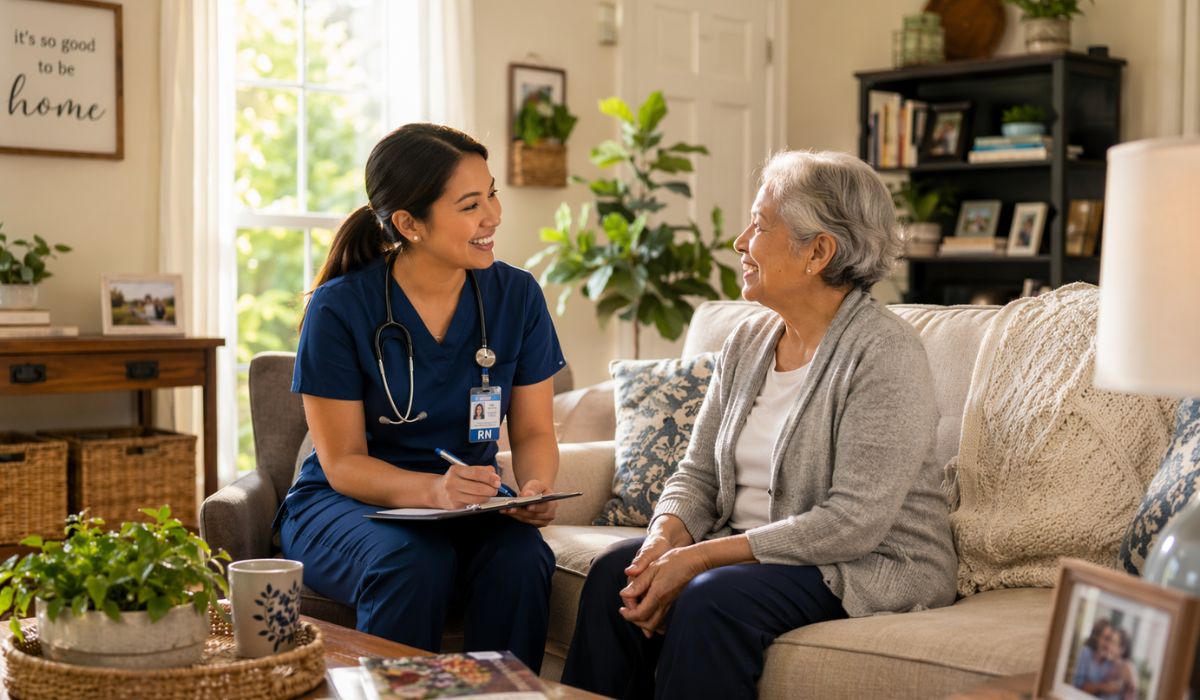

When health needs change, the question of where care happens matters as much as the care itself. A hospital or residential facility offers clinical expertise but asks something significant in return — familiarity, routine, the particular comfort of being in a place that belongs to you. For many people and many families, that trade is worth avoiding if there is a genuine alternative.
At-home nursing care is that alternative for a growing number of Australians. Not as a compromise on clinical quality, but as a genuinely different approach to how professional healthcare can be delivered — one that fits around the person rather than asking the person to fit around a system.
What At-Home Nursing Care Actually Involves
At-home nursing care delivers professional healthcare services in the patient’s own home. The scope is broader than most people initially expect. Services can include personal care and mobility assistance, medication management and injections, wound and post-surgical care, rehabilitation after illness or hospitalisation, chronic disease management, dementia support, palliative care, and respite support for family caregivers.
Some of those needs are short-term. A recovery period after surgery, a course of treatment that requires regular clinical monitoring, a transition out of hospital that needs professional support while the body adjusts. Others are ongoing — the kind of care that becomes part of the fabric of daily life rather than a temporary intervention.
What distinguishes home-based care from residential care is not just the location. It is the structure. Care plans are built around the individual’s health goals, daily routine, and specific clinical requirements rather than around the schedule and systems of a facility. The support comes to you. Everything else stays the same.

What Sets It Apart from Traditional Healthcare Options
Traditional nursing homes and residential aged care facilities operate within fixed routines. Meals, medication, visiting hours, activities — these are structured around the facility’s operational requirements as much as around the resident’s preferences. For many people, particularly those accustomed to independence, that adjustment is harder than the health condition that prompted the move.
At-home nursing care removes that adjustment from the equation. The familiar surroundings, the established routines, the relationships and rhythms of ordinary home life — these remain intact. The clinical support arrives within that context rather than replacing it.
This matters more than it might initially seem. Familiar environments reduce stress. They support cognitive function in people managing conditions like dementia. They make it easier to maintain the practical routines — cooking, moving around the house, seeing people you know — that contribute to overall wellbeing in ways that are difficult to fully replicate in a shared residential setting.
For families, providers like Five Good Friends add another layer of visibility through real-time visit tracking and updates via their app, keeping family members informed and making coordination considerably easier regardless of where they are.
The Flexibility That Makes It Work
Flexibility is genuinely the structural strength of home nursing services and it operates at several levels.
At the care plan level it means that no two people receive identical support because no two people have identical needs. Someone recovering from a hip replacement requires different assistance from someone managing a chronic condition or someone in the later stages of a progressive illness. Effective home care plans are built from the specific requirements of the individual — the right mix of clinical and practical support, delivered in a way that fits how that person actually lives.
At the scheduling level it means that visits can be arranged to suit morning routines, medical appointment windows, family availability, or the particular rhythms of someone’s week. Care hours can be adjusted as needs change — increased during a difficult period, scaled back as recovery progresses, reconfigured as circumstances shift. This adaptability is something residential care simply cannot offer in the same way.
For families managing the care of an older relative, this flexibility also provides meaningful respite. Knowing that a trusted, qualified nurse or support worker is visiting reliably changes what family caregivers can sustainably give. It distributes the load in a way that is better for everyone involved.
The Real Benefits Over Time
The advantages of at-home nursing care compound over time in ways that are easy to underestimate at the point of decision.
Staying in a familiar home environment directly supports emotional wellbeing. The connection to place, to neighbourhood, to established social networks and daily habits — these are not incidental to health. They contribute to it in ways that clinical metrics do not always capture but that anyone caring for an older person recognises intuitively.
Independence, even when partial and supported, preserves dignity in a way that matters profoundly. Being able to choose when to eat, who visits, how the day is structured — these are not luxuries. They are part of what makes daily life feel like one’s own. At-home care supports that continuity rather than interrupting it.
For families the visibility that good home care providers offer changes the dynamic significantly. Rather than worrying about what is happening at a facility they cannot easily observe, families receive updates, can track visits, and stay meaningfully connected to their loved one’s care. That connection reduces anxiety and improves the quality of the care relationship for everyone involved.
Cost Considerations Worth Understanding
Cost comparisons between home care and residential care are not straightforward because the right comparison depends on the level of support required.
For someone needing occasional clinical visits, targeted medication management, or rehabilitation support, home care typically costs considerably less than full residential care which packages accommodation, meals, activities, and around-the-clock staffing into a single fee regardless of how much of it is actually needed.
| Care Option | Cost Management Approach |
|---|---|
| At-home nursing care | Tailored to the required level — from brief visits to ongoing support |
| Home care packages | Can fund approved services for eligible individuals |
| Private support at home | Families choose services based on immediate priorities |
| Nursing homes | Includes all residential and care costs in one setting |
For people with higher or more complex care needs the comparison shifts, but even then the personalisation of home care means resources go toward what is actually needed rather than toward maintaining a residential infrastructure around the patient.
Accessing At-Home Nursing Care in Australia
Access to home nursing services in Australia depends on the type of support needed and how it will be funded. Government-funded pathways include aged care home care packages and NDIS support for those with disability needs. Private arrangements are also available for families who want to access services directly or supplement government funding.
Five Good Friends is an approved aged care and NDIS provider, which simplifies access for eligible individuals and ensures continuity within supported funding pathways. The process of getting started is straightforward — an initial conversation to discuss needs and eligibility, followed by matching with appropriately qualified helpers, and ongoing coordination through their app.
For those unsure about eligibility or funding options, speaking with a provider directly is the most efficient starting point. Needs vary enough that a conversation about a specific situation produces considerably more useful information than general guidance.
A Care Approach Worth Considering Seriously
The decision about how and where care is delivered is one of the more significant decisions families navigate. It involves clinical considerations, financial realities, and deeply personal questions about what quality of life means for the person at the centre of it.
At-home nursing care does not suit every situation. For people requiring constant clinical monitoring or very high levels of complex care, a residential setting may be the more appropriate choice. But for a large proportion of people managing recovery, chronic conditions, or the gradual changes that come with ageing, home-based care offers something that facilities cannot easily replicate — the ability to receive professional clinical support while remaining in the life you have built, surrounded by the people and the routines that make it familiar.
That combination of clinical quality and personal continuity is what makes it worth understanding properly before deciding it is not an option.